
肠道CD4CD8αβTCRαβ T细胞在小鼠中作为耐受性抗原呈递细胞发挥作用。
Intestinal CD4CD8αβTCRαβ T cells function as tolerogenic antigen presenting cells in mice.
作者信息
Nemoto Yasuhiro, Morikawa Ryo, Yonemoto Yuki, Tanaka Shohei, Takei Yuria, Oshima Shigeru, Nagaishi Takashi, Tsuchiya Kiichiro, Nakamura Tetsuya, Takenaka Kento, Ohtsuka Kazuo, Chen Xigui, Okazawa Hitoshi, Okamoto Ryuichi, Watanabe Mamoru, von Andrian Ulrich H
机构信息
Department of Gastroenterology and Hepatology, Institute of Science Tokyo, Tokyo, Japan.
Department of Immunology, Harvard Medical School, Boston, MA, USA.
出版信息
Nat Commun. 2025 Aug 1;16(1):7072. doi: 10.1038/s41467-025-62089-y.
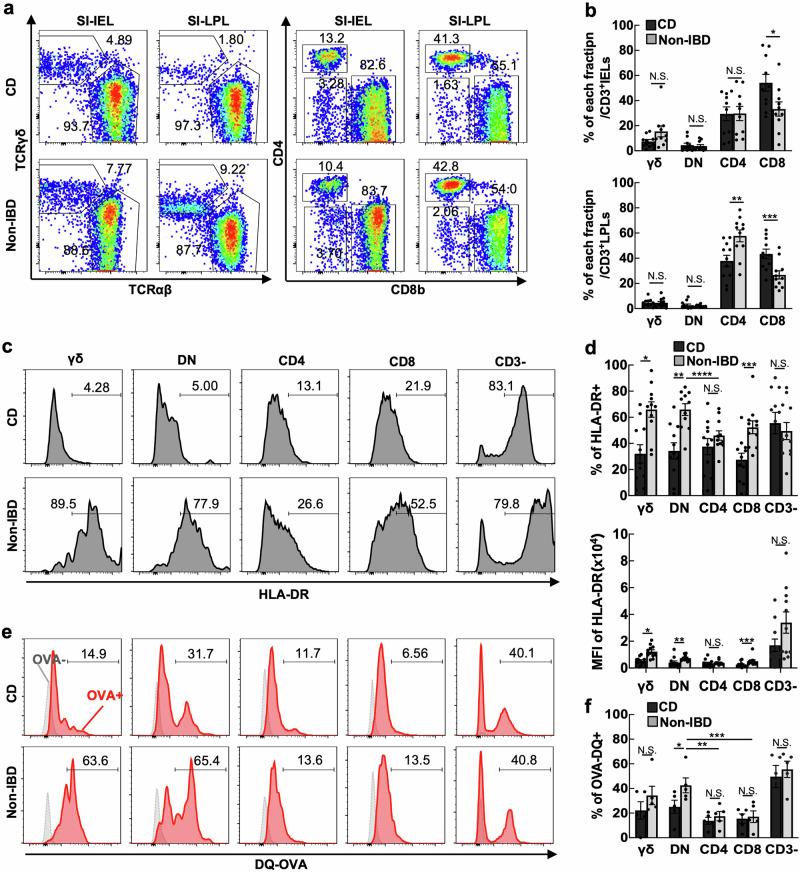
The intestinal mucosa harbors diverse lymphocyte populations, including double negative CD4CD8αβTCRαβ T (DNT) cells, in the intraepithelial compartment and the lamina propria. Here we report that DNT cells in mouse small intestines are motile and reach across the epithelial barrier to capture luminal antigens (Ags). DNT cells then migrate to mesenteric lymph nodes (MLN) and upregulate MHC-II, as evidenced by a sizeable fraction of mouse DNT cells in Peyer's patches (PP) and MLN expressing MHC-II but little or no co-stimulatory molecules. Functionally, the presentation of intestinal antigens by DNT cells tolerizes antigen-specific naive CD4 T cells, with this tolerization reversed by conditional ablation of MHC-II in T cells, thereby rendering mutant mice hypersusceptible to intestinal inflammation. Intriguingly, intestinal T cells in patients with Crohn's disease also express lower levels of HLA-DR than those in healthy controls. Our findings thus potentially implicate MHC-II DNT cells in intestinal immune homeostasis and pathogenesis of inflammatory bowel disease.
肠道黏膜在肠上皮内区室和固有层中含有多种淋巴细胞群体,包括双阴性CD4CD8αβTCRαβT(DNT)细胞。在此我们报告,小鼠小肠中的DNT细胞具有运动能力,能够穿过上皮屏障捕获肠腔抗原(Ag)。随后,DNT细胞迁移至肠系膜淋巴结(MLN)并上调MHC-II,派尔集合淋巴结(PP)和MLN中相当一部分表达MHC-II但几乎不表达或不表达共刺激分子的小鼠DNT细胞就证明了这一点。在功能上,DNT细胞呈递肠道抗原可使抗原特异性初始CD4 T细胞产生耐受,T细胞中MHC-II的条件性缺失可逆转这种耐受,从而使突变小鼠对肠道炎症高度敏感。有趣的是,克罗恩病患者的肠道T细胞表达的HLA-DR水平也低于健康对照者。因此,我们的发现可能表明MHC-II DNT细胞与肠道免疫稳态及炎症性肠病的发病机制有关。


 Zotero 插件