
APOE基因分型与他汀类药物反应:来自英国生物银行和“我们所有人”计划的证据。
APOE Genotype and Statin Response: Evidence From the UK Biobank and All of Us Program.
作者信息
Asiimwe Innocent G, Jorgensen Andrea L, Pirmohamed Munir
机构信息
Department of Pharmacology and Therapeutics, Institute of Systems, Molecular and Integrative Biology, University of Liverpool, Liverpool, UK.
Department of Health Data Science, Institute of Population Health Sciences, University of Liverpool, Liverpool, UK.
出版信息
Clin Transl Sci. 2025 Aug;18(8):e70314. doi: 10.1111/cts.70314.
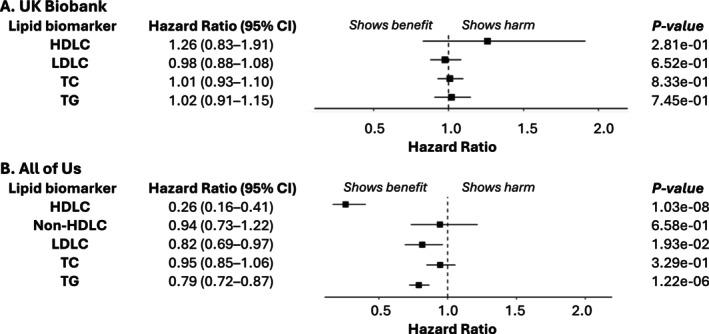
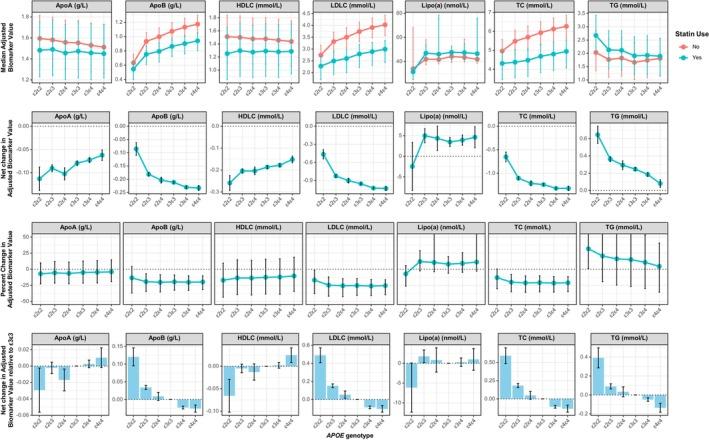
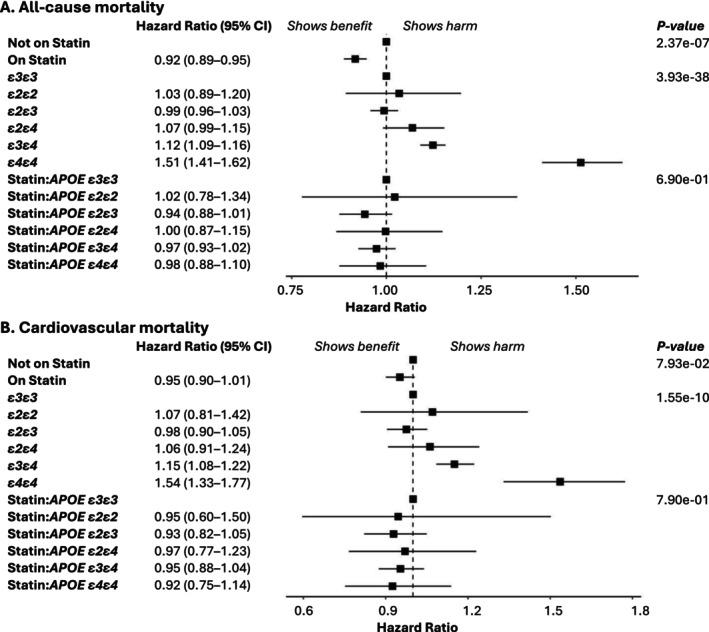
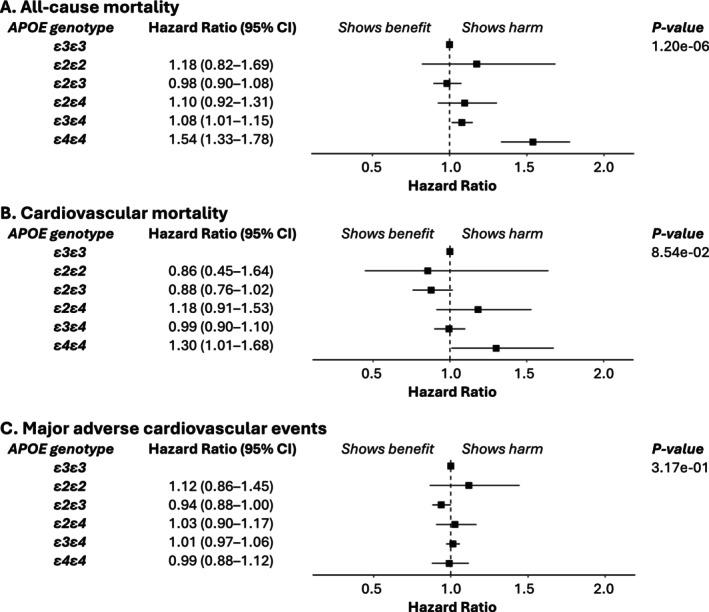
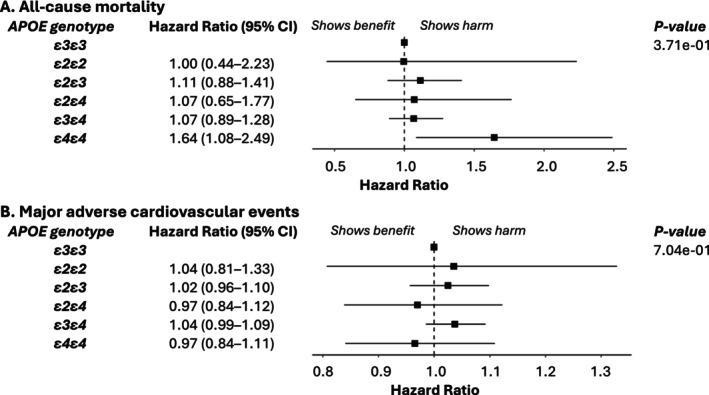
APOE genotype may affect statin response. Using UK Biobank (UKB) and All of Us (AoU) data, we aimed to investigate associations between APOE genotype, statin use, and key health outcomes. Our analysis included UKB baseline data and linked mortality records (389,843-452,189 participants), and electronic health records (EHR) from 45,515 UKB and 35,562 AoU participants. Multivariable regression and Cox models assessed lipid biomarkers, all-cause mortality, cardiovascular mortality, and major adverse cardiovascular events (MACE). In UKB, ε3ε4 (HR: 1.08, 95% CI: 1.01-1.15) and ε4ε4 (HR: 1.54, 95% CI: 1.33-1.78) carriers had higher all-cause mortality risk. In AoU, only ε4ε4 carriers showed increased risk (HR: 1.64, 95% CI: 1.08-2.49). Cardiovascular mortality was assessed only in UKB, where ε4ε4 carriers had an increased risk (HR: 1.30, 95% CI: 1.01-1.68). Mortality associations in UKB EHR data were consistent with those from baseline data and linked mortality records (e.g., ε4ε4 genotype: all-cause mortality HR: 1.51, 95% CI: 1.41-1.62; cardiovascular mortality HR: 1.54, 95% CI: 1.33-1.77). However, the statin:APOE interaction term included in the baseline analysis was not statistically significant. In AoU, changes in HDLC, LDLC, and triglycerides were associated with reduced all-cause mortality risk. No significant MACE associations were observed in either cohort. This study reaffirms that APOE ε4 genotype increases mortality risk, including in statin-treated patients, and could therefore be used to inform enhanced monitoring or medication review in these patients.
载脂蛋白E(APOE)基因型可能会影响他汀类药物的反应。利用英国生物银行(UKB)和“我们所有人”(AoU)的数据,我们旨在研究APOE基因型、他汀类药物使用与关键健康结局之间的关联。我们的分析纳入了UKB基线数据和关联的死亡记录(389,843 - 452,189名参与者),以及来自45,515名UKB参与者和35,562名AoU参与者的电子健康记录(EHR)。多变量回归和Cox模型评估了脂质生物标志物、全因死亡率、心血管死亡率和主要不良心血管事件(MACE)。在UKB中,ε3ε4(风险比:1.08,95%置信区间:1.01 - 1.15)和ε4ε4(风险比:1.54,95%置信区间:1.33 - 1.78)携带者的全因死亡风险更高。在AoU中,只有ε4ε4携带者显示出风险增加(风险比:1.64,95%置信区间:1.08 - 2.49)。仅在UKB中评估了心血管死亡率,其中ε4ε4携带者风险增加(风险比:1.30,95%置信区间:1.01 - 1.68)。UKB EHR数据中的死亡率关联与基线数据和关联死亡记录中的一致(例如,ε4ε4基因型:全因死亡率风险比:1.51,95%置信区间:1.41 - 1.62;心血管死亡率风险比:1.54,95%置信区间:1.33 - 1.77)。然而,基线分析中纳入的他汀类药物:APOE交互项无统计学意义。在AoU中,高密度脂蛋白胆固醇(HDLC)、低密度脂蛋白胆固醇(LDLC)和甘油三酯的变化与全因死亡风险降低相关。在两个队列中均未观察到显著的MACE关联。这项研究再次证实,APOE ε4基因型会增加死亡风险,包括在接受他汀类药物治疗的患者中,因此可用于指导对这些患者加强监测或药物评估。

 Zotero 插件