
阿尔茨海默病中淀粉样蛋白、tau蛋白和炎症病理生理学之间关系的综合观点。
An integrated view of the relationships between amyloid, tau, and inflammatory pathophysiology in Alzheimer's disease.
作者信息
Arnsten Amy F T, Del Tredici Kelly, Barthélemy Nicolas R, Gabitto Mariano, van Dyck Christopher H, Lein Edward, Braak Heiko, Datta Dibyadeep
机构信息
Department of Neuroscience, Yale School of Medicine, New Haven, Connecticut, USA.
Clinical Neuroanatomy/Department of Neurology, Center for Biomedical Research, University of Ulm, Ulm, Germany.
出版信息
Alzheimers Dement. 2025 Aug;21(8):e70404. doi: 10.1002/alz.70404.
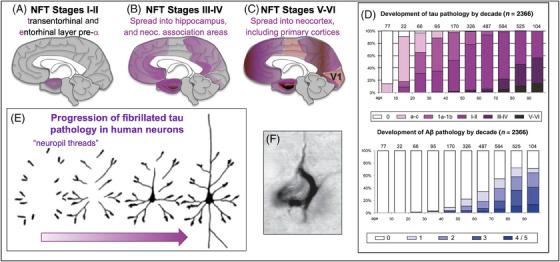
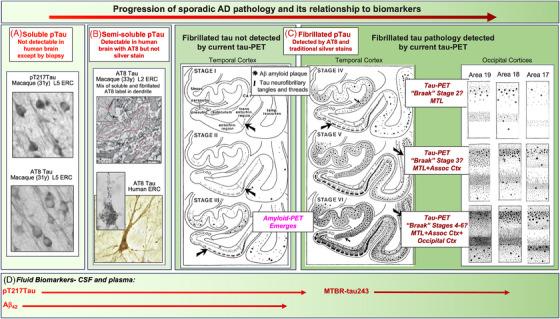
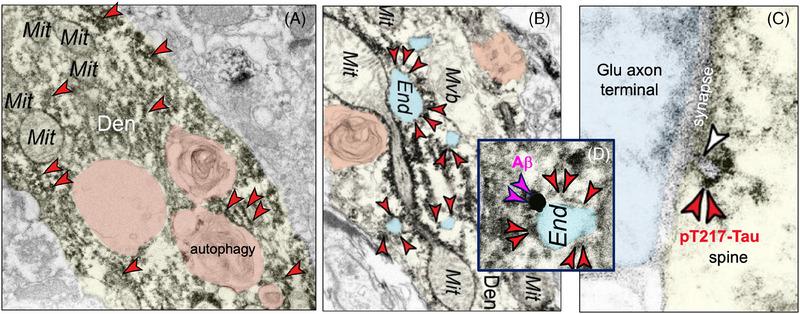
Alzheimer's disease (AD) research is a large and burgeoning field, where varied methodological approaches are providing multifaceted, but sometimes contradictory, views on the etiology and progression of pathology. The current review aims to summarize and integrate these findings to provide greater coherence to an increasingly splintered field. We provide an overview of the findings from each subfield (neuropathology, positron emission tomography imaging, fluid biomarkers, genetics, transcriptomics/proteomics), highlighting the strengths and weaknesses of each approach and, where possible, trying to resolve discrepancies between subfields. In particular, we address arguments about whether amyloid versus tau initiates pathology, and integrate nanoscale data from aging macaques to improve clarity regarding the earliest pathological stages, as initial phosphorylation events can be lost post mortem in human tissue. We find that Aβ, phosphorylated tau, and inflammation/excessive calcium can all interact in feedforward cycles to drive AD pathology. Increasing cohesion across subdisciplines will strengthen our understanding of this devastating disease. HIGHLIGHTS: AD research is an expansive field, where subfields often diverge. The current review integrates across approaches to give a more cohesive view. Many methods cannot detect the earliest changes in brain. The new fluid biomarker pT217Tau shows that soluble tau pathology begins early. Relating amyloid/tau pathologies to inflammation is key for understanding sporadic AD.
阿尔茨海默病(AD)研究是一个庞大且不断发展的领域,在该领域中,各种方法正在就病理的病因和进展提供多方面但有时相互矛盾的观点。本综述旨在总结和整合这些发现,以使这个日益分散的领域更具连贯性。我们概述了每个子领域(神经病理学、正电子发射断层扫描成像、液体生物标志物、遗传学、转录组学/蛋白质组学)的研究结果,突出每种方法的优缺点,并尽可能解决子领域之间的差异。特别是,我们探讨了关于淀粉样蛋白与tau蛋白谁引发病理的争论,并整合了来自老年猕猴的纳米级数据,以提高对最早病理阶段的清晰度,因为初始磷酸化事件在人体组织死后可能会丢失。我们发现β淀粉样蛋白(Aβ)、磷酸化tau蛋白以及炎症/钙过量都可以在前馈循环中相互作用,从而推动AD病理发展。加强各子学科之间的凝聚力将增强我们对这种毁灭性疾病的理解。要点:AD研究是一个广阔的领域,各子领域常常存在分歧。本综述整合了多种方法,以提供更具连贯性的观点。许多方法无法检测到大脑最早的变化。新的液体生物标志物pT217Tau表明可溶性tau蛋白病理变化始于早期。将淀粉样蛋白/tau蛋白病理与炎症联系起来是理解散发性AD的关键。




 Zotero 插件