
含有天然多酚化合物的结冷胶制剂用于治疗口腔念珠菌病。
Gellan gum formulations containing natural polyphenolic compounds to treat oral candidiasis.
作者信息
Ganesan Narchonai, Felix Lewis Oscar, Mishra Biswajit, Zhang Liyang, Dellis Charilaos, Shehadeh Fadi, Wu Danielle, Cruz Lissette A, Arce R M, Mylonakis Eleftherios
机构信息
Department of Medicine, Houston Methodist Research Institute and Houston Methodist Hospital, Houston, Texas, USA.
Department of Pharmaceutical Chemistry, National and Kapodistrian University of Athens, Panepistimioupolis Zografou, Athens, Greece.
出版信息
Microbiol Spectr. 2025 Sep 2;13(9):e0079825. doi: 10.1128/spectrum.00798-25. Epub 2025 Aug 6.
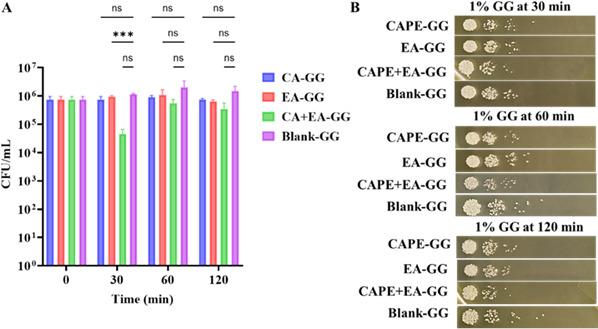
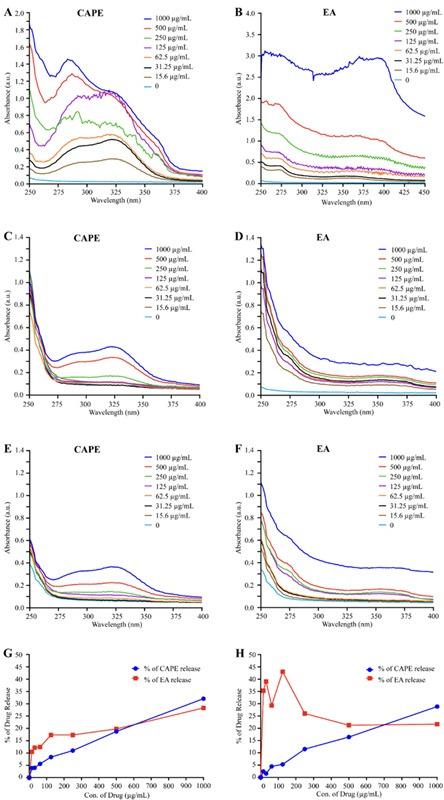
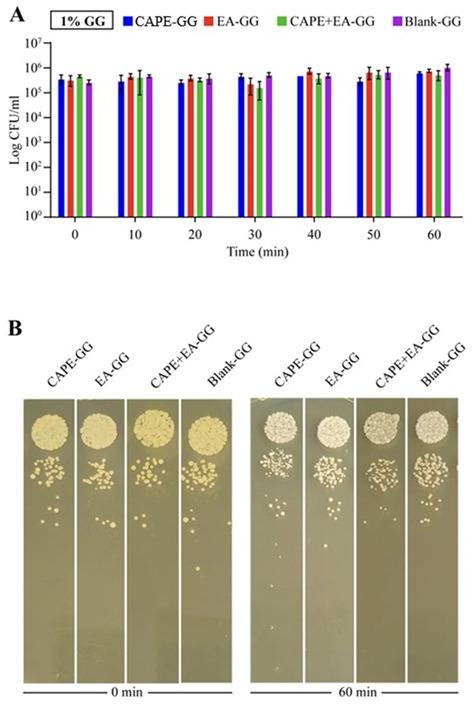
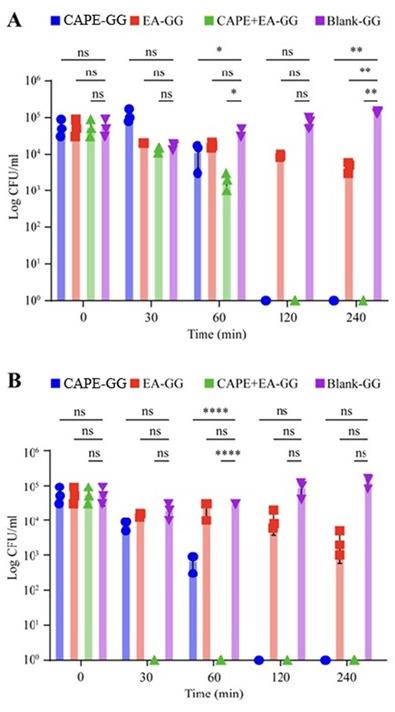
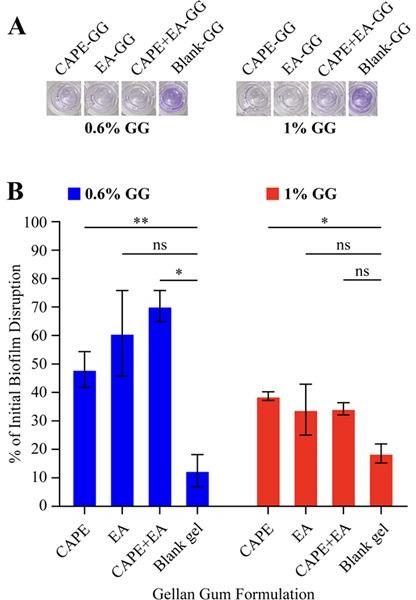
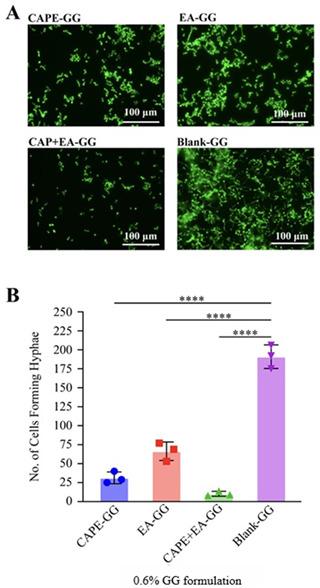
Oral candidiasis (OC) is caused by , targeting immunocompromised individuals and developing drug resistance, highlighting the need for advanced therapeutics. Polyphenols such as caffeic acid phenethyl ester (CAPE) and ellagic acid (EA) display antifungal and immune-modulating properties. Incorporating CAPE and EA in gellan gum (GG) formulation enhances their applicability and effectiveness against OC. We developed GG-based formulations loaded with CAPE (1,000 µg/mL), EA (1,000 µg/mL), or CAPE + EA (1,000 µg/mL each) against . GG formulations containing gellan (0.6% and 1.0%), genipin (5 mM), polyethylene glycol 400 (0.5%), and sorbitan monooleate 80 (0.5%) demonstrated enhanced release of CAPE and EA. The 0.6% GG formulation reduced CFU by 2-6 log within 30 min ( < 0.05) and biofilm mass by 48% (CAPE, = 0.0034), 60.7% (EA, = 0.0980), and 70% (CAPE + EA, = 0.0181). Both 0.6% and 1.0% GG formulations inhibited hyphae ( < 0.0001). GG formulations showed high viability of human red blood cells (92%-94%) and human gingival cells (61%-69%). In artificial chewing simulations (ACS), 0.6% GG exhibited 67.7% (30 min), 55.9% (60 min), and 35.8% (120 min) for CAPE release, and 48.2% (30 min), 45.1% (60 min), and 42.1% (120 min) for EA. In 1% GG, about 44.07% (30 min), 43.8% (60 min), and 29.5% (120 min) of CAPE and 55.8% (30 min), 49.6% (60 min), and 50.6% (120 min) of EA were released. The present study is the first to evaluate the efficacy of CAPE- and EA-loaded GG formulations against under ACS, thereby supporting their potential development for OC treatment.IMPORTANCE causes OC and presents challenges due to rising antifungal resistance and recurrence in immunocompromised patients. Existing antifungal treatments for OC often fail due to limited bioavailability, short retention times, adverse side effects, and the bitter taste of formulations, impacting patient adherence. CAPE and EA are recognized for their antifungal and immunomodulatory properties but face practical limitations in therapeutic applications, such as poor bioavailability and stability. The present study addresses these challenges by developing GG-based formulations incorporating CAPE and EA. The formulation exhibited significant antifungal efficacy against biofilms and hyphal formation, reducing fungal viability under simulated mechanical chewing conditions. These GG-based systems showed minimal cytotoxicity, indicating promising biocompatibility and suitability for oral application. Therefore, the study presents the first report of CAPE/EA-loaded GG formulations under simulated chewing that highlights the importance of innovative therapeutic strategies to improve clinical outcomes in OC treatment.
口腔念珠菌病(OC)是由[具体病因未提及]引起的,主要针对免疫功能低下的个体,并且会产生耐药性,这凸显了对先进治疗方法的需求。诸如咖啡酸苯乙酯(CAPE)和鞣花酸(EA)等多酚类物质具有抗真菌和免疫调节特性。将CAPE和EA纳入结冷胶(GG)制剂中可增强它们对OC的适用性和有效性。我们开发了负载有CAPE(1000μg/mL)、EA(1000μg/mL)或CAPE+EA(各1000μg/mL)的基于GG的制剂来对抗[具体病原体未提及]。含有结冷胶(0.6%和1.0%)、京尼平(5mM)、聚乙二醇400([此处原文有误,推测应为0.5%])和脱水山梨醇单油酸酯80(0.5%)的GG制剂显示出CAPE和EA的释放增强。0.6%的GG制剂在30分钟内使[具体病原体未提及]的CFU降低了2 - 6个对数(P<0.05),生物膜量分别降低了48%(CAPE,P = 0.0034)、60.7%(EA,P = 0.0980)和70%(CAPE + EA,P = 0.0181)。0.6%和1.0%的GG制剂均抑制了菌丝形成(P<0.0001)。GG制剂显示人红细胞(92% - 94%)和人牙龈细胞(61% - 69%)具有高活力。在人工咀嚼模拟(ACS)中,0.6%的GG制剂中CAPE的释放率在30分钟时为67.7%、60分钟时为55.9%、120分钟时为35.8%,EA的释放率在30分钟时为48.2%、60分钟时为45.1%、120分钟时为42.1%。在1%的GG制剂中,约44.07%(30分钟)、43.8%(60分钟)和29.5%(120分钟)的CAPE以及55.8%(30分钟)、49.6%(60分钟)和50.6%(120分钟)的EA被释放。本研究首次评估了负载CAPE和EA的GG制剂在ACS条件下对[具体病原体未提及]的疗效,从而支持了它们在OC治疗中的潜在开发。重要性[具体病原体未提及]导致OC,并且由于抗真菌耐药性的增加以及免疫功能低下患者中的复发而带来挑战。现有的OC抗真菌治疗常常由于生物利用度有限、保留时间短、不良副作用以及制剂的苦味而失败,影响患者的依从性。CAPE和EA因其抗真菌和免疫调节特性而受到认可,但在治疗应用中面临实际限制,如生物利用度和稳定性差。本研究通过开发包含CAPE和EA的基于GG的制剂来应对这些挑战。该制剂对[具体病原体未提及]生物膜和菌丝形成表现出显著的抗真菌疗效,在模拟机械咀嚼条件下降低了真菌活力。这些基于GG的系统显示出最小的细胞毒性,表明具有良好的生物相容性和口腔应用的适用性。因此,该研究首次报道了在模拟咀嚼条件下负载CAPE/EA的GG制剂,突出了创新治疗策略对改善OC治疗临床结果的重要性。




 Zotero 插件