
2020年至2024年禽传染性支气管炎病毒GI-19基因型的优势及S1基因的基因组特征
Dominance of the GI-19 genotype and genomic characterization of the S1 gene in avian infectious bronchitis virus from 2020 to 2024.
作者信息
Guo Xiaozhen, Liu Cunxia, Hu Feng, Liu Liping, Zhu Tong, Gao Yuehua, Lin Zhongyin, Xu Huaiying, Huang Bing, Qin Zhuoming, Ma Xiuli
机构信息
Institute of Poultry Science, Shandong Academy of Agricultural Sciences, Jinan, Shandong, China.
出版信息
Front Cell Infect Microbiol. 2025 Jul 23;15:1640152. doi: 10.3389/fcimb.2025.1640152. eCollection 2025.
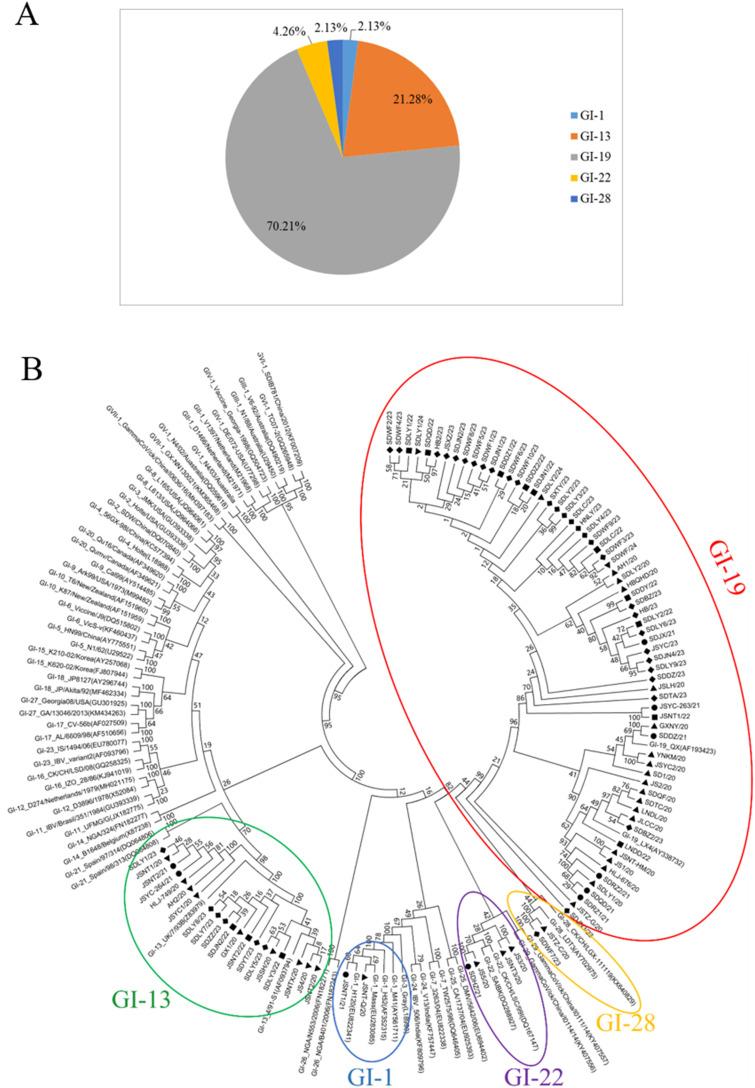
The continuous emergence of avian infectious bronchitis virus (IBV) variants poses a critical threat to poultry health and productivity in China. In this study, we conducted comprehensive genetic and antigenic analyses of IBV strains isolated in our laboratory between 2020 and 2024. A total of 94 IBV isolates were sequenced for the S1 gene, revealing widespread nucleotide insertions, deletions, and mutations. Phylogenetic analysis indicated that GI-19 was the predominant genotype (70.21%), followed by GI-13 (21.28%). Recombination analysis using RDP 5.42 identified 14 recombinant strains, primarily GI-13/GI-22 (50%), GI-19/GI-7 (28.6%), and GI-19/GI-22 (21.4%), which were further confirmed using Simplot. Glycosylation analysis revealed that all isolates possessed 14 to18 N-glycosylation sites, whereas only the SDJN3/23 strain contained an O-glycosylation site (position 416). Novel cleavage site motifs (HRRKR, HRHRR, RRFRR) were identified in GI-19 strains, diverging from the canonical HRRRR. The evolutionary rate calculated via BEAST software, was 1.98 × 10 substitutions/site/year. Serum neutralization assays demonstrated that GI-19 recombinants exhibited partial one-way cross-protection against GI-1, GI-13, and GI-22 genotypes (titer ≥ 1:32), but reciprocal neutralization was limited. Overall, we systematically characterized the genetic diversity and antigenic evolution of the currently circulating IBV strains in China, emphasizing the critical demand for genotype-specific vaccine development and dynamic surveillance systems to counteract viral immune escape.
禽传染性支气管炎病毒(IBV)变异株的不断出现对中国家禽健康和生产构成了严重威胁。在本研究中,我们对2020年至2024年期间在我们实验室分离的IBV毒株进行了全面的基因和抗原分析。对94株IBV分离株的S1基因进行了测序,发现存在广泛的核苷酸插入、缺失和突变。系统发育分析表明,GI-19是主要基因型(70.21%),其次是GI-13(21.28%)。使用RDP 5.42进行的重组分析鉴定出14株重组毒株,主要为GI-13/GI-22(50%)、GI-19/GI-7(28.6%)和GI-19/GI-22(21.4%),并使用Simplot进一步确认。糖基化分析显示,所有分离株均具有14至18个N-糖基化位点,而只有SDJN3/23毒株含有一个O-糖基化位点(第416位)。在GI-19毒株中鉴定出新型裂解位点基序(HRRKR、HRHRR、RRFRR),与经典的HRRRR不同。通过BEAST软件计算的进化速率为1.98×10个替换/位点/年。血清中和试验表明GI-19重组毒株对GI-1、GI-13和GI-22基因型表现出部分单向交叉保护(效价≥1:32),但双向中和作用有限。总体而言,我们系统地描述了中国目前流行的IBV毒株的遗传多样性和抗原进化,强调了开发基因型特异性疫苗和动态监测系统以应对病毒免疫逃逸的迫切需求。


 Zotero 插件