
卡度尼利单抗作为免疫治疗耐药的鳞状非小细胞肺癌二线治疗:一例病例报告及文献复习
Cadonilimab as second-line therapy in immunotherapy-resistant squamous NSCLC: a case report and review.
作者信息
Qiu Shuo, Shi Mingtao, Chen Zhiying, Wang Jing, Cui Huanliang, Zhang Yongchun
机构信息
Department of Radiation Oncology, The Affiliated Hospital of Qingdao University, Qingdao, China.
出版信息
Front Immunol. 2025 Jul 24;16:1627147. doi: 10.3389/fimmu.2025.1627147. eCollection 2025.
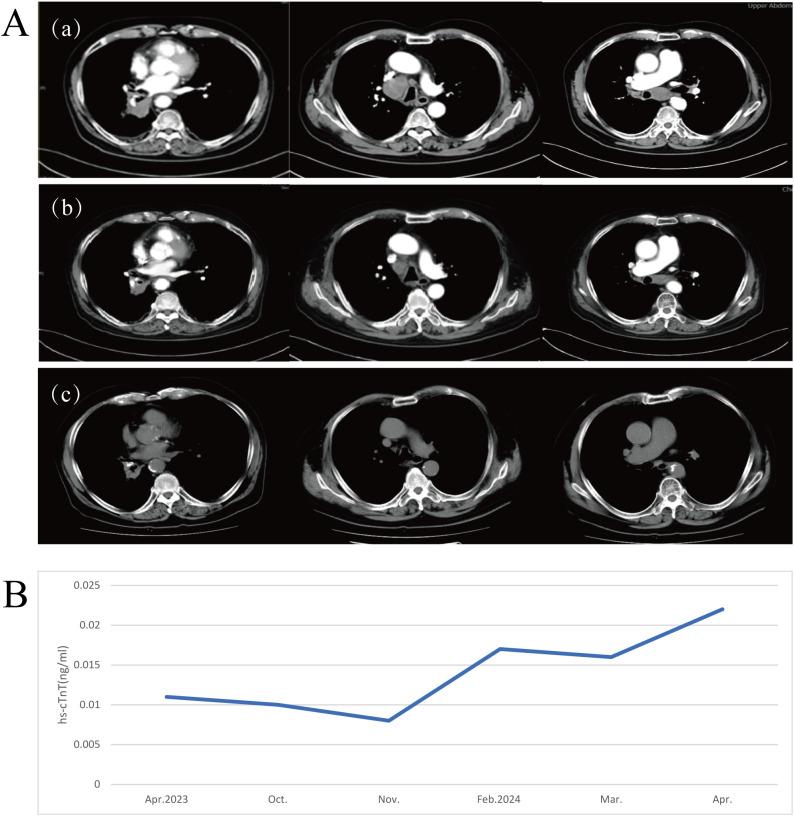
Immune checkpoint inhibitors (ICIs) have become a pivotal therapeutic option for the treatment of advanced non-small cell lung cancer (NSCLC), particularly as a standard first-line therapy. However, most patients eventually develop resistance to ICIs, and the options for second-line treatment remain limited with suboptimal efficacy. Cadonilimab, a novel bispecific antibody targeting programmed death-1 (PD-1) and cytotoxic T-lymphocyte-associated antigen 4 (CTLA-4), has demonstrated promising antitumor activity with a manageable safety profile. Nevertheless, its clinical efficacy in patients who have developed resistance to prior immunotherapy remains largely unexplored. This report presents a case of an elderly patient with early-stage NSCLC who developed resistance following first-line immunotherapy. After receiving subsequent treatment with cadonilimab, the patient achieved a partial response (PR) at the third cycle. The patient experienced substantial clinical improvement, including marked relief from chest tightness and shortness of breath, as evidenced by a reduction in modified Medical Research Council (mMRC) dyspnea grade from 3 to 1. The quality of life improved significantly, as indicated by a rise in the Karnofsky Performance Status (KPS) score from 60 to 80. Progression-free survival (PFS) was extended to 17 months, and the patient continues to derive clinical benefit. No immune-related adverse events (irAEs) affecting daily life occurred throughout the entire course of therapy. These findings suggest that cadonilimab may serve as a promising subsequent-line therapeutic option for patients with immunotherapy resistance.
免疫检查点抑制剂(ICIs)已成为治疗晚期非小细胞肺癌(NSCLC)的关键治疗选择,尤其是作为标准一线治疗。然而,大多数患者最终会对ICIs产生耐药性,二线治疗选择仍然有限且疗效欠佳。卡度尼利单抗是一种新型双特异性抗体,靶向程序性死亡-1(PD-1)和细胞毒性T淋巴细胞相关抗原4(CTLA-4),已显示出有前景的抗肿瘤活性且安全性可控。然而,其在对先前免疫治疗产生耐药性的患者中的临床疗效在很大程度上仍未得到探索。本报告介绍了一例老年早期NSCLC患者,该患者在一线免疫治疗后产生耐药性。在接受卡度尼利单抗后续治疗后,患者在第三个周期达到部分缓解(PR)。患者临床症状有显著改善,包括胸闷和气短明显缓解,改良医学研究委员会(mMRC)呼吸困难分级从3级降至1级。生活质量显著提高,卡氏功能状态(KPS)评分从60分升至80分。无进展生存期(PFS)延长至17个月,患者持续从临床治疗中获益。在整个治疗过程中未发生影响日常生活的免疫相关不良事件(irAEs)。这些发现表明,卡度尼利单抗可能是免疫治疗耐药患者有前景的二线治疗选择。


 Zotero 插件