
考察音乐素养、认知能力和社交技能对脑年龄差距估计值(BrainAGE)的影响。
Examining the influence of musical sophistication, cognitive performance, and social skills on the Brain Age Gap Estimate (BrainAGE).
作者信息
Davis Alisha D, Motamed Yeganeh Negin, Hermiston Nancy, Werker Janet F, Boyd Lara A, Kraeutner Sarah N, Cui Anja-Xiaoxing
机构信息
Neuroplasticity, Imagery, and Motor Behaviour Laboratory, Department of Psychology, University of British Columbia, Kelowna, BC, Canada.
Brain Behaviour Lab, Department of Physical Therapy, University of British Columbia, Vancouver, BC, Canada.
出版信息
Brain Struct Funct. 2025 Aug 11;230(7):132. doi: 10.1007/s00429-025-03001-8.
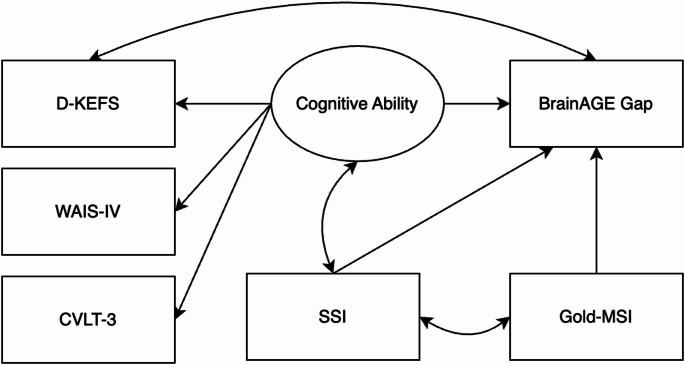
Brain age, an estimate of biological brain aging derived from neuroimaging, has been linked to cognitive and related factors. Metrics such as the Brain Age Gap Estimate (BrainAGE), depicting the discrepancy between predicted and chronological age, are commonly used to determine the influence of variables on brain aging. This study explored how cognitive ability, musical sophistication, and social skills contribute to BrainAGE in a sample of 81 healthy participants who underwent high-resolution magnetic resonance imaging and completed cognitive, musical, and social assessments. Following statistical analyses to fit the model, structural equation modelling was used to examine the influence of cognitive ability, assessed using the Delis-Kaplan Executive Function System, California Verbal Learning Test, and Wechsler Adult Intelligence Scale; musical sophistication, measured by the Goldsmiths Musical Sophistication Index; and social skills, evaluated using the Social Skills Inventory, on BrainAGE. Our findings demonstrated no significant influence of cognitive ability, musical expertise, or social skills on BrainAGE. These findings highlight the complexity of cognitive and social influences on brain age and underscore the need for further research into their interactive effects on neurobiological aging.
脑龄是一种从神经影像学得出的对生物性脑老化的估计,它已与认知及相关因素联系起来。诸如脑龄差距估计值(BrainAGE)等指标描绘了预测年龄与实际年龄之间的差异,常用于确定变量对脑老化的影响。本研究在81名健康参与者的样本中探讨了认知能力、音乐素养和社交技能如何影响脑龄差距估计值,这些参与者接受了高分辨率磁共振成像,并完成了认知、音乐和社交评估。在进行统计分析以拟合模型之后,使用结构方程模型来检验认知能力、音乐素养和社交技能对脑龄差距估计值的影响,认知能力通过德利斯-卡普兰执行功能系统、加利福尼亚言语学习测验和韦克斯勒成人智力量表进行评估;音乐素养通过戈德史密斯音乐素养指数来衡量;社交技能则使用社交技能量表进行评估。我们的研究结果表明,认知能力、音乐专业水平或社交技能对脑龄差距估计值没有显著影响。这些发现凸显了认知和社会因素对脑龄影响的复杂性,并强调需要进一步研究它们对神经生物学老化的交互作用。
 Zotero 插件