
整合环境与衰老研究:协同与加速的机遇
Integrating Environment and Aging Research: Opportunities for Synergy and Acceleration.
作者信息
Malecki Kristen M C, Andersen Julie K, Geller Andrew M, Harry G Jean, Jackson Chandra L, James Katherine A, Miller Gary W, Ottinger Mary Ann
机构信息
Department of Population Health Sciences, School of Medicine and Public Health, University of Wisconsin-Madison, Madison, WI, United States.
Buck Institute for Research on Aging, Novato, CA, United States.
出版信息
Front Aging Neurosci. 2022 Feb 21;14:824921. doi: 10.3389/fnagi.2022.824921. eCollection 2022.
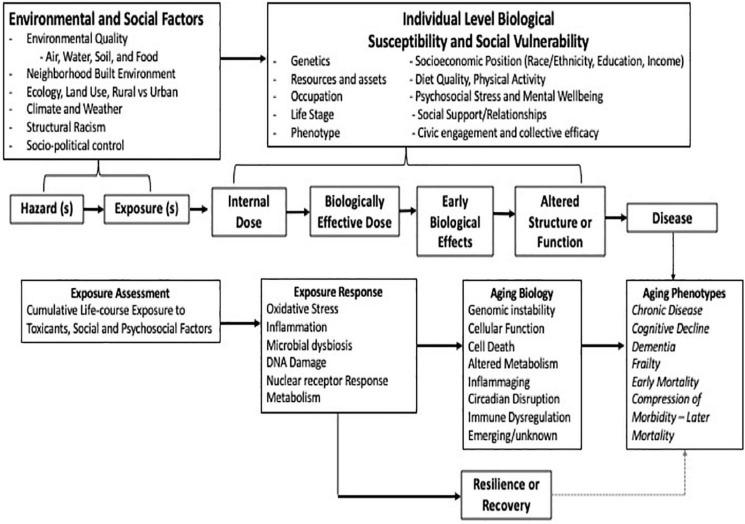
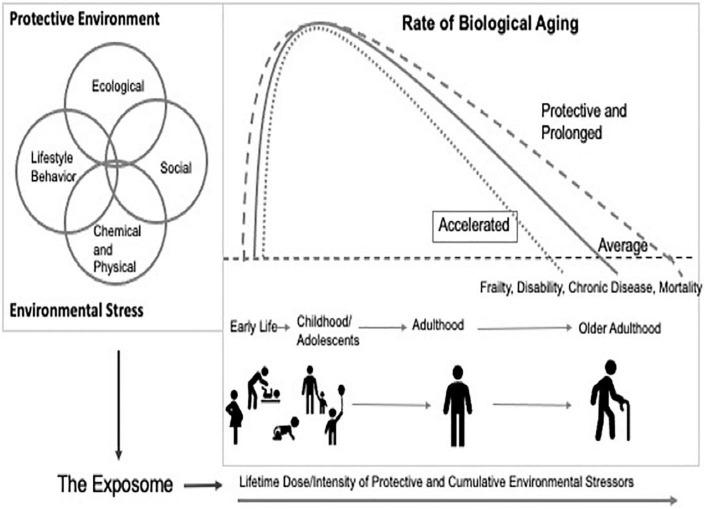
Despite significant overlaps in mission, the fields of environmental health sciences and aging biology are just beginning to intersect. It is increasingly clear that genetics alone does not predict an individual's neurological aging and sensitivity to disease. Accordingly, aging neuroscience is a growing area of mutual interest within environmental health sciences. The impetus for this review came from a workshop hosted by the National Academies of Sciences, Engineering, and Medicine in June of 2020, which focused on integrating the science of aging and environmental health research. It is critical to bridge disciplines with multidisciplinary collaborations across toxicology, comparative biology, epidemiology to understand the impacts of environmental toxicant exposures and age-related outcomes. This scoping review aims to highlight overlaps and gaps in existing knowledge and identify essential research initiatives. It begins with an overview of aging biology and biomarkers, followed by examples of synergy with environmental health sciences. New areas for synergistic research and policy development are also discussed. Technological advances including next-generation sequencing and other-omics tools now offer new opportunities, including exposomic research, to integrate aging biomarkers into environmental health assessments and bridge disciplinary gaps. This is necessary to advance a more complete mechanistic understanding of how life-time exposures to toxicants and other physical and social stressors alter biological aging. New cumulative risk frameworks in environmental health sciences acknowledge that exposures and other external stressors can accumulate across the life course and the advancement of new biomarkers of exposure and response grounded in aging biology can support increased understanding of population vulnerability. Identifying the role of environmental stressors, broadly defined, on aging biology and neuroscience can similarly advance opportunities for intervention and translational research. Several areas of growing research interest include expanding exposomics and use of multi-omics, the microbiome as a mediator of environmental stressors, toxicant mixtures and neurobiology, and the role of structural and historical marginalization and racism in shaping persistent disparities in population aging and outcomes. Integrated foundational and translational aging biology research in environmental health sciences is needed to improve policy, reduce disparities, and enhance the quality of life for older individuals.
尽管环境卫生科学和衰老生物学在使命上有显著重叠,但这两个领域才刚刚开始交叉。越来越明显的是,仅靠遗传学并不能预测个体的神经衰老和对疾病的易感性。因此,衰老神经科学是环境卫生科学中一个日益受到共同关注的领域。这篇综述的动力来自于美国国家科学院、工程院和医学院在2020年6月举办的一次研讨会,该研讨会聚焦于整合衰老科学与环境卫生研究。通过毒理学、比较生物学、流行病学等多学科合作来弥合学科之间的差距,对于理解环境毒物暴露的影响以及与年龄相关的结果至关重要。本范围综述旨在突出现有知识中的重叠和差距,并确定重要的研究倡议。它首先概述衰老生物学和生物标志物,接着列举与环境卫生科学协同作用的例子。还讨论了协同研究和政策制定的新领域。包括下一代测序和其他组学工具在内的技术进步,现在提供了新的机会,包括暴露组学研究,将衰老生物标志物整合到环境卫生评估中,并弥合学科差距。这对于更全面地理解终身接触毒物及其他物理和社会应激源如何改变生物衰老的机制是必要的。环境卫生科学中的新累积风险框架认识到,暴露和其他外部应激源可在生命历程中累积,基于衰老生物学的新的暴露和反应生物标志物的发展可有助于增进对人群易感性的理解。确定广义定义的环境应激源在衰老生物学和神经科学中的作用,同样可以推动干预和转化研究的机会。几个研究兴趣日益浓厚的领域包括扩大暴露组学和多组学的应用、微生物群作为环境应激源的介导因素、毒物混合物与神经生物学,以及结构性和历史性边缘化及种族主义在形成人群衰老和结果方面持续存在的差异中的作用。需要在环境卫生科学中开展综合的基础和转化衰老生物学研究,以改进政策、减少差异并提高老年人的生活质量。
 Zotero 插件