
免疫细胞与骨关节炎之间的全基因组关联评估:一项双向孟德尔随机化研究
Genome-wide association assessment between immune cells and osteoarthritis: a bidirectional Mendelian randomization study.
作者信息
Zheng Jiayuan, Sun Yujun, Liu Wenzhou, Chen Yanbo, Zhou Taolve, Zheng Zhenxiang, Li Jiajie, Zeng Gang, Wu Liangyan, Song Weidong
机构信息
Department of Orthopedic Surgery, Sun Yat-sen Memorial Hospital, Sun Yat-sen University, Guangzhou, China.
Department of Endocrinology and Metabolism, The First Affiliated Hospital of Jinan University, Guangzhou, China.
出版信息
Ann Jt. 2025 Jul 22;10:22. doi: 10.21037/aoj-24-60. eCollection 2025.
BACKGROUND
The synovial immune microenvironment plays a critical role in the onset and advancement of osteoarthritis (OA), but previous findings on some immune cells were inconsistent. This study seeks to comprehensively investigate the causal association between a multitude of immune cell traits and OA.
METHODS
We performed this bidirectional Mendelian randomization (MR) analysis between a genome-wide association studies (GWAS) summary statistics containing 407,746 European ancestry and the largest GWAS data on 731 immune phenotypes. A replication analysis was conducted on a dataset containing 63,556 participants for validating the positive results. The causal effects were primarily estimated through inverse variance weighted (IVW) method, with four other methods (MR Egger, weighted median, simple mode, weighted mode) to reinforce the strength of causal evidence. Multiple sensitivity analyses (MR Egger, IVW method, leave-one-out analysis) were applied to mitigate the impact of heterogeneity and horizontal pleiotropy. Additionally, we employed a bioinformatics analysis by xCell algorithm to examine the expression of these immune cell phenotypes in OA and normal synovial tissues.
RESULTS
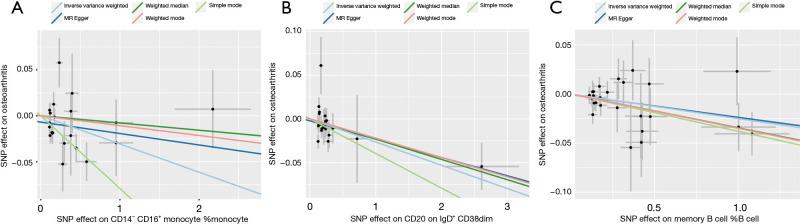
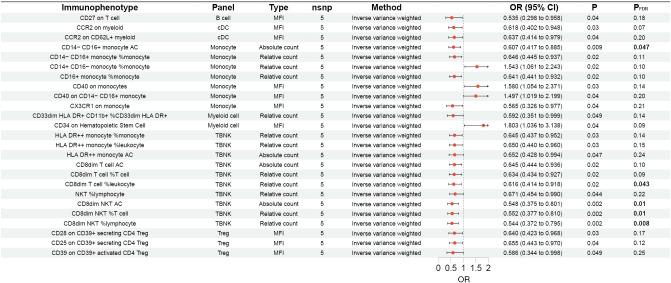
After false discovery rate (FDR) correction test, thirteen immune cell traits exhibited significant causal relationships with OA. These immune cell phenotypes came from seven groups, including B cell (n=3), conventional dendritic cell (cDC) (n=3), monocyte (n=3), myeloid cell (n=1), T cell, B cell, natural killer (NK) cell (TBNK) (n=2), regulatory T cell (Treg) (n=1). The strongest effects on OA were found in "CD64 on CD14 CD16 monocyte" [odds ratio (OR): 1.044; 95% confidence interval (CI): 1.012-1.076; P=0.03] and "CD16 monocyte %monocyte" (OR: 0.948; 95% CI: 0.916-0.980; P=0.009). Sensitivity analyses did not detect any evidence of heterogeneity and horizontal pleiotropy. We also identify five immune traits influenced by OA. Additionally, replication analysis reconfirmed the causal effect of "CD64 on CD14 CD16 monocyte" (OR: 1.102; 95% CI: 1.046-1.161; P<0.001) and "HLA DR NK %NK" (OR: 0.945; 95% CI: 0.908-0.983; P=0.03) on OA.
CONCLUSIONS
Our findings reveal the causal relationships between specific immune cells and OA, offering genetic insights into the role of immune cells in OA pathogenesis and guiding the exploration of novel immunological treatments for OA.
背景
滑膜免疫微环境在骨关节炎(OA)的发病和进展中起关键作用,但先前关于一些免疫细胞的研究结果并不一致。本研究旨在全面调查多种免疫细胞特征与OA之间的因果关系。
方法
我们在包含407,746名欧洲血统个体的全基因组关联研究(GWAS)汇总统计数据与关于731种免疫表型的最大GWAS数据之间进行了双向孟德尔随机化(MR)分析。在一个包含63,556名参与者的数据集上进行了重复分析,以验证阳性结果。因果效应主要通过逆方差加权(IVW)方法估计,并用其他四种方法(MR Egger、加权中位数、简单模式、加权模式)来加强因果证据的强度。应用了多种敏感性分析(MR Egger、IVW方法、留一法分析)以减轻异质性和水平多效性的影响。此外,我们采用xCell算法进行生物信息学分析,以检查这些免疫细胞表型在OA和正常滑膜组织中的表达。
结果
经过错误发现率(FDR)校正检验后,13种免疫细胞特征与OA表现出显著的因果关系。这些免疫细胞表型来自7组,包括B细胞(n = 3)、传统树突状细胞(cDC)(n = 3)、单核细胞(n = 3)、髓样细胞(n = 1)、T细胞、B细胞、自然杀伤(NK)细胞(TBNK)(n = 2)、调节性T细胞(Treg)(n = 1)。对OA影响最强的是“CD + 14 CD + 16单核细胞上的CD64”[优势比(OR):1.044;95%置信区间(CI):1.012 - 1.076;P = 0.03]和“CD16单核细胞占单核细胞的百分比”(OR:0.948;95% CI:0.916 - 0.980;P = 0.009)。敏感性分析未检测到任何异质性和水平多效性的证据。我们还确定了5种受OA影响的免疫特征。此外,重复分析再次证实了“CD + 14 CD + 16单核细胞上的CD64”(OR:1.102;95% CI:1.046 - 1.161;P < 0.001)和“NK细胞上的HLA - DR占NK细胞的百分比”(OR:0.945;95% CI:0.908 - 0.983;P = 0.03)对OA的因果效应。
结论
我们的研究结果揭示了特定免疫细胞与OA之间的因果关系,为免疫细胞在OA发病机制中的作用提供了遗传学见解,并指导了针对OA的新型免疫治疗方法的探索。




 Zotero 插件