
C反应蛋白与淋巴细胞比值和小梁骨评分:对2005年至2008年美国国家健康与营养检查调查队列中BMI的中介分析
C-reactive protein-to-lymphocyte ratio and trabecular bone score: A mediation analysis of BMI in the NHANES 2005 to 2008 cohort.
作者信息
Wang Zhizhuang, Xu Bo, Ma Guoliang, Chen Xin, Yang Bowen, Qin Xiaokuan, Duan Weili, Feng Minshan, Sun Kai, Zhu Liguo, Yin He
机构信息
Department of Spine, Wangjing Hospital, China Academy of Chinese Medical Sciences, Beijing, China.
Nanyang Hospital, Wangjing Hospital, Chinese Academy of Traditional Chinese Medicine (Dushan Hospital District), Henan, China.
出版信息
Medicine (Baltimore). 2025 Aug 8;104(32):e43847. doi: 10.1097/MD.0000000000043847.
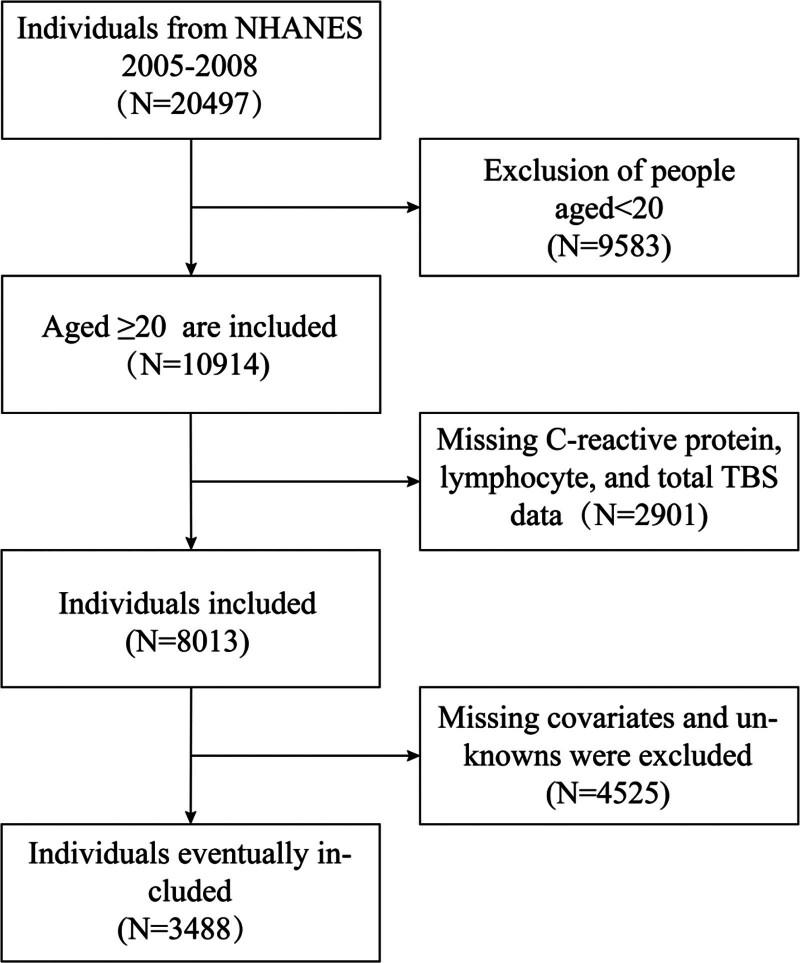
Previous studies have focused on the relationship between C-reactive protein and Trabecular Bone Score (TBS), but the correlation between C-reactive protein-to-lymphocyte ratio (CLR) and TBS remains unclear. Some studies have shown that of body mass index (BMI) is associated with CLR and TBS, respectively. This study focused on the correlation between CLR and TBS and the mediating effect of BMI based on data from the National Health and Nutrition Examination Survey (NHANES) from 2005 to 2008. This study used data from the NHANES database (1789 males and 1699 females) to perform multivariate logistic regression, population characterization, and subgroup and interaction analyses to estimate the relationship between CLR and TBS, and explored the mediating role of BMI on the correlation between CLR and TBS through mediation analysis. A total of 3488 participants aged 20 years and older were recruited for this study. Multivariate regression analysis showed that those with a high CLR had a low TBS. Mediation analyses showed that CLR had a large direct effect on TBS (P < .0001) and that BMI partially mediated this relationship (55.2148%, P < .0001). This study found that increased levels of CLR were associated with decreased TBS and were influenced by BMI. CLR may be a valuable tool for assessing bone metabolism and deserves further exploration. These findings contribute to a deeper understanding of the impact of obesity on the lineage of the relationship between inflammation and bone health and provide new perspectives on the treatment and prevention of osteoporosis and osteoporotic fractures.
以往的研究主要关注C反应蛋白与骨小梁骨评分(TBS)之间的关系,但C反应蛋白与淋巴细胞比值(CLR)和TBS之间的相关性仍不明确。一些研究表明,体重指数(BMI)分别与CLR和TBS相关。本研究基于2005年至2008年美国国家健康与营养检查调查(NHANES)的数据,重点关注CLR与TBS之间的相关性以及BMI的中介作用。本研究使用NHANES数据库中的数据(1789名男性和1699名女性)进行多因素逻辑回归、人群特征分析以及亚组和交互分析,以评估CLR与TBS之间的关系,并通过中介分析探讨BMI在CLR与TBS相关性中的中介作用。本研究共招募了3488名20岁及以上的参与者。多因素回归分析显示,CLR高的参与者TBS低。中介分析表明,CLR对TBS有较大的直接影响(P <.0001),且BMI部分介导了这种关系(55.2148%,P <.0001)。本研究发现,CLR水平升高与TBS降低相关,且受BMI影响。CLR可能是评估骨代谢的一个有价值的工具,值得进一步探索。这些发现有助于更深入地理解肥胖对炎症与骨骼健康关系谱系的影响,并为骨质疏松症和骨质疏松性骨折的治疗与预防提供新的视角。


 Zotero 插件