
美国成年人的脂质积聚产物、贫困收入比与骨密度:基于美国国家健康与营养检查调查(2009 - 2020)的中介分析
Lipid accumulation product, poverty income ratio, and bone mineral density in U.S. adults: a mediation analysis based on NHANES (2009-2020).
作者信息
Chen Zihao, Ye Haobo, Li Enli, Lin Yuzhe, Jin Chen, Yang Lei
机构信息
Department of Orthopaedic Surgery, The Second Affiliated Hospital and Yuying Children Hospital of Wenzhou Medical University, Wenzhou, China.
出版信息
Front Nutr. 2024 Oct 3;11:1466288. doi: 10.3389/fnut.2024.1466288. eCollection 2024.
OBJECTIVE
This study aims to investigate the relationship between the lipid accumulation product (LAP) index and total femur bone mineral density (BMD), while also examining the mediating role of the poverty-income ratio (PIR).
METHODS
Using the most recent data from the National Health and Nutrition Examination Survey (NHANES) spanning 2009 to 2020, multivariate logistic regression models were employed in this study to investigate the relationship between the LAP index and total femur BMD. Saturation effects and potential non-linear associations were examined using a smooth curve-fitting approach to determine saturation levels. Interaction tests and subgroup analyses were also performed. Additionally, a mediation analysis was conducted to explore the mediating role of PIR.
RESULTS
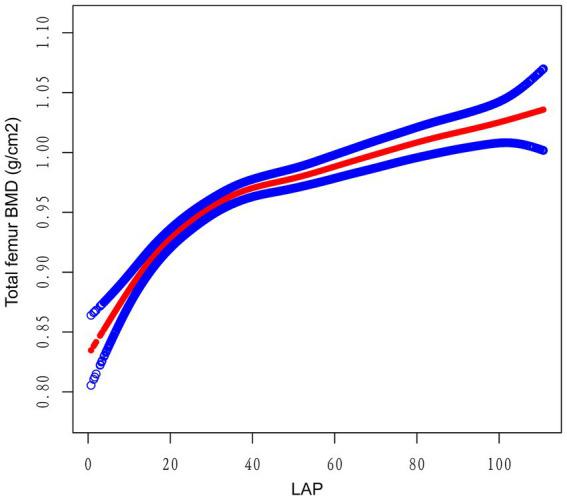
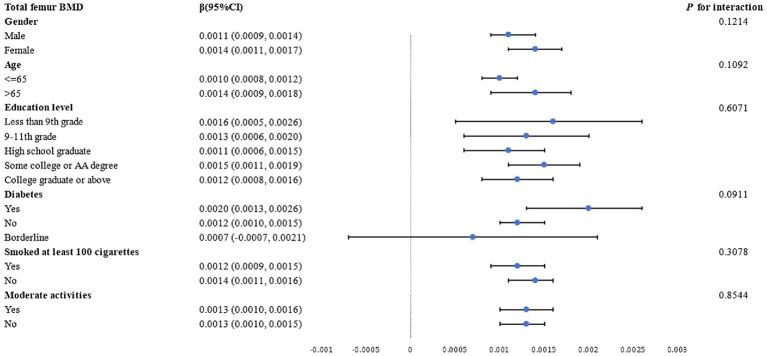
Three thousand two hundred and twenty three participants aged 20 years or older were recruited for this study. Multivariate regression analysis demonstrated a greater total femur BMD in individuals with a high LAP index. Additionally, analysis of the saturation effect and smooth curve fitting identified a clear saturation effect between the LAP index and total femur BMD. A saturation value of 16.05 was determined when investigating the relationship between the LAP index and total femur BMD. Subgroup analysis revealed no significant interaction effects after adjusting for covariates. Moreover, mediation analysis indicated that the LAP index had a substantial direct effect on total femur BMD ( < 0.0001), with PIR partially mediating this relationship (1.115%, = 0.0280).
CONCLUSION
The results of this investigation demonstrated a saturation effect between the LAP index and total femur BMD, which may have been mediated by PIR.
目的
本研究旨在探讨脂质蓄积产物(LAP)指数与股骨总骨密度(BMD)之间的关系,同时检验贫困收入比(PIR)的中介作用。
方法
利用2009年至2020年美国国家健康与营养检查调查(NHANES)的最新数据,本研究采用多元逻辑回归模型来研究LAP指数与股骨总骨密度之间的关系。使用平滑曲线拟合方法检验饱和效应和潜在的非线性关联,以确定饱和水平。还进行了交互作用检验和亚组分析。此外,进行中介分析以探讨PIR的中介作用。
结果
本研究招募了3223名20岁及以上的参与者。多元回归分析表明,LAP指数高的个体股骨总骨密度更高。此外,对饱和效应和平滑曲线拟合的分析确定了LAP指数与股骨总骨密度之间存在明显的饱和效应。在研究LAP指数与股骨总骨密度之间的关系时,确定饱和值为16.05。亚组分析显示,在调整协变量后没有显著的交互作用。此外,中介分析表明,LAP指数对股骨总骨密度有显著的直接影响(<0.0001),PIR部分中介了这种关系(1.115%,=0.0280)。
结论
本研究结果表明,LAP指数与股骨总骨密度之间存在饱和效应,这可能由PIR介导。



 Zotero 插件