
咖啡因摄入量和睡眠时间与骨密度的关联:一项基于2011年至2018年美国国家健康与营养检查调查的横断面研究。
Association of caffeine intake and sleep duration with bone mineral density: a cross-sectional study from National Health and Nutrition Examination Survey between 2011 and 2018.
作者信息
He Yuxue, Zou Wenjia, Xiao Fei
机构信息
Department of General Surgery, Wuhan Fourth Hospital, No. 473, Hanzheng Street, Qiaokou District, Wuhan, China.
Department of Orthopedics, Wuhan Fourth Hospital, Wuhan fourth hospital, No. 473, Hanzheng Street, Qiaokou District, Wuhan, China.
出版信息
BMC Musculoskelet Disord. 2025 Jan 13;26(1):43. doi: 10.1186/s12891-025-08300-z.
OBJECTIVE
The association between sleep duration, caffeine intake, and bone mineral density (BMD) is not well understood, with previous studies providing controversial results. This study explores the associations among caffeine intake, sleep duration, and BMD.
METHODS
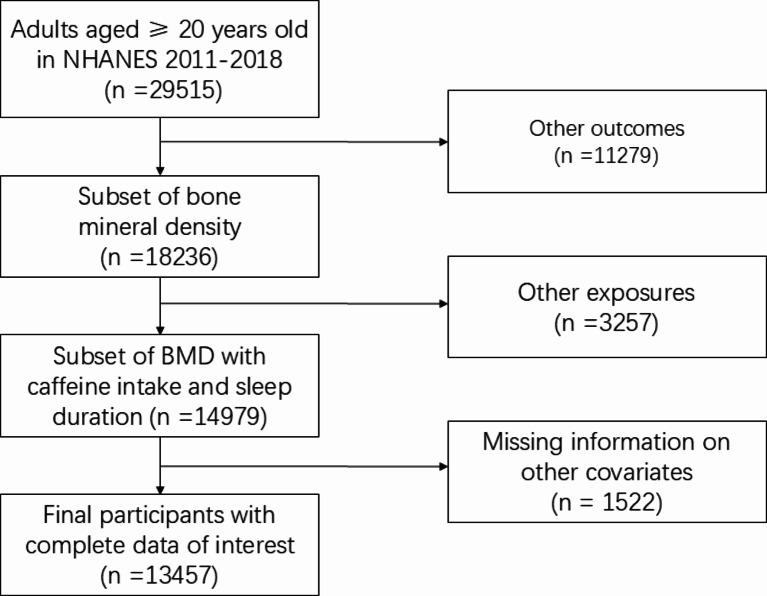
Data were sourced from the National Health and Nutrition Examination Survey (NHANES) from 2011 to 2018, including 13,457 participants who self-reported sleep duration and caffeine intake, with BMD measured via dual X-ray absorptiometry. Multivariable linear regression models, adjusted for confounders, were used alongside restricted cubic splines to examine dose-response association.
RESULTS
Of all participants, 6821 (50.7%) were males and 6636 were females (49.3%). The mean caffeine intake and sleep duration were 93.4 mg/day and 7.19 h, respectively. RCS results showed that BMD increased with the increase in caffeine intake, especially in the low dose range of 0-200 mg/day. The dose-response association between sleep duration and BMD showed that sleep durations of 0-6 h may promote the increase of BMD, but after sleep durations greater than 6 h, BMD decreases. After adjustment for potential confounders, compared to the lowest referent quartile, individuals with caffeine intake in quartiles 2, 3, and 4 had a positive correlation with BMD (0.62 95% CI: 0.24-1.37; 0.51 95% CI: 0.22-1.13; 0.75 95% CI: 0.41-1.46; P for trend < 0.05). In covariate-adjusted linear regression models, compared with those sleeping 6 h or less per night, the difference in BMD among those sleeping 6-7 h, 7-8 h, and 8-14.5 h per night were 1.81 (95% CI: 0.4122.71), 1.25 (95% CI: 0.55-2.93), and 0.87 (95% CI: 0.38-1.69). Associations of caffeine intake, sleep duration, and BMD stratified by sex and age failed to reach statistical significance.
CONCLUSIONS
Association might exist between the consumption of caffeine, sleep duration, and BMD; however, when stratified by sex and age, the association did not reach statistical significance.
目的
睡眠时长、咖啡因摄入量与骨密度(BMD)之间的关联尚未完全明确,先前的研究结果存在争议。本研究旨在探讨咖啡因摄入量、睡眠时长与骨密度之间的关联。
方法
数据来源于2011年至2018年的美国国家健康与营养检查调查(NHANES),包括13457名自我报告睡眠时长和咖啡因摄入量的参与者,通过双能X线吸收法测量骨密度。使用多变量线性回归模型并对混杂因素进行调整,同时结合受限立方样条来检验剂量反应关联。
结果
在所有参与者中,男性6821名(50.7%),女性6636名(49.3%)。平均咖啡因摄入量和睡眠时长分别为93.4毫克/天和7.19小时。受限立方样条结果显示骨密度随咖啡因摄入量的增加而增加,尤其是在每天0 - 200毫克的低剂量范围内。睡眠时长与骨密度之间的剂量反应关联表明,0 - 6小时的睡眠时长可能促进骨密度增加,但睡眠时长超过6小时后,骨密度会下降。在对潜在混杂因素进行调整后,与最低参考四分位数相比,咖啡因摄入量处于第二、第三和第四四分位数的个体与骨密度呈正相关(0.62 95%可信区间:0.24 - 1.37;0.51 95%可信区间:0.22 - 1.13;0.75 95%可信区间:0.41 - 1.46;趋势P值<0.05)。在协变量调整的线性回归模型中,与每晚睡眠6小时或更少的人相比,每晚睡眠6 - 7小时、7 - 8小时和8 - 14.5小时的人骨密度差异分别为1.81(95%可信区间:0.41 - 2.71)、1.25(95%可信区间:0.55 - 2.93)和0.87(95%可信区间:0.38 - 1.69)。按性别和年龄分层的咖啡因摄入量、睡眠时长与骨密度之间的关联未达到统计学意义。
结论
咖啡因摄入、睡眠时长与骨密度之间可能存在关联;然而,按性别和年龄分层时,该关联未达到统计学意义。
 Zotero 插件