
超加工食品消费与基于磁共振成像的颈动脉斑块特征的关联:社区动脉粥样硬化风险研究结果
Association of ultra-processed food consumption and MRI-based carotid plaque characteristics: results from the Atherosclerosis Risk in Communities study.
作者信息
Du Shutong, Sullivan Valerie K, Matsushita Kunihiro, Whelton Seamus P, Steffen Lyn M, Fang Michael, Appel Lawrence J, Wesserman Bruce A, Rebholz Casey M
机构信息
Welch Center for Prevention, Epidemiology, and Clinical Research, Johns Hopkins University, Baltimore, MD, USA.
Department of Epidemiology, Johns Hopkins University Bloomberg School of Public Health, Baltimore, MD, USA.
出版信息
Am J Prev Cardiol. 2025 Jul 24;23:101065. doi: 10.1016/j.ajpc.2025.101065. eCollection 2025 Sep.
BACKGROUND
Ultra-processed food and beverage consumption has been linked with adverse cardiovascular events, yet its association with sub-clinical disease remains less explored.
METHODS
A total of 768 white participants from the Carotid MRI visit (2004-2005) in the Atherosclerosis Risk in Communities (ARIC) study were included. Participants were selected via stratified sampling to enrich for informative plaques while preserving population-level reference. Dietary intake was assessed using a 148-item food frequency questionnaire, with items classified by Nova processing levels. Carotid artery imaging was conducted via MRI and analyzed with semiautomated software. Weighted multivariable linear and logistic regression models assessed associations between quartiles of ultra-processed food intake and plaque measurements or lipid core presence.
RESULTS
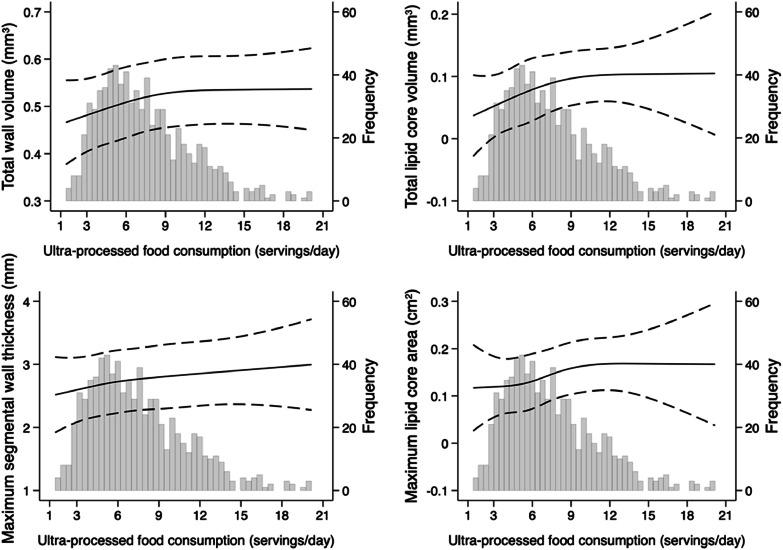
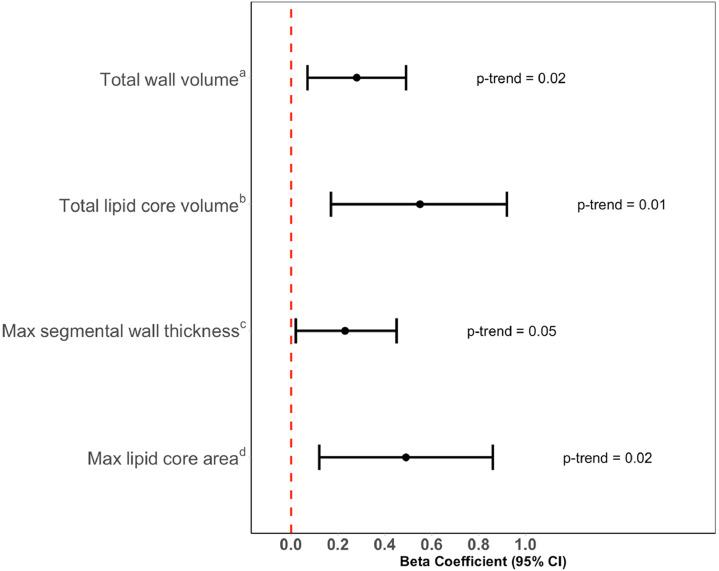
Higher ultra-processed food consumption was associated with unfavorable carotid plaque characteristics. Participants in quartile 4 of ultra-processed food consumption had greater total wall volume (standardized difference: β = 0.28, 95% CI, 0.07, 0.49), total lipid core volume (β = 0.55, 95% CI, 0.17, 0.92), maximum segmental wall thickness (β = 0.23, 95% CI, 0.01, 0.45), and maximum lipid core area (β = 0.49, 95% CI, 0.12, 0.86) vs. quartile 1. Replacing one daily serving of ultra-processed food with unprocessed or minimally processed food was associated with a reduction in total wall volume (β = -0.02, 95% CI, -0.05, -0.00).
CONCLUSIONS
Higher intake of ultra-processed food was associated with a greater burden of atherosclerotic plaque in the carotid artery. Our findings support the need for further investigation into the potential impact of ultra-processed food on atherosclerotic changes and the underlying mechanisms by which it may increase the future risk of cardiovascular disease development.
背景
超加工食品和饮料的消费与不良心血管事件有关,但其与亚临床疾病的关联仍有待进一步探索。
方法
纳入社区动脉粥样硬化风险(ARIC)研究中2004 - 2005年颈动脉MRI检查的768名白人参与者。通过分层抽样选择参与者,以富集信息性斑块同时保留人群水平的参考。使用148项食物频率问卷评估饮食摄入量,问卷项目按诺瓦加工水平分类。通过MRI进行颈动脉成像,并使用半自动软件进行分析。加权多变量线性和逻辑回归模型评估超加工食品摄入量四分位数与斑块测量值或脂质核心存在之间的关联。
结果
超加工食品摄入量较高与颈动脉斑块特征不良有关。超加工食品消费四分位数4的参与者与四分位数1相比,总壁体积更大(标准化差异:β = 0.28,95% CI,0.07,0.49),总脂质核心体积更大(β = 0.55,95% CI,0.17,0.92),最大节段壁厚度更大(β = 0.23,95% CI,0.01,0.45),以及最大脂质核心面积更大(β = 0.49,95% CI,0.12,0.86)。用未加工或最少加工的食品替代每日一份超加工食品与总壁体积减少有关(β = -0.02,95% CI,-0.05,-0.00)。
结论
超加工食品摄入量较高与颈动脉动脉粥样硬化斑块负担加重有关。我们的研究结果支持有必要进一步调查超加工食品对动脉粥样硬化变化的潜在影响及其可能增加未来心血管疾病发生风险的潜在机制。

 Zotero 插件