
超加工食品的消费与心血管事件风险:一项系统评价和剂量反应荟萃分析。
Ultra-processed food consumption and risk of cardiovascular events: a systematic review and dose-response meta-analysis.
作者信息
Qu Yang, Hu Wei, Huang Jing, Tan Bijun, Ma Fenghui, Xing Changyang, Yuan Lijun
机构信息
Department of Ultrasound Diagnostics, Tangdu Hospital, Air Force Medical University, Xi'an, Shaanxi Province, 710038, China.
Xi'an Medical University, No. 74 Hanguang North Road, Xi'an, Shaanxi Province, 710068, China.
出版信息
EClinicalMedicine. 2024 Feb 16;69:102484. doi: 10.1016/j.eclinm.2024.102484. eCollection 2024 Mar.
BACKGROUND
Ultra-processed food (UPF) consumption continues to increase worldwide. However, evidences from meta-analyses are limited regarding the effects on cardiovascular events (CVEs).
METHODS
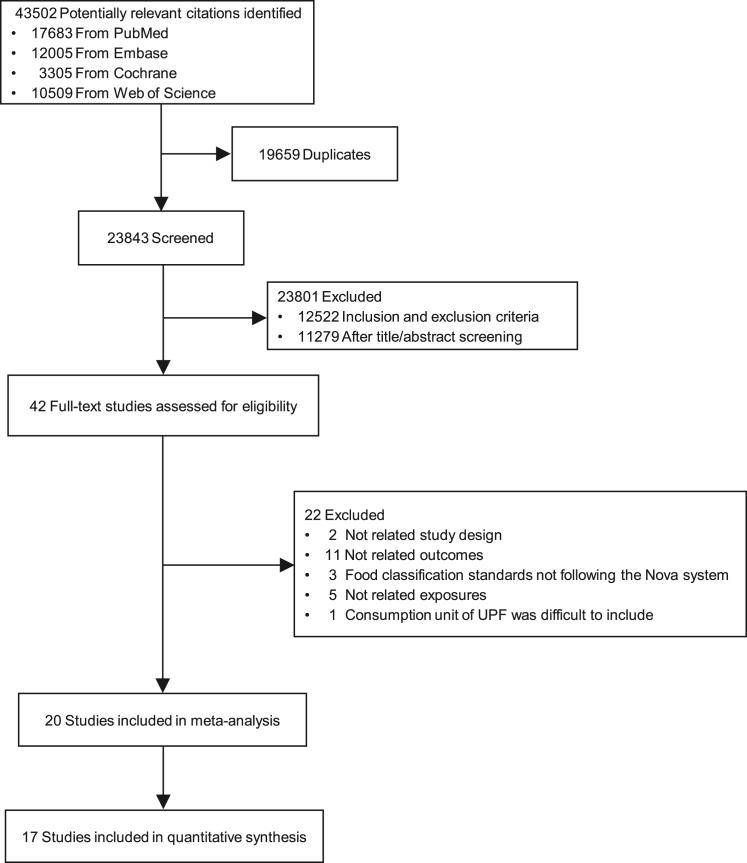
A meta-analysis was performed to assess the dose-response relationship of UPF consumption and CVEs risk (including the morbidity and mortality of cardiovascular causes, and myocardial infarction, stroke, transient ischemic attack, coronary intervention). Databases (PubMed, EMBASE, Cochrane Library, and Web of Science) were searched for observational studies published in English language up to October 24, 2023. Generalized least squares regression and restricted cubic splines were used to estimate the linear/nonlinear relationship. PROSPERO CRD 42023391122.
FINDINGS
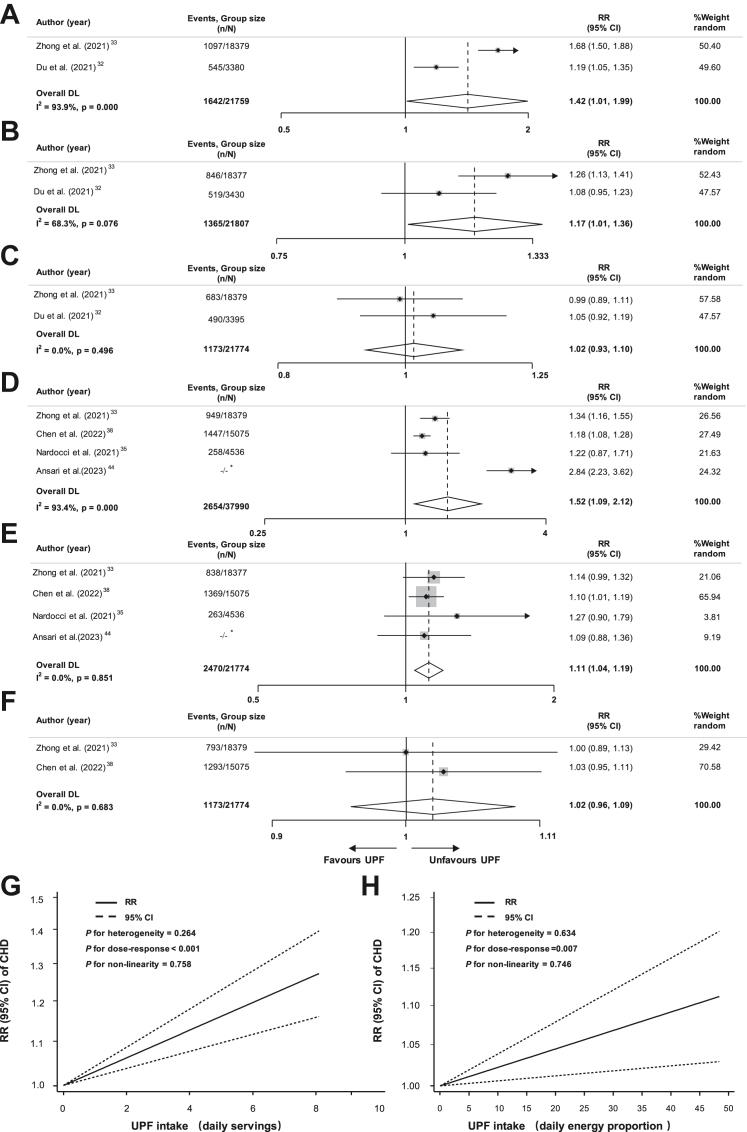
Twenty studies with 1,101,073 participants and 58,201 CVEs cases with a median follow-up of 12.2 years were included. A positive linear relationship between UPF intake and CVEs risk was identified. In addition, positive correlation between coronary heart disease and UPF consumption in terms of daily serving and daily energy proportion. No significant association of UPF consumption with the risk of cerebrovascular disease was observed. Briefly, 10% increase of UPF by daily weight proportion was associated with a 1.9% increase of CVEs risk (RR = 1.019; 95% CI, 1.007-1.031; = 0.002), an additional daily serving corresponding to 2.2% CVEs risk increase (RR = 1.022; 95% CI, 1.013-1.031; < 0.001), and 10% increase by daily energy proportion corresponding to 1.6% CVEs risk increase (RR = 1.016; 95% CI, 1.002-1.030; = 0.022).
INTERPRETATION
UPF consumption were associated with a higher risk of CVEs in the positive linear relationship. Our findings highlight the importance of minimizing UPF consumption for cardiovascular health and might be help to pursue public health policies in control of UPF consumption.
FUNDING
This work was supported by the Key Research and Development Program of Shaanxi Province (2023-ZDLSF-22), the Innovative Talent Support Program of Shaanxi Province (2022KJXX-106), and the Key Research and Development Program of Shaanxi Province (2023-YBSF-424).
背景
超加工食品(UPF)的消费量在全球范围内持续增加。然而,关于其对心血管事件(CVE)影响的荟萃分析证据有限。
方法
进行了一项荟萃分析,以评估UPF消费与CVE风险(包括心血管病因的发病率和死亡率,以及心肌梗死、中风、短暂性脑缺血发作、冠状动脉介入治疗)之间的剂量反应关系。检索了数据库(PubMed、EMBASE、Cochrane图书馆和Web of Science),以查找截至2023年10月24日发表的英文观察性研究。使用广义最小二乘回归和受限立方样条来估计线性/非线性关系。PROSPERO CRD 42023391122。
结果
纳入了20项研究,共1,101,073名参与者和58,201例CVE病例,中位随访时间为12.2年。确定了UPF摄入量与CVE风险之间存在正线性关系。此外,就每日份数和每日能量比例而言,冠心病与UPF消费之间存在正相关。未观察到UPF消费与脑血管疾病风险之间存在显著关联。简而言之,UPF每日重量比例增加10%与CVE风险增加1.9%相关(RR = 1.019;95% CI,1.007 - 1.031;P = 0.002),额外增加一份对应CVE风险增加2.2%(RR = 1.022;95% CI,1.013 -

 Zotero 插件