
基于CRISPR/Cas的体外基因治疗与溶酶体贮积症:超越Cas9的视角
CRISPR/Cas-Based Ex Vivo Gene Therapy and Lysosomal Storage Disorders: A Perspective Beyond Cas9.
作者信息
Leal Andrés Felipe, Prieto Luis Eduardo, Pachajoa Harry
机构信息
Centro de Investigaciones en Anomalías Congénitas y Enfermedades Raras, Universidad Icesi, Cali 760031, Colombia.
Centro de Investigaciones Clínicas, Fundación Valle de Lili, Cali 760001, Colombia.
出版信息
Cells. 2025 Jul 25;14(15):1147. doi: 10.3390/cells14151147.
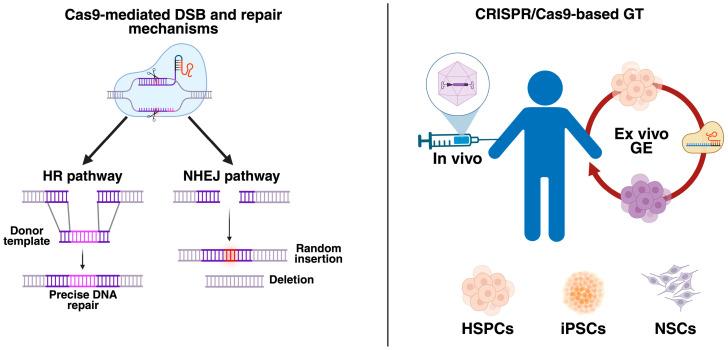
Lysosomal storage disorders (LSDs) are inherited metabolic conditions characterized by lysosomal enzyme deficiencies leading to substrate accumulation. As genetic diseases, LSDs can be treated with gene therapies (GT), including the CRISPR/Cas systems. The CRISPR/Cas systems enable precise and programmable genome editing, leading to targeted modifications at specific genomic loci. While the classical CRISPR/Cas9 system has been extensively used to generate LSD disease models and correct disease-associated genetic alterations through homologous recombination (HR), recently described Cas proteins as well as CRISPR/Cas9-derived strategies such as base editing, prime editing, and homology-independent targeted integration (HITI) offer a novel way to develop innovative treatments for LSDs. The direct administration of the CRISPR/Cas9 system remains the primary strategy evaluated in several LSDs; nevertheless, the ex vivo CRISPR/Cas9-based approach has been recently explored, primarily in central nervous system-affecting LSDs. Ex vivo approaches involve genetically modifying, in theory, any patient cells in the laboratory and reintroducing them into the patient to provide a therapeutic effect. This manuscript reviews the molecular aspects of the CRISPR/Cas technology and its implementation in ex vivo strategies for LSDs while discussing novel approaches beyond the classical CRISPR/Cas9 system.
溶酶体贮积症(LSDs)是一类遗传性代谢疾病,其特征是溶酶体酶缺乏导致底物蓄积。作为遗传性疾病,LSDs可用基因疗法(GT)进行治疗,包括CRISPR/Cas系统。CRISPR/Cas系统能够实现精确且可编程的基因组编辑,从而在特定基因组位点进行靶向修饰。虽然经典的CRISPR/Cas9系统已被广泛用于建立LSD疾病模型,并通过同源重组(HR)纠正与疾病相关的基因改变,但最近报道的Cas蛋白以及CRISPR/Cas9衍生策略,如碱基编辑、先导编辑和非同源靶向整合(HITI),为开发LSD的创新治疗方法提供了新途径。CRISPR/Cas9系统的直接给药仍然是几种LSD中评估的主要策略;然而,最近已经探索了基于CRISPR/Cas9的体外方法,主要用于治疗影响中枢神经系统的LSD。体外方法理论上涉及在实验室对任何患者细胞进行基因改造,然后将其重新引入患者体内以产生治疗效果。本文综述了CRISPR/Cas技术的分子层面及其在LSD体外策略中的应用,同时讨论了超越经典CRISPR/Cas9系统的新方法。


 Zotero 插件