
厄瓜多尔传统轻度加工食品中的霉菌毒素评估
Mycotoxin Assessment in Minimally Processed Traditional Ecuadorian Foods.
作者信息
Ortiz-Ulloa Johana, Saquicela Jorge, Castro Michelle, Cueva-Chamba Alexander, Cevallos-Cevallos Juan Manuel, León Jessica
机构信息
Department of Biosciences, Faculty of Chemical Sciences, University of Cuenca, Av. 12 de Abril s/n Cdla. Universitaria, Cuenca P.O. Box 01.01.168, Ecuador.
Centro de Investigaciones Biotecnológicas del Ecuador (CIBE), Escuela Superior Politécnica del Litoral, Campus Gustavo Galindo Km. 30.5 Vía Perimetral, Guayaquil P.O. Box 09.01.863, Ecuador.
出版信息
Foods. 2025 Jul 26;14(15):2621. doi: 10.3390/foods14152621.
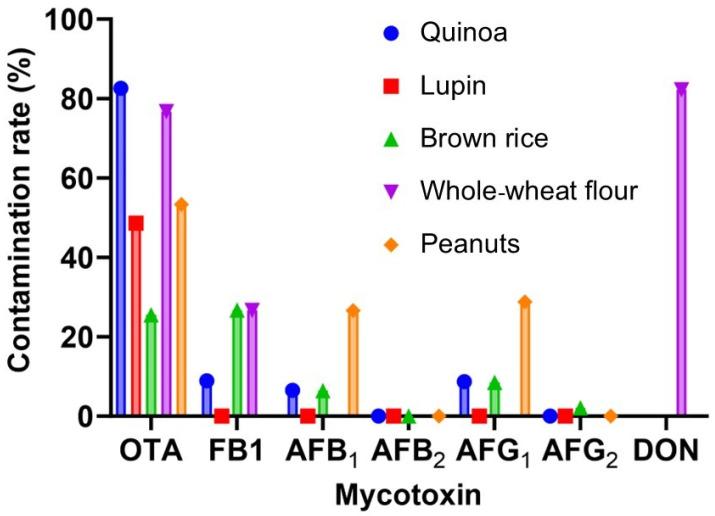
Nowadays, there is special interest in promoting the consumption of ancestral crops and minimally processed foods with high nutritional value. However, besides nutritional issues, safety assessments must be addressed. This study aimed to evaluate mycotoxin contamination in five minimally processed traditional Ecuadorian foods: ochratoxin A (OTA), fumonisin B (FB), and aflatoxins (AFs) in brown rice, lupin, and quinoa; OTA, FB, and deoxynivalenol (DON) in whole-wheat flour; and OTA and AFs in peanuts. Samples (45 samples of peanuts and whole-wheat flour, 47 of brown rice, 46 of quinoa, and 36 of lupin) were collected from local markets and supermarkets in the three most populated cities in Ecuador. Mycotoxins were determined by RP-HPLC with fluorescence and detection. Results were compared with the maximum permitted levels (MPLs) of European Regulation 2023/915/EC. Overall contamination reached up to 59.8% of the analyzed samples (38.4% with one mycotoxin and 21.5% with co-occurrence). OTA was the most prevalent mycotoxin (in 82.6% of quinoa, 76.7% of whole-wheat flour, 53.3% of peanuts, 48.6% of lupin, and 25.5% of brown rice), and a modest number of quinoa (17%) and lupin (5.7%) samples surpassed the MPLs. DON was found in 82.2% of whole-wheat flour (28.9% > MPL). FB was detected in above 25% of brown rice and whole-wheat flour and in 9% of the quinoa samples. FB levels were above the MPLs only for whole-wheat flour (17.8%). AFB and AFG showed similar prevalence (about 6.5 and 8.5%, respectively) in quinoa and rice and about 27% in peanuts. Overall, these findings underscore the importance of enhancing fungal control in the pre- and post-harvest stages of these foods, which are recognized for their high nutritional value and ancestral worth; consequently, the results present key issues related to healthy diet promotion and food sovereignty. This study provides compelling insights into mycotoxin occurrence in minimally processed Ecuadorian foods and highlights the need for further exposure assessments by combining population consumption data.
如今,人们对推广食用祖传作物和营养丰富的最低限度加工食品有着特别的兴趣。然而,除了营养问题外,还必须进行安全性评估。本研究旨在评估厄瓜多尔五种最低限度加工的传统食品中的霉菌毒素污染情况:糙米、羽扇豆和藜麦中的赭曲霉毒素A(OTA)、伏马毒素B(FB)和黄曲霉毒素(AFs);全麦面粉中的OTA、FB和脱氧雪腐镰刀菌烯醇(DON);以及花生中的OTA和AFs。从厄瓜多尔人口最多的三个城市的当地市场和超市采集了样本(45份花生和全麦面粉样本、47份糙米样本、46份藜麦样本和36份羽扇豆样本)。通过带荧光检测的反相高效液相色谱法测定霉菌毒素。将结果与欧盟法规2023/915/EC的最大允许水平(MPLs)进行比较。总体污染率高达所分析样本的59.8%(38.4%含有一种霉菌毒素,21.5%含有多种霉菌毒素同时存在)。OTA是最普遍的霉菌毒素(在82.6%的藜麦、76.7%的全麦面粉、53.3%的花生、48.6%的羽扇豆和25.5%的糙米中被检测到),少量藜麦(17%)和羽扇豆(5.7%)样本超过了MPLs。在82.2%的全麦面粉中检测到DON(28.9%超过MPL)。在超过25%的糙米和全麦面粉以及9%的藜麦样本中检测到FB。仅全麦面粉中的FB水平超过了MPLs(17.8%)。黄曲霉毒素B1(AFB)和黄曲霉毒素G1(AFG)在藜麦和大米中的检出率相似(分别约为6.5%和8.5%),在花生中的检出率约为27%。总体而言,这些发现强调了在这些具有高营养价值和祖传价值的食品收获前和收获后阶段加强真菌控制的重要性;因此,这些结果提出了与促进健康饮食和粮食主权相关的关键问题。本研究为厄瓜多尔最低限度加工食品中霉菌毒素的存在提供了引人注目的见解,并强调了通过结合人群消费数据进行进一步暴露评估的必要性。

 Zotero 插件