
化疗治疗晚期非小细胞肺癌患者生存结局的改善:一项评估免疫检查点抑制剂作用的回顾性队列研究
Improvement of survival outcomes in patients with advanced-stage non-small-cell lung cancer treated with chemotherapy: a retrospective cohort study evaluating the role of immune checkpoint inhibitors.
作者信息
Sakamori Yuichi, Kawachi Hiroaki, Yamoto Mako, Fukao Akari, Terashita Satoshi, Watanabe Kizuku, Ikeue Tatsuyoshi, Sugita Takakazu
机构信息
Department of Respiratory Medicine, Japan Red Cross Society Wakayama Medical Center, Wakayama City, Japan.
出版信息
J Thorac Dis. 2025 Jul 31;17(7):4689-4700. doi: 10.21037/jtd-2024-2202. Epub 2025 Jul 29.
BACKGROUND
Immune checkpoint inhibitors (ICIs) have transformed the treatment landscape of advanced non-small-cell lung cancer (NSCLC). However, there is limited real-world evidence on their impact in patients with driver mutation-negative or unknown mutation status. This subgroup remains underrepresented in the literature despite having fewer treatment options and a historically poor prognosis. This study aimed to evaluate the long-term impact of ICIs on survival outcomes in this patient population.
METHODS
We retrospectively reviewed patients with stage IV NSCLC who were treated at our institution between 2007 and 2024. Patients with driver mutation-negative or unknown mutation status who did not receive molecular-targeted therapies were included. We divided the study cohort into three periods based on the timing of chemotherapy initiation: period 1 [2007-2015], period 2 [2016-2018], and period 3 [2019-2024]. Overall survival (OS) was calculated from the start of chemotherapy to the date of death or last follow-up. Kaplan-Meier curves and Cox regression analysis were used to evaluate survival, with propensity score matching (PSM) conducted for sensitivity analysis.
RESULTS
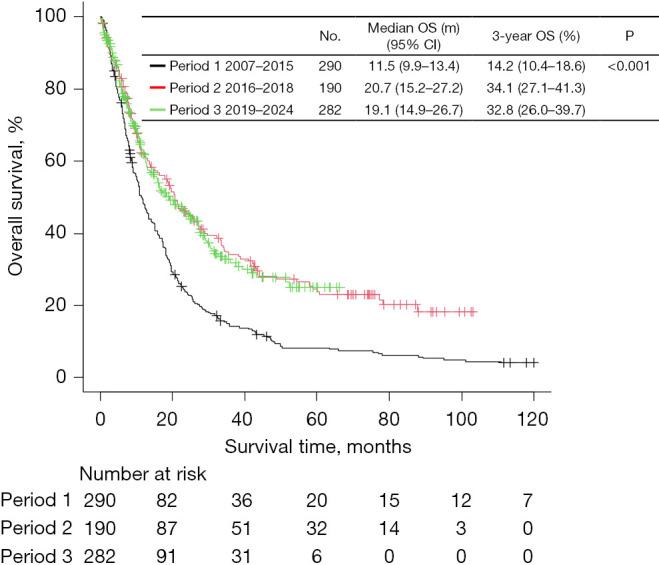
A total of 762 patients met the inclusion criteria. Patient demographics changed over time, with an increasing median age and a higher proportion of elderly patients (≥75 years) in later periods. The use of ICIs increased significantly over the three periods, from 0% in period 1 to 79.4% in period 3. Median OS (mOS) improved from 11.5 to 20.7 months and then to 19.1 months (P<0.001). In the multivariate Cox regression analysis, ICI use was significantly associated with improved OS [hazard ratio (HR) =0.52; 95% confidence interval (CI): 0.43-0.64; P<0.001], whereas treatment period itself was not an independent prognostic factor. The matched cohort analysis confirmed significant survival gains in periods 2 and 3 compared to period 1.
CONCLUSIONS
The widespread adoption of ICIs has significantly improved survival in patients with driver mutation-negative or unknown mutation status in a real-world setting. These findings support the integration of ICI-based regimens into routine clinical practice and underscore the need for ongoing efforts to optimize treatment strategies for patients without actionable mutations.
背景
免疫检查点抑制剂(ICIs)已经改变了晚期非小细胞肺癌(NSCLC)的治疗格局。然而,关于其对驱动基因突变阴性或突变状态未知患者的影响,现实世界中的证据有限。尽管该亚组患者的治疗选择较少且预后历来较差,但在文献中仍未得到充分体现。本研究旨在评估ICIs对该患者群体生存结局的长期影响。
方法
我们回顾性分析了2007年至2024年在我院接受治疗的IV期NSCLC患者。纳入未接受分子靶向治疗且驱动基因突变阴性或突变状态未知的患者。根据化疗开始时间,我们将研究队列分为三个时期:时期1[2007 - 2015年]、时期2[2016 - 2018年]和时期3[2019 - 2024年]。总生存期(OS)从化疗开始至死亡或最后一次随访日期计算。采用Kaplan - Meier曲线和Cox回归分析评估生存情况,并进行倾向评分匹配(PSM)以进行敏感性分析。
结果
共有762例患者符合纳入标准。患者人口统计学特征随时间变化,中位年龄增加,后期老年患者(≥75岁)比例更高。在三个时期中,ICIs的使用显著增加,从时期1的0%增至时期3的79.4%。中位OS(mOS)从11.5个月改善至20.7个月,然后降至19.1个月(P<0.001)。在多变量Cox回归分析中,使用ICIs与OS改善显著相关[风险比(HR)=0.52;95%置信区间(CI):0.43 - 0.64;P<0.001],而治疗时期本身并非独立的预后因素。匹配队列分析证实,与时期1相比,时期2和时期3的生存有显著改善。
结论
在现实世界中,ICIs的广泛应用显著改善了驱动基因突变阴性或突变状态未知患者的生存。这些发现支持将基于ICIs的方案纳入常规临床实践,并强调需要持续努力优化无可操作突变患者的治疗策略。


 Zotero 插件