
对选定的英语高收入国家移民人群中宫颈癌、乳腺癌和结直肠癌筛查的水平、实施策略、促进因素和障碍的范围审查。
A scoping review of the levels, implementation strategies, enablers, and barriers to cervical, breast, and colorectal cancer screening among migrant populations in selected English-speaking high-income countries.
作者信息
Khatri Resham B, Endalamaw Aklilu, Darssan Darsy, Assefa Yibeltal
机构信息
School of Public Health, The University of Queensland, Brisbane, Australia.
Health Social Science and Development Research Institute, Kathmandu, Nepal.
出版信息
PLoS One. 2025 Aug 14;20(8):e0329854. doi: 10.1371/journal.pone.0329854. eCollection 2025.
BACKGROUND
Cancer remains one of the leading causes of mortality and morbidity worldwide with colorectal, cervical, and breast cancers accounting for significant proportion of preventable deaths. Early screening, diagnosis, and treatment could prevent many of these deaths. However, migrants face persistent disparities in the screening, early diagnosis, and treatment of these cancers. This study synthesizes evidence on cancer screening uptake, implementation strategies, as well as their enablers and barriers among migrants in English-speaking high-income countries (Australia, the USA, the UK, Canada, and New Zealand).
METHODS
We conducted a scoping review of studies published in any language between 1 January 2015 and 31 December 2024. Studies were retrieved from four databases: PubMed, Scopus, Embase, and Web of Science. Search terms were developed based on four domains: types of cancer (colorectal, cervical, and breast), migrant populations, screening coverage, and country of residence. The uptake of cancer screening among migrants in selected countries was determined. A thematic analysis was conducted to analyze the data and identify key themes related to the implementation of cancer screening strategies, as well as their enablers and barriers.
RESULTS
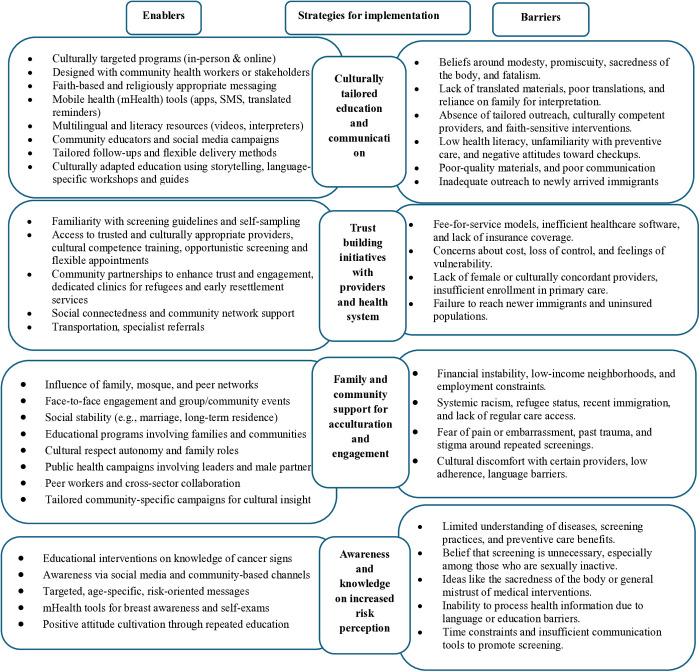
A total of 80 studies were included in the review. Migrants exhibited varied levels of utilization of cancer screening such as cervical cancer (41% - 84%), breast cancer (24%-87%), and colorectal cancer (4%-55%). Four themes related to the implementation of cancer screening strategies were identified: i) culturally tailored health education and communication, ii) trust-building initiatives with providers and health systems, iii) family and community support for acculturation and engagement, iv) awareness and knowledge on increased risk perception. Several barriers to the implementation of cancer screening strategies were identified, including lack of insurance, transportation challenges, difficulty in speaking and understanding English, inflexible work hours of health services, cultural taboos, stigma, poverty, and undocumented (illegal) status of migrants. Enablers of the implementation of cancer screening strategies included faith-based messaging on cancer screening, community partnerships, home-based fecal immunochemical test kits, availability of after-hours services, gender-concordant care, social networks, acculturation, and trust-building.
CONCLUSIONS
The uptake of cancer screening (breast, cervical, colorectal) varied and had low among migrants (e.g., refugees, culturally and linguistically diverse populations). Targeted, culturally tailored approaches, expanding interpreter services, and fostering cross-sector collaborations (e.g., linking screenings to cultural events) are essential for addressing disparities in cancer screening among migrants. Culturally sensitive and adaptive, equity-focussed interventions on cancer screening should be prioritized by ensuring sustained funding, disaggregated data collection on the uptake of cancers screening and design and implementation of programs on targeting diverse population groups.
背景
癌症仍然是全球主要的死亡和发病原因之一,结直肠癌、宫颈癌和乳腺癌占可预防死亡的很大比例。早期筛查、诊断和治疗可以预防许多此类死亡。然而,移民在这些癌症的筛查、早期诊断和治疗方面一直存在差异。本研究综合了关于英语国家高收入国家(澳大利亚、美国、英国、加拿大和新西兰)移民的癌症筛查接受情况、实施策略及其促进因素和障碍的证据。
方法
我们对2015年1月1日至2024年12月31日期间以任何语言发表的研究进行了范围综述。研究从四个数据库检索:PubMed、Scopus、Embase和Web of Science。搜索词基于四个领域制定:癌症类型(结直肠癌、宫颈癌和乳腺癌)、移民人口、筛查覆盖率和居住国家。确定了选定国家移民中癌症筛查的接受情况。进行了主题分析以分析数据并确定与癌症筛查策略实施相关的关键主题及其促进因素和障碍。
结果
综述共纳入80项研究。移民在癌症筛查的利用率方面存在差异,如宫颈癌(4l%-84%)、乳腺癌(24%-87%)和结直肠癌(4%-55%)。确定了与癌症筛查策略实施相关的四个主题:i)文化定制的健康教育和沟通,ii)与提供者和卫生系统建立信任的举措,iii)家庭和社区对文化适应和参与的支持,iv)对增加风险认知的认识和知识。确定了癌症筛查策略实施的几个障碍,包括缺乏保险、交通挑战、英语听说困难、卫生服务工作时间不灵活、文化禁忌、耻辱感、贫困以及移民的无证(非法)身份。癌症筛查策略实施的促进因素包括基于信仰的癌症筛查信息、社区伙伴关系、家庭粪便免疫化学检测试剂盒、非工作时间服务的可用性、性别协调护理、社会网络、文化适应和建立信任。
结论
移民(如难民、文化和语言多样化人群)对癌症筛查(乳腺癌、宫颈癌、结直肠癌)接受程度各异且较低。有针对性的、文化定制的方法、扩大口译服务以及促进跨部门合作(如将筛查与文化活动联系起来)对于解决移民在癌症筛查方面的差异至关重要。应优先考虑对癌症筛查采取文化敏感和适应性强、以公平为重点的干预措施,确保持续供资、收集关于癌症筛查接受情况的分类数据以及设计和实施针对不同人群的项目。


 Zotero 插件