
伊朗癌症死亡率的空间和时空分析:性别差异及其对卫生政策的影响。
Spatial and spatio-temporal analysis of cancer mortality in Iran: gender disparities and implications for health policy.
作者信息
Zangeneh Alireza, Ziapour Arash, Hoseini Seyede Negin, Nazari Babak, Molavi Homa, Najafi Farid, Khosravi Ardeshir, Moghadam Reza Heidari
机构信息
Cardiovascular Research Center, Health Policy and Promotion Institute, Kermanshah University of Medical Sciences, Kermanshah, Iran.
Research Development Center, Imam Khomeini Hospitals, Kermanshah University of Medical Sciences, Kermanshah, Iran.
出版信息
Prev Med Rep. 2025 Aug 5;57:103180. doi: 10.1016/j.pmedr.2025.103180. eCollection 2025 Sep.
OBJECTIVES
Cancer mortality, particularly for gender-specific cancers, has increased in Iran and other developing countries, highlighting notable disparities in regional trends and patterns. This study examines geographical and temporal trends in cancer mortality from 2017 to 2019.
METHODS
We analyzed data from Iran's Ministry of Health's death registration system, focusing on populations of 11,807 females and 14,450 males in 2017; 3133 females and 4439 males in 2018; and 4799 females and 6624 males in 2019. We employed spatial statistical methods, including Anselin Local Moran's I and Hot Spot Analysis (Getis-Ord Gi*), alongside techniques such as Mean Center, Standard Distance, and Geographic Information Systems to evaluate cancer mortality at the township level.
RESULTS
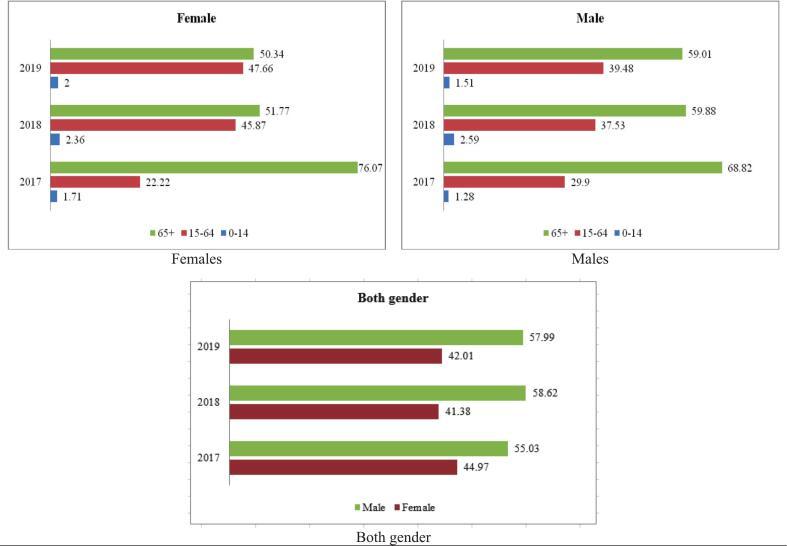
Between 2017 and 2019, cancer mortality rates among women declined from 44.9 % to 42.0 %, while rates among men increased from 55.0 % to 57.9 %. The epicenter of mortality shifted from central regions in 2017 to western regions in 2018, then to eastern regions in 2019. The standard deviation ellipse indicated a transition in cancer mortality distribution from a northwest-southeast alignment in 2017 to predominantly western and eastern orientations in subsequent years, with varied hotspot patterns across Iran.
CONCLUSIONS
The study highlights rising cancer mortality rates, particularly among men and premenopausal women, underscoring the need for targeted public health interventions and improved medical infrastructure to enhance prevention and treatment efforts.
目的
在伊朗和其他发展中国家,癌症死亡率,尤其是特定性别癌症的死亡率有所上升,凸显了区域趋势和模式上的显著差异。本研究考察了2017年至2019年癌症死亡率的地理和时间趋势。
方法
我们分析了伊朗卫生部死亡登记系统的数据,重点关注2017年的11807名女性和14450名男性;2018年的3133名女性和4439名男性;以及2019年的4799名女性和6624名男性。我们采用了空间统计方法,包括安塞尔林局部莫兰指数和热点分析(Getis-Ord Gi*),以及诸如平均中心、标准距离和地理信息系统等技术,以评估乡镇一级的癌症死亡率。
结果
2017年至2019年期间,女性癌症死亡率从44.9%降至42.0%,而男性死亡率从55.0%升至57.9%。死亡率的中心从2017年的中部地区转移到2018年的西部地区,然后在2019年转移到东部地区。标准差椭圆表明,癌症死亡率分布从2017年的西北-东南走向转变为随后几年主要的西部和东部走向,伊朗各地的热点模式各不相同。
结论
该研究突出了癌症死亡率的上升,尤其是男性和绝经前女性,强调需要有针对性的公共卫生干预措施并改善医疗基础设施,以加强预防和治疗工作。

 Zotero 插件