
骨转移中的微小RNA:机制与研究进展
MicroRNAs in bone metastases: mechanisms and research progression.
作者信息
He Wei, Wang Zhen, Li ZiHan
机构信息
Department of Orthopedics, Third Clinical School of Medicine, Ningxia Hui Autonomous Region, Ningxia Medical University, YinChuan, China.
出版信息
Front Oncol. 2025 Aug 5;15:1552902. doi: 10.3389/fonc.2025.1552902. eCollection 2025.
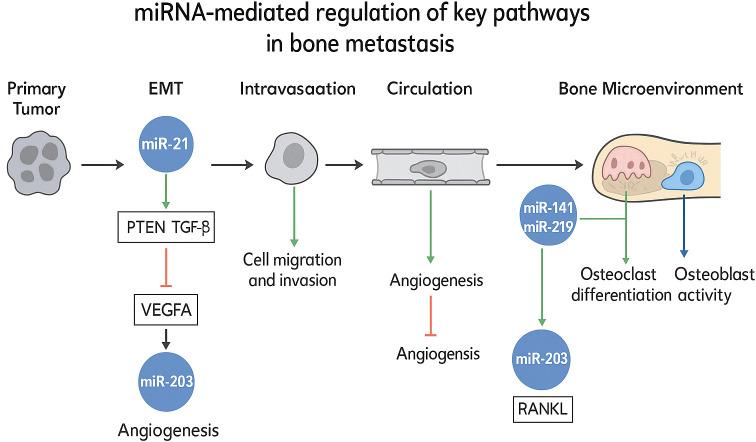
Bone metastasis, an exceedingly critical and often life - threatening complication in the course of diverse cancer progression, impacts nearly all tumor types, with an especially pronounced prevalence in breast, prostate, lung, liver, and thyroid malignancies. These metastatic lesions are typically localized in the spine, pelvis, shoulders, and distal femur, thereby exerting a substantial influence on patients' quality of life and prognosis. In numerous instances, the early detection of cancers frequently coincides with patients presenting symptoms induced by bone metastases, which strikingly highlights the severe and debilitating nature of this condition. MicroRNAs (miRNAs), a class of short non - coding RNAs, have emerged as pivotal regulators of gene expression. They are widely and comprehensively acknowledged for their indispensable role in cancer initiation, progression, invasion, and metastasis. Abundant evidence has underscored the involvement of specific miRNAs at various stages of bone metastasis, further emphasizing their vital contribution to the pathogenesis of metastatic bone disease. In this comprehensive review, we systematically collate and summarize the current state - of - the - art knowledge regarding the participation of miRNAs in bone metastasis within breast, prostate, lung, liver, and thyroid cancers. Moreover, we thoroughly explore the potential of miRNAs as therapeutic targets or advanced - generation therapeutic agents for bone metastasis. Concurrently, we also in - depth investigate their function as predictive biomarkers for earlier diagnosis and the development of optimized treatment strategies for cancer patients.
骨转移是多种癌症进展过程中极其关键且往往危及生命的并发症,几乎影响所有肿瘤类型,在乳腺癌、前列腺癌、肺癌、肝癌和甲状腺癌中尤为常见。这些转移病灶通常位于脊柱、骨盆、肩部和股骨远端,从而对患者的生活质量和预后产生重大影响。在许多情况下,癌症的早期发现往往与患者出现由骨转移引起的症状同时发生,这突出表明了这种情况的严重性和衰弱性。微小RNA(miRNA)是一类短链非编码RNA,已成为基因表达的关键调节因子。它们在癌症的发生、发展、侵袭和转移中发挥不可或缺的作用,这一点已得到广泛而全面的认可。大量证据强调了特定miRNA在骨转移各个阶段的参与,进一步凸显了它们对转移性骨病发病机制的重要贡献。在这篇综述中,我们系统地整理和总结了关于miRNA在乳腺癌、前列腺癌、肺癌、肝癌和甲状腺癌骨转移中作用的最新知识。此外,我们深入探讨了miRNA作为骨转移治疗靶点或新一代治疗药物的潜力。同时,我们还深入研究了它们作为预测生物标志物在早期诊断以及为癌症患者制定优化治疗策略方面的作用。
 Zotero 插件