
调节胃癌中的细胞增殖、迁移、凋亡和铁死亡。
regulates cell proliferation, migration, apoptosis and ferroptosis in gastric cancer.
作者信息
Zhang Qi, Yuan Zu-Guo, Zheng Kai-Feng, Chen Ke
机构信息
Department of Gastroenterology, The Affiliated People's Hospital of Ningbo University, Ningbo 315000, Zhejiang Province, China.
Chemoradiotherapy Center of Oncology, The Affiliated People's Hospital of Ningbo University, Ningbo 315000, Zhejiang Province, China.
出版信息
World J Gastrointest Oncol. 2025 Aug 15;17(8):106781. doi: 10.4251/wjgo.v17.i8.106781.
BACKGROUND
Gastric cancer (GC) has a high prevalence and mortality overall. is associated with abnormal centrosome amplification, DNA damage and increased apoptosis. To date, little is known about the function and mechanism of in GC.
AIM
To explore the cellular processes associated with GC will help to elucidate the mechanism of the occurrence and development of GC and discover potential therapeutic targets.
METHODS
The detection of expression at mRNA and protein levels was done by real-time quantitative polymerase chain reaction and western blotting. The function of was verified by loss-of-function experiments in AGS cells. The genes co-expressed with were searched from the stomach adenocarcinomas (STAD) data in The Cancer Genome Atlas database. Kyoto Encyclopedia of Genes and Genomes (KEGG) enrichment analysis of the genes co-expressed with to further identify the pathways involved in . Rescue experiments using ferroptosis inhibitor ferrostatin-1 and chemotherapeutic sensitivity assays with cisplatin were also performed.
RESULTS
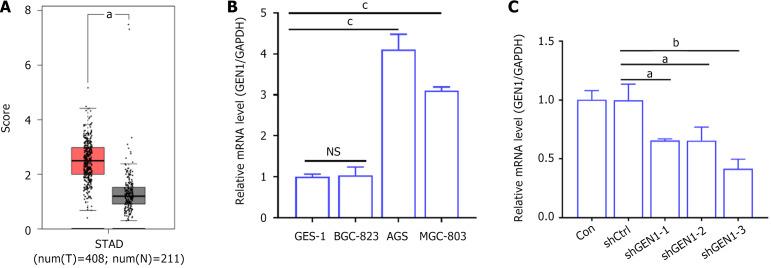
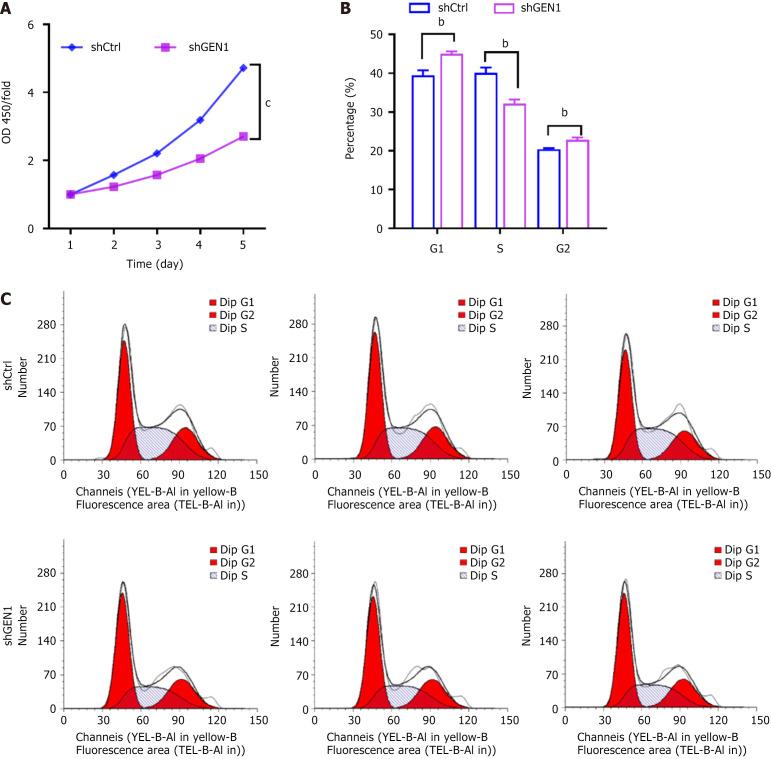
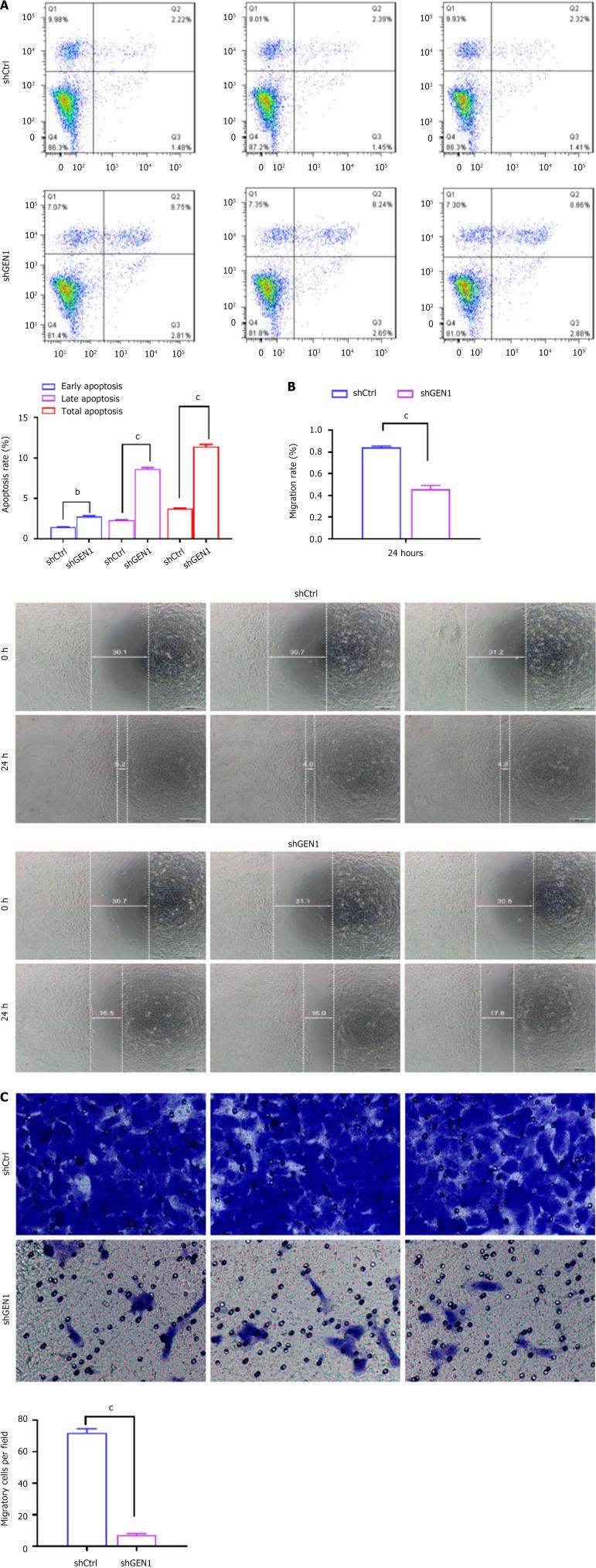
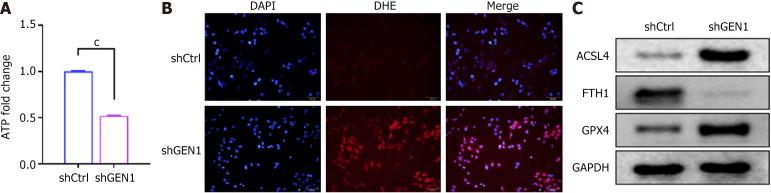
Significant up-regulation of was observed in GC cell lines AGS and MGC-803. Inhibition of induced cell apoptosis and decreased cell proliferation, cycle progression, migration in AGS cells. There were 264 genes co-expressed with in STAD cohort ( > 0.4, < 0.001). KEGG enrichment analysis showed that might be associated with the cell cycle, Fanconi anemia pathway, homologous recombination, oocyte meiosis and cellular senescence in GC. Furthermore, , , , cyclin-dependent kinase (CDK) 1, CDK2 and polo-like kinase 1 protein levels were lower in -knockdown AGS cells, manifesting that was associated with the cell cycle pathway in AGS cells. Downregulation of decreased adenosine triphosphate content and elevated reactive oxygen species in AGS cells, suggesting that silencing led to mitochondrial dysfunction in AGS cells. In addition, silencing caused an overt decrease in and protein levels and a significant elevation in protein levels, implying that silencing promoted AGS cell ferroptosis. Treatment with ferrostatin-1 rescued cell viability loss induced by knockdown, confirming ferroptosis as a key death mechanism. Additionally, -deficient AGS cells showed enhanced sensitivity to cisplatin, with a significantly reduced half-maximal inhibitory concentration compared to control cells.
CONCLUSION
promotes GC cell proliferation and migration while suppressing apoptosis and ferroptosis. Targeting not only disrupts mitochondrial function and cell cycle progression but also sensitizes GC cells to ferroptosis and chemotherapy. These findings highlight as a potential therapeutic target for enhancing treatment efficacy in gastric cancer.
背景
胃癌(GC)总体发病率和死亡率较高。它与中心体异常扩增、DNA损伤及凋亡增加有关。迄今为止,关于其在胃癌中的功能和机制知之甚少。
目的
探索与胃癌相关的细胞过程将有助于阐明胃癌发生发展的机制并发现潜在治疗靶点。
方法
通过实时定量聚合酶链反应和蛋白质印迹法检测其在mRNA和蛋白质水平的表达。通过在AGS细胞中进行功能缺失实验验证其功能。从癌症基因组图谱数据库的胃腺癌(STAD)数据中搜索与它共表达的基因。对与它共表达的基因进行京都基因与基因组百科全书(KEGG)富集分析以进一步确定其涉及的途径。还进行了使用铁死亡抑制剂铁抑素-1的挽救实验和顺铂化疗敏感性测定。
结果
在胃癌细胞系AGS和MGC-803中观察到其显著上调。抑制它可诱导AGS细胞凋亡并降低细胞增殖、细胞周期进程及迁移能力。在STAD队列中有264个基因与它共表达(>0.4,<0.001)。KEGG富集分析表明它可能与胃癌中的细胞周期、范可尼贫血途径、同源重组、卵母细胞减数分裂及细胞衰老有关。此外,在敲低的AGS细胞中,、、、细胞周期蛋白依赖性激酶(CDK)1、CDK2和polo样激酶1的蛋白水平较低,表明它与AGS细胞中的细胞周期途径有关。它的下调降低了AGS细胞中的三磷酸腺苷含量并提高了活性氧水平,表明它的沉默导致AGS细胞线粒体功能障碍。此外,它的沉默导致和蛋白水平明显降低,蛋白水平显著升高,这意味着它的沉默促进了AGS细胞铁死亡。用铁抑素-1处理挽救了由它的敲低诱导的细胞活力丧失,证实铁死亡是关键的死亡机制。此外,缺乏它的AGS细胞对顺铂表现出增强的敏感性,与对照细胞相比,半数最大抑制浓度显著降低。
结论
它促进胃癌细胞增殖和迁移,同时抑制凋亡和铁死亡。靶向它不仅破坏线粒体功能和细胞周期进程,还使胃癌细胞对铁死亡和化疗敏感。这些发现突出了它作为提高胃癌治疗疗效的潜在治疗靶点。



 Zotero 插件