
决策辅助导航工具的临床医生需求与要求:定性研究
Clinician Needs and Requirements for a Decision Aid Navigator: Qualitative Study.
作者信息
Morse Brad, Reale Carrie, Nguyen An T, Latella Erin, Bauguess Hannah, Anders Shilo, Roberts Pamela, SooHoo Spencer L, El-Kareh Robert, Soares Andrey, Schilling Lisa
机构信息
Division of General Internal Medicine, University of Colorado Anschutz Medical Campus, 1890 North Revere Court, Aurora, CO, 80045, United States, 1 3037245138.
Vanderbilt University Medical Center, Nashville, TN, United States.
出版信息
JMIR Hum Factors. 2025 Aug 21;12:e69756. doi: 10.2196/69756.
BACKGROUND
Decision aids (DAs) are important tools that support shared decision-making (SDM) between clinicians and patients, enabling patients to be more informed and engaged in decisions regarding their care. The use of DAs can increase patient knowledge, reduce decisional regret, and engage the clinician and patient in meaningful dialog. Despite proven effectiveness in enhancing patient-centered care, a gap remains in clinician use of DAs. Known clinician barriers to using DAs include (1) time constraints, (2) concerns about the match between patient need and available DAs, (3) forcing users to leave the electronic health record (EHR) to access DAs, and (4) the burden of manually entering data into the DA.
OBJECTIVE
This qualitative study identified the needs and requirements of clinicians to inform the design of a clinician-facing, EHR-integrated, Substitutable Medical Applications, Reusable Technologies (SMART; SMART Health IT) on Fast Healthcare Interoperability Resources (FHIR) (HL7) app, the Decision Aid Navigator (DEAN; University of Colorado Anschutz Medical Campus). The Navigator identifies and surfaces DAs that are relevant to a patient's health care conditions (eg, atrial fibrillation), current care (eg, not on anticoagulation), and demographics (eg, check the youngest age for the stroke prevention), and facilitates documentation of SDM discussions and decisions.
METHODS
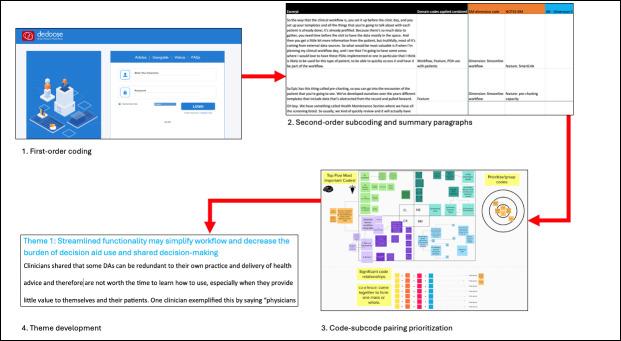
We conducted 13 semistructured interviews with clinicians who were recruited from 4 academic medical centers. Interviews included a demonstration of an initial, mid-fidelity, DEAN app prototype that was designed to address DA use and barriers described in the literature. The interviews focused on clinician context and use of the prototype, affordances and barriers to using the system, and clinician needs and requirements of the system. We used qualitative content analysis to code and reduce the data, using a consensus-making approach, and identify emerging themes.
RESULTS
We identified 3 overarching themes: (1) streamlined functionality may simplify workflow and decrease the burden of DA use and SDM; (2) clinicians need appropriate competencies to effectively use the Navigator and relevant DAs; and (3) trust that the Navigator suggests prevetted DAs. Unanimously, clinicians shared that the DEAN Navigator should be integrated into the EHR. To accomplish this clear priority, clinicians stated that they needed the requisite competencies to successfully use the tool within their workflow and build trust with the tool itself.
CONCLUSIONS
Better tools to support and harness the benefits of SDM are needed. Overcoming the barriers of using DAs is paramount. Tools designed and developed to support DA use must be integrated into the EHR efficiently to create an opportunity for uptake of the technology by busy clinicians. If tools like DEAN can streamline the cumbersome process of documenting the use of DAs, more clinicians may potentially use DAs with their patients, given the right context and appropriate DA.
背景
决策辅助工具(DAs)是支持临床医生与患者之间共同决策(SDM)的重要工具,能使患者在有关自身护理的决策中了解更多信息并积极参与。使用DAs可以增加患者知识、减少决策后悔,并促使临床医生和患者进行有意义的对话。尽管在加强以患者为中心的护理方面已证明其有效性,但临床医生在使用DAs方面仍存在差距。临床医生使用DAs已知的障碍包括:(1)时间限制;(2)对患者需求与可用DAs之间匹配度的担忧;(3)迫使用户离开电子健康记录(EHR)以访问DAs;(4)手动将数据输入DAs的负担。
目的
本定性研究确定了临床医生的需求和要求,以为面向临床医生的、集成于EHR的、基于快速医疗保健互操作性资源(FHIR)(HL7)应用程序的可替代医疗应用、可重复使用技术(SMART;SMART Health IT)决策辅助导航器(DEAN;科罗拉多大学安舒茨医学校区)的设计提供信息。该导航器可识别并展示与患者健康状况(如心房颤动)、当前护理(如未进行抗凝治疗)和人口统计学特征(如查看预防中风的最小年龄)相关的DAs,并促进对SDM讨论和决策的记录。
方法
我们对从4个学术医疗中心招募的临床医生进行了13次半结构化访谈。访谈内容包括对一个初始的、中等保真度的DEAN应用程序原型的演示,该原型旨在解决文献中描述的DAs使用和障碍问题。访谈重点关注临床医生的背景和对原型的使用、使用该系统的便利之处和障碍,以及临床医生对该系统的需求和要求。我们使用定性内容分析法对数据进行编码和精简,采用达成共识的方法,并确定新出现的主题。
结果
我们确定了3个总体主题:(1)简化的功能可能会简化工作流程并减轻DAs使用和SDM的负担;(2)临床医生需要适当的能力才能有效使用导航器和相关DAs;(3)相信导航器推荐的是经过审核的DAs。临床医生一致认为,DEAN导航器应集成到EHR中。为实现这一明确的优先事项,临床医生表示,他们需要必要的能力,以便在工作流程中成功使用该工具并与工具本身建立信任。
结论
需要更好的工具来支持并利用SDM的益处。克服使用DAs的障碍至关重要。为支持DAs使用而设计和开发的工具必须有效地集成到EHR中,以便为忙碌的临床医生提供采用该技术的机会。如果像DEAN这样的工具能够简化记录DAs使用情况的繁琐过程,那么在合适的背景和适当的DAs条件下,更多的临床医生可能会与患者一起使用DAs。
 Zotero 插件