
心血管-肾脏-代谢综合征患者中生命关键9与疾病严重程度、全因死亡率和心血管死亡率之间的关联:表型年龄加速的中介作用
Associations between Life's Crucial 9 and severity, all-cause mortality, and cardiovascular mortality in individuals with cardiovascular-kidney-metabolic syndrome: the mediating role of phenotypic age acceleration.
作者信息
Li Jing, Xu Zengxin, Lin Jiayi, Luo Shunxiang, Xu Shanghua
机构信息
Department of Clinical Medicine, Fujian Medical University, Fuzhou, Fujian, China.
Department of Cardiology, Nanping First Hospital Affiliated to Fujian Medical University, Nanping, China.
出版信息
Front Nutr. 2025 Aug 6;12:1612293. doi: 10.3389/fnut.2025.1612293. eCollection 2025.
OBJECTIVE
The American Heart Association (AHA) recently introduced the concept of cardiovascular-kidney-metabolic (CKM) syndrome. This study aimed to explore the associations of Life's Crucial 9 (LC9), the recently updated lifestyle guidelines for cardiovascular health, with the severity and mortality of CKM syndrome.
METHODS
For this study, we utilized National Health and Nutrition Examination Survey (NHANES) data and conducted logistic regression analyses to evaluate the association between LC9 scores and the severity of CKM syndrome, whereas Cox regression models were employed to assess the effects of LC9 scores and mortality in patients with CKM syndrome. Subsequently, restricted cubic spline (RCS) analysis was used to investigate potential nonlinear relationships between LC9 scores and both the severity and mortality of CKM syndrome. Stratification and interaction analyses were carried out across different subgroups to validate the findings. Finally, mediation analysis was performed to investigate whether phenotypic age acceleration (PhenoAgeAccel) status mediates the association between LC9 scores and CKM syndrome severity.
RESULTS
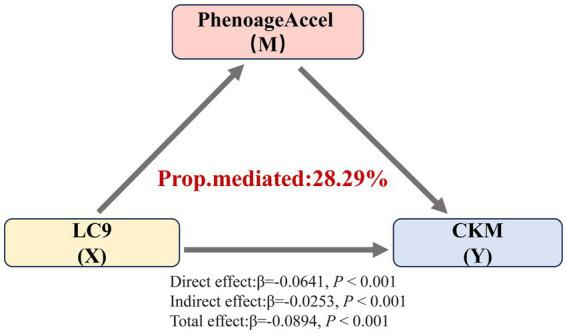
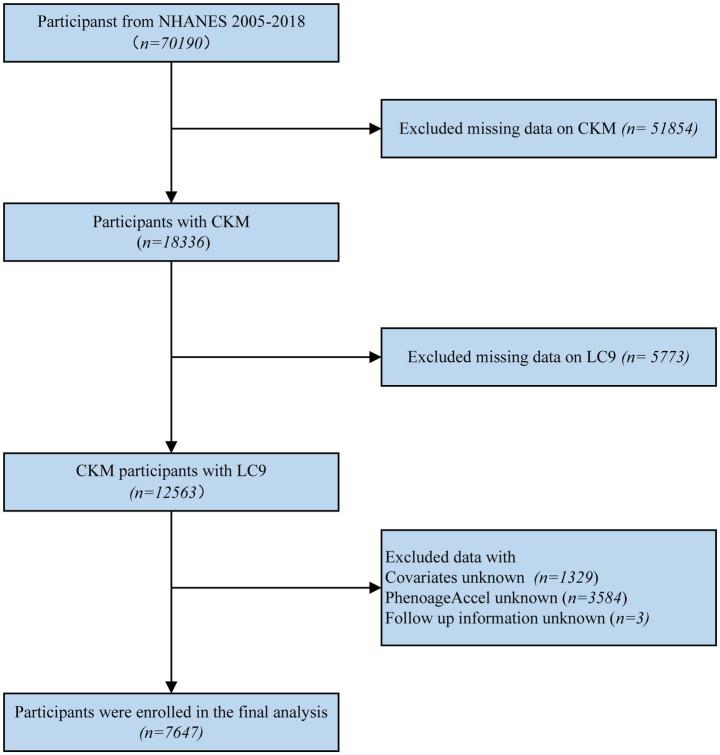
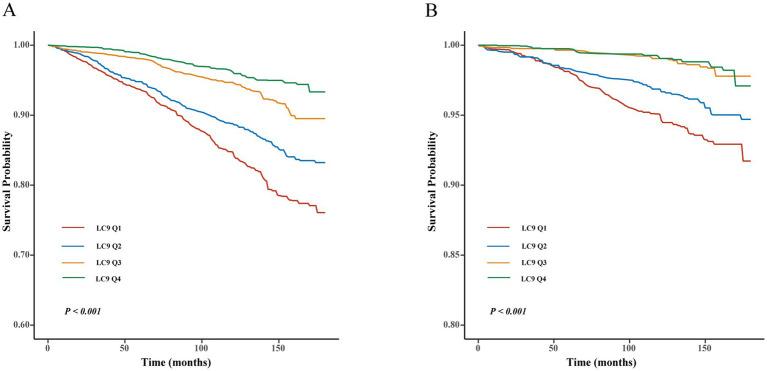
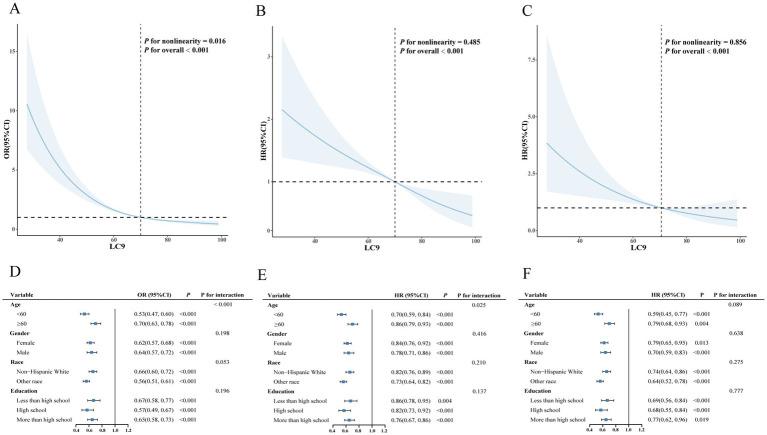
A total of 7,647 patients were included in our study. After adjusting for covariates, each 10% increase in the LC9 score was associated with a 37% reduction in the risk of progression to advanced CKM syndrome stages, and WQS analysis revealed that the blood glucose level was the most influential contributing factor. Moreover, Cox regression analysis revealed that higher LC9 scores were significantly linked to lower risks of all-cause mortality (HR = 0.81, 95% CI: 0.76-0.87) and cardiovascular mortality (HR = 0.74, 95% CI: 0.65-0.84) among individuals with CKM syndrome. Additionally, RCS analysis revealed a significant nonlinear association between LC9 scores and CKM syndrome severity, but no nonlinear association was found between LC9 scores and the risk of mortality. Mediation analysis confirmed that PhenoAgeAccel mediated the association between LC9 scores and CKM syndrome severity.
CONCLUSION
Our findings indicate significant negative associations of LC9 scores with CKM syndrome severity and mortality, highlighting the potential role of LC9 in guiding targeted public health strategies to prevent the progression of CKM syndrome to advanced stages and reduce mortality risk.
目的
美国心脏协会(AHA)最近引入了心血管-肾脏-代谢(CKM)综合征的概念。本研究旨在探讨最新版心血管健康生活方式指南“生命关键9要素”(LC9)与CKM综合征严重程度及死亡率之间的关联。
方法
在本研究中,我们利用了美国国家健康与营养检查调查(NHANES)的数据,并进行了逻辑回归分析,以评估LC9评分与CKM综合征严重程度之间的关联,同时采用Cox回归模型评估LC9评分对CKM综合征患者死亡率的影响。随后,使用受限立方样条(RCS)分析来研究LC9评分与CKM综合征严重程度及死亡率之间潜在的非线性关系。通过对不同亚组进行分层和交互分析来验证研究结果。最后,进行中介分析以研究表型年龄加速(PhenoAgeAccel)状态是否介导了LC9评分与CKM综合征严重程度之间的关联。
结果
我们的研究共纳入了7647名患者。在对协变量进行调整后,LC9评分每增加10%,进展至晚期CKM综合征阶段的风险降低37%,加权分位数和(WQS)分析显示血糖水平是最具影响力的因素。此外,Cox回归分析显示,在CKM综合征患者中,较高的LC9评分与全因死亡率(HR = 0.81,95%CI:0.76 - 0.87)和心血管死亡率(HR = 0.74,95%CI:0.65 - 0.84)的较低风险显著相关。此外,RCS分析显示LC9评分与CKM综合征严重程度之间存在显著的非线性关联,但未发现LC9评分与死亡风险之间存在非线性关联。中介分析证实,PhenoAgeAccel介导了LC9评分与CKM综合征严重程度之间的关联。
结论
我们的研究结果表明,LC9评分与CKM综合征严重程度及死亡率之间存在显著的负相关,突出了LC9在指导针对性公共卫生策略以预防CKM综合征进展至晚期并降低死亡风险方面的潜在作用。

 Zotero 插件