
癌症护理中患者对人工智能的态度:范围综述
Patient Attitudes Toward Artificial Intelligence in Cancer Care: Scoping Review.
作者信息
Hilbers Daniel, Nekain Navid, Bates Alan, Nunez John-Jose
机构信息
Faculty of Medicine, University of British Columbia, Vancouver, BC, Canada.
Supportive Care, BC Cancer Agency, Vancouver, BC, Canada.
出版信息
JMIR Cancer. 2025 Aug 22;11:e74010. doi: 10.2196/74010.
BACKGROUND
Artificial intelligence is reshaping cancer care, but little is known about how people with cancer perceive its integration into their care. Understanding these perspectives is essential to ensuring artificial intelligence adoption aligns with patient needs and preferences while supporting a patient-centered approach.
OBJECTIVE
The aim of this study is to synthesize existing literature on patient attitudes toward artificial intelligence in cancer care and identify knowledge gaps that can inform future research and clinical implementation.
METHODS
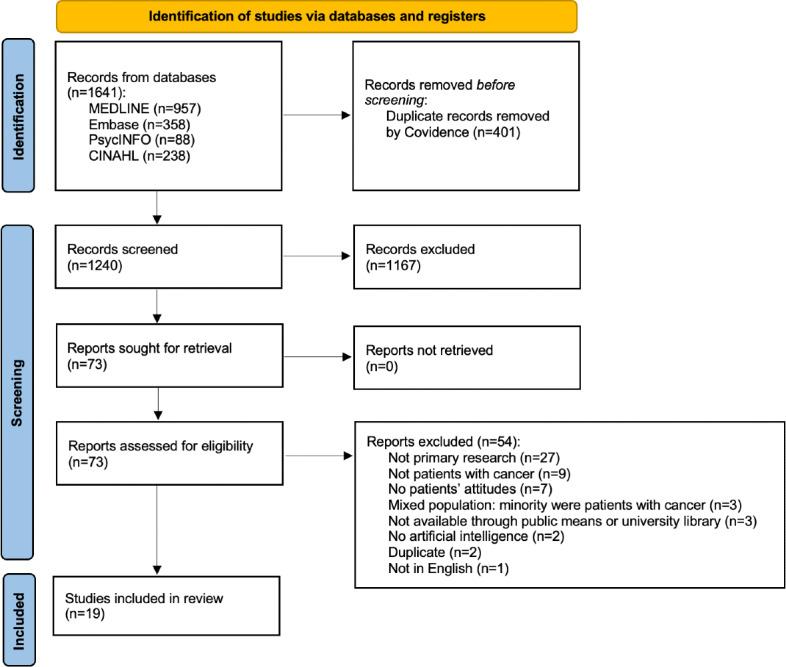
A scoping review was conducted following the PRISMA-ScR (Preferred Reporting Items for Systematic Reviews and Meta-Analyses extension for Scoping Reviews) guidelines. MEDLINE, Embase, PsycINFO, and CINAHL were searched for peer-reviewed primary research studies published until February 1, 2025. The Population-Concept-Context framework guided study selection, focusing on adult patients with cancer and their attitudes toward artificial intelligence. Studies with quantitative or qualitative data were included. Two independent reviewers screened studies, with a third resolving disagreements. Data were synthesized into tabular and narrative summaries.
RESULTS
Our search yielded 1240 citations, of which 19 studies met the inclusion criteria, representing 2114 patients with cancer across 15 countries. Most studies used quantitative methods (9/19, 47%) such as questionnaires or surveys. The most studied cancers were melanoma (375/2114, 17.7%), prostate (n=323, 15.3%), breast (n=263, 12.4%), and colorectal cancer (n=251, 11.9%). Although patients with cancer generally supported artificial intelligence when used as a physician-guided tool (9/19, 47%), concerns about depersonalization, treatment bias, and data security highlighted challenges in implementation. Trust in artificial intelligence (10/19, 53%) was shaped by physician endorsement and patient familiarity, with greater trust when artificial intelligence was physician-guided. Geographic differences were observed, with greater artificial intelligence acceptance in Asia, while skepticism was more prevalent in North America and Europe. Additionally, patients with metastatic cancer (99/2114, 5%) were underrepresented, limiting insights into artificial intelligence perceptions in this population.
CONCLUSIONS
This scoping review provides the first synthesis of patient attitudes toward artificial intelligence across all cancer types and highlights concerns unique to patients with cancer. Clinicians can use these findings to enhance patient acceptance of artificial intelligence by positioning it as a physician-guided tool and ensuring its integration aligns with patient values and expectations.
背景
人工智能正在重塑癌症护理,但对于癌症患者如何看待其融入自身护理了解甚少。理解这些观点对于确保人工智能的应用符合患者需求和偏好,同时支持以患者为中心的方法至关重要。
目的
本研究的目的是综合现有关于患者对癌症护理中人工智能态度的文献,并确定可为未来研究和临床实施提供信息的知识空白。
方法
按照PRISMA-ScR(系统评价和Meta分析扩展版的范围综述首选报告项目)指南进行范围综述。检索MEDLINE、Embase、PsycINFO和CINAHL,查找截至2025年2月1日发表的同行评审的原发性研究。人群-概念-背景框架指导研究选择,重点关注成年癌症患者及其对人工智能的态度。纳入有定量或定性数据的研究。两名独立评审员筛选研究,第三名评审员解决分歧。数据被综合成表格和叙述性总结。
结果
我们的检索产生了1240条引文,其中19项研究符合纳入标准,代表了来自15个国家的2114名癌症患者。大多数研究采用定量方法(9/19,47%),如问卷调查。研究最多的癌症类型是黑色素瘤(375/2114,17.7%)、前列腺癌(n = 323,15.3%)、乳腺癌(n = 263,12.4%)和结直肠癌(n = 251,11.9%)。尽管癌症患者在将人工智能用作医生指导工具时普遍支持(9/19,47%),但对非个性化、治疗偏差和数据安全的担忧凸显了实施中的挑战。对人工智能的信任(10/19,53%)受医生认可和患者熟悉程度影响,当人工智能由医生指导时信任度更高。观察到地理差异,亚洲对人工智能的接受度更高,而北美和欧洲的怀疑态度更为普遍。此外,转移性癌症患者(99/2114,5%)代表性不足,限制了对该人群对人工智能看法的深入了解。
结论
本范围综述首次综合了所有癌症类型患者对人工智能的态度,并突出了癌症患者特有的担忧。临床医生可利用这些发现,将人工智能定位为医生指导工具,确保其融入符合患者价值观和期望,从而提高患者对人工智能的接受度。
 Zotero 插件