
利用螺吡喃溶剂化变色效应检测水溶液中的重金属离子。
Exploiting Spiropyran Solvatochromism for Heavy Metal Ion Detection in Aqueous Solutions.
作者信息
Mendonça Nathália E N, Leão Carlos A S, Alexis Frank, Ochoa-Herrera Valeria, Zambrano-Romero Aracely, Nobuyasu Roberto S, Miguez Flávio B, De Sousa Frederico B
机构信息
Laboratório de Sistemas Poliméricos e Supramoleculares (LSPS) - Instituto de Física e Química, Universidade Federal de Itajubá (UNIFEI), Itajubá, MG 37500-903, Brazil.
Laboratório de Fotofísica Molecular - Instituto de Física e Química, Universidade Federal de Itajubá (UNIFEI), Itajubá, MG 37500-903, Brazil.
出版信息
ACS Omega. 2025 Aug 6;10(32):36412-36420. doi: 10.1021/acsomega.5c04821. eCollection 2025 Aug 19.
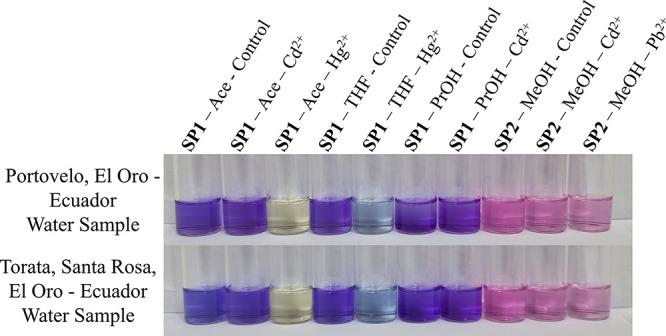
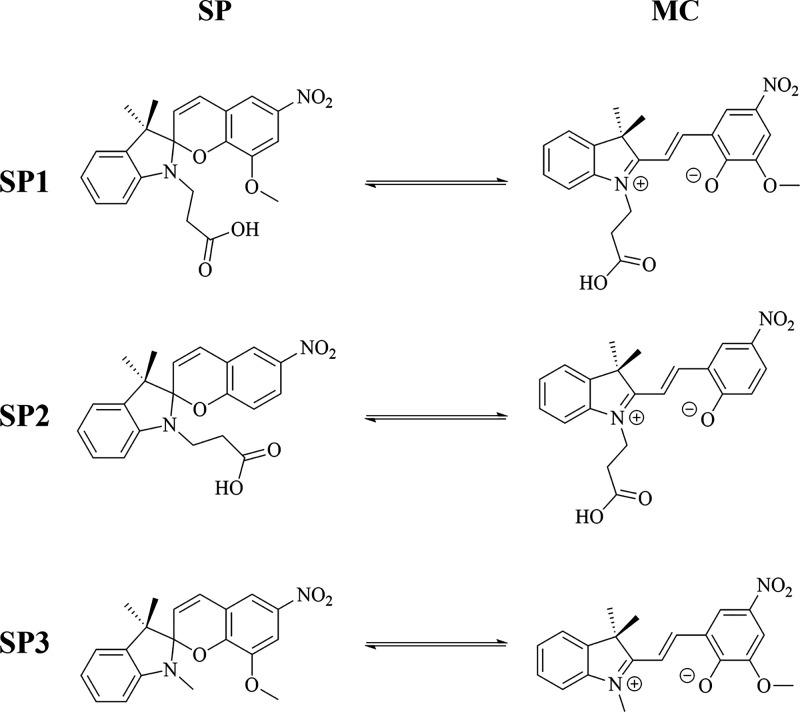
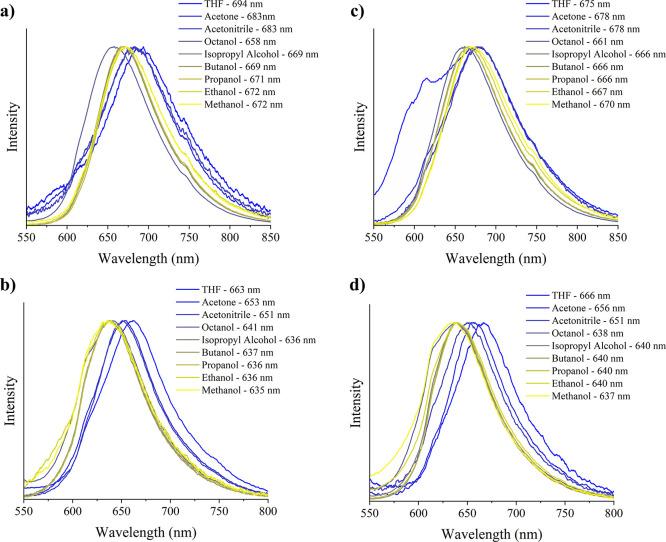
Three spiropyran derivatives (-) were studied as colorimetric sensors for Cd, Pb, and Hg ions in nine solvents of varying polarity and hydrogen-bonding character based on the E(30) scale. We used solvatochromic analysis and UV-visible titrations to characterize each spiropyran's baseline absorption in each solvent and its changes upon metal interaction. Solvatochromic measurements enabled us to separate intrinsic solvent-induced color shifts from metal-specific responses. The results revealed a strong solvent dependence for sensing. and yielded distinct metal-induced colorimetric responses, with the former showing its strongest Hg response in tetrahydrofuran and acetone and the latter detecting Pb and Cd in methanol, whereas was comparatively less sensitive overall. Notably, Hg elicited the most selective and sensitive colorimetric response (inducing a purple to yellow transition), Cd presented clear blue shifts (with a color change from purple to dark pink and pink to colorless), and Pb caused only minor spectral changes in one system. These findings highlight that solvent polarity can be utilized to modulate spiropyran-merocyanine equilibria and interaction affinities. Selectivity tests in real contaminated water samples confirmed that the probe retains high specificity for Hg even in the presence of common interfering ions. Overall, this study highlights the potential of solvent-tuned spiropyran probes for rapid, selective detection of toxic heavy metals (particularly Hg) in environmental monitoring applications.
基于E(30)标度,研究了三种螺吡喃衍生物(-)作为比色传感器用于检测九种不同极性和氢键性质溶剂中的镉、铅和汞离子。我们使用溶剂化显色分析和紫外-可见滴定法来表征每种螺吡喃在每种溶剂中的基线吸收及其与金属相互作用时的变化。溶剂化显色测量使我们能够将内在的溶剂诱导颜色变化与金属特异性响应区分开来。结果表明传感对溶剂有很强的依赖性。[此处可能有遗漏信息,原文提到两种物质有不同响应,这里未明确指出具体两种物质]产生了不同的金属诱导比色响应,前者在四氢呋喃和丙酮中对汞的响应最强,后者在甲醇中检测铅和镉,而[此处可能有遗漏信息,原文提到一种物质相对不敏感,这里未明确指出具体物质]总体上相对不太敏感。值得注意的是,汞引发了最具选择性和敏感性的比色响应(从紫色转变为黄色),镉呈现明显的蓝移(颜色从紫色变为深粉色,从粉色变为无色),而铅在一个体系中仅引起微小的光谱变化。这些发现突出表明,溶剂极性可用于调节螺吡喃-部花青平衡和相互作用亲和力。在实际污染水样中的选择性测试证实,即使存在常见干扰离子,[此处可能有遗漏信息,原文提到一种探针,这里未明确指出具体探针]对汞仍保持高特异性。总体而言,本研究突出了溶剂调谐螺吡喃探针在环境监测应用中快速、选择性检测有毒重金属(特别是汞)的潜力。


 Zotero 插件