
病例报告:一个由基因突变引起的波动性黄斑囊样水肿家族。
Case Report: A family of fluctuating cystoid macular edema caused by gene mutations.
作者信息
Duan Cong, Zong Yuan, Chen Qian, Liu Wei, Chang Qing, Xiong Cheng, Hu Zhu-Lin, Xu Ge-Zhi, Gao Feng-Juan
机构信息
Yunnan Eye Institute & Key Laboratory of Yunnan Province, Yunnan Eye Disease Clinical Medical Center, Affiliated Hospital of Yunnan University, Yunnan University, Yunnan, China.
Eye Institute and Department of Ophthalmology, Eye & ENT Hospital, Fudan University, Shanghai, China.
出版信息
Front Med (Lausanne). 2025 Aug 7;12:1582930. doi: 10.3389/fmed.2025.1582930. eCollection 2025.
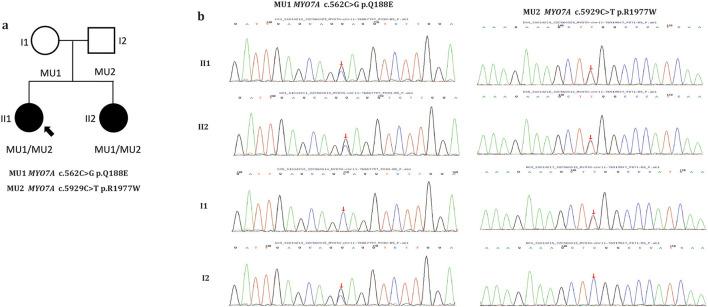
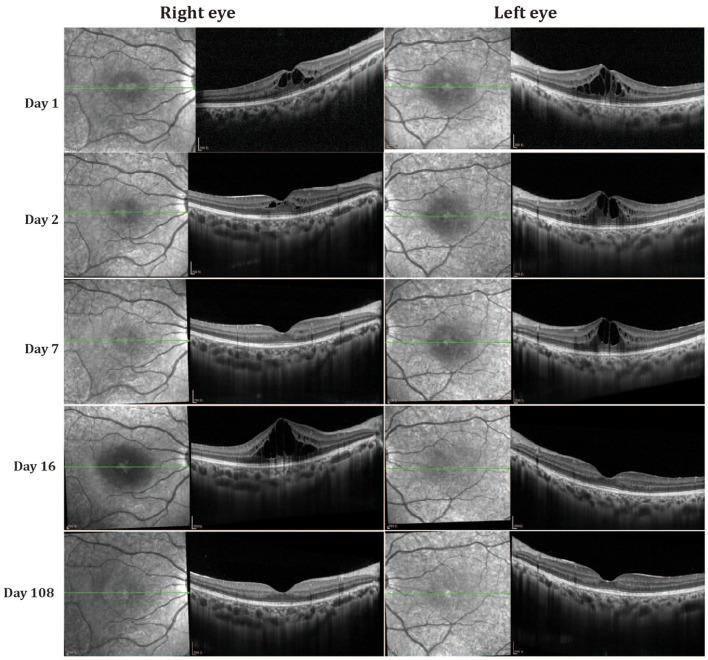
Cystoid macular edema (CME) is a common complication in various retinal disorders, often leading to significant central vision impairment. However, the underlying genetic causes and detailed clinical features in patients with fluctuating CME remain unclear. This retrospective, observational case series analyzed two patients from a single family with fluctuating CME, focusing on both clinical and genetic aspects. Data were collected and analyzed from September 2022 to January 2023 at a single center. Comprehensive ocular examinations, including best-corrected visual acuity tests, color fundus photography, fundus fluorescein angiography (FFA), optical coherence tomography (OCT), visual field tests, flash electroretinography, multifocal electroretinography, and electrooculography, were performed. Genetic analysis was conducted using whole exome sequencing, with confirmation through Sanger sequencing and co-segregation analysis. The results identified two compound heterozygous variants in the gene: c.562C>G p.Q188E and c.5929C>T p.R1977W in both patients. Fundus fluorescein angiography revealed cystoid hyperfluorescence in a petaloid pattern in the foveal area and a honeycomb pattern parafoveally. OCT showed that macular cystoid changes were primarily located in the outer nuclear layer (ONL), and full-field electroretinography indicated rod-cone dysfunction. Over a 108-day follow-up period, CME in both patients exhibited fluctuating changes without any treatment. This case series suggests that the identified MYO7A variants are likely associated with fluctuating CME, expanding the phenotypic spectrum of MYO7A and providing new insights into the mechanisms underlying CME. Identifying these MYO7A variants bridges genetic research with clinical diagnostics, potentially offering more precise and personalized treatment strategies for retinal disorders.
黄斑囊样水肿(CME)是各种视网膜疾病中的常见并发症,常导致严重的中心视力损害。然而,波动性CME患者的潜在遗传原因和详细临床特征仍不清楚。本回顾性观察性病例系列分析了来自一个家族的两名波动性CME患者,重点关注临床和遗传方面。2022年9月至2023年1月在单一中心收集并分析数据。进行了全面的眼部检查,包括最佳矫正视力测试、彩色眼底照相、眼底荧光血管造影(FFA)、光学相干断层扫描(OCT)、视野测试、闪光视网膜电图、多焦视网膜电图和眼电图。使用全外显子组测序进行基因分析,并通过桑格测序和共分离分析进行确认。结果在两名患者的 基因中鉴定出两个复合杂合变异:c.562C>G p.Q188E和c.5929C>T p.R1977W。眼底荧光血管造影显示黄斑区呈花瓣样囊样高荧光,黄斑旁呈蜂窝样。OCT显示黄斑囊样改变主要位于外核层(ONL),全视野视网膜电图显示视杆 - 视锥功能障碍。在108天的随访期内,两名患者的CME在未接受任何治疗的情况下均表现出波动变化。该病例系列表明,鉴定出的MYO7A变异可能与波动性CME相关,扩展了MYO7A的表型谱,并为CME的潜在机制提供了新见解。鉴定这些MYO7A变异将基因研究与临床诊断联系起来,可能为视网膜疾病提供更精确和个性化的治疗策略。

 Zotero 插件