
老年人抑郁症状与残疾的恶性循环。
The vicious cycle of depressive symptoms and disability in older adults.
作者信息
Sun Mengzhen, Sun Xiaoru, Zhang Hui, Jiang Xiaoyan, Wang Xiaofeng, Zhang Qi
机构信息
Human Phenome Institute and MOE Key Laboratory of Contemporary Anthropology, School of Life Science, Fudan University, Shanghai, China; Fudan University People's Hospital of Rugao Joint Research Institute of Longevity and Aging, Rugao, Jiangsu Province, China.
Institute for Medical Dataology, School of Public Health, Cheeloo College of Medicine, Shandong University, Jinan, China.
出版信息
J Nutr Health Aging. 2025 Aug 25;29(9):100649. doi: 10.1016/j.jnha.2025.100649.
BACKGROUND
Unidirectional researches have suggested a correlation between depressive symptoms and disability, but it remains uncertain whether this association is bidirectional.
METHODS
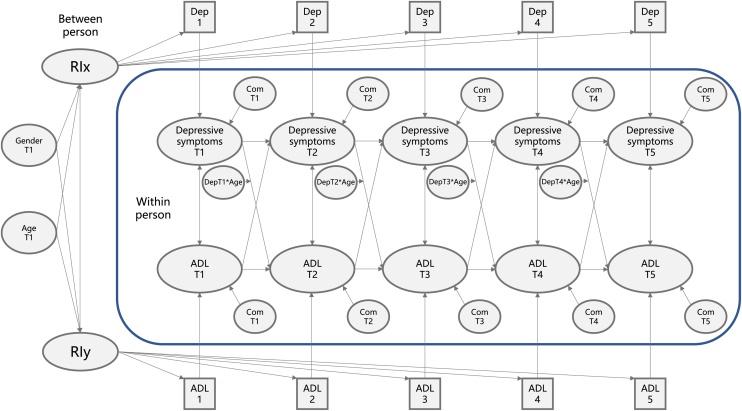
The study is based on the 1st-10 th waves of the NHATS (National Health and Aging Trends Study). The subset A and subset B included 3,459 and 3,801 samples, respectively. A random-intercept cross-lagged panel model was employed to explore the bidirectional dynamic relationship between depressive symptoms and physical function indicators, including BADL (basic ADL), IADL (instrumental ADL), and ADL (a combination of BADL and IADL).
RESULTS
An increase in depressive symptoms led to a decline in physical function at all levels, and vice versa. When older adults experienced poorer physical function than usual, their subsequent depressive symptoms were stronger (BADL, β = 0.082, p < 0.0001; IADL, β = 0.072, p < 0.001; ADL, β = 0.098, p < 0.0001). Conversely, an increase in earlier depressive symptoms resulted in a future decline in physical function (BADL, β = 0.042-0.057, p < 0.05; IADL, β = 0.048, p < 0.05; ADL, β = 0.061, p < 0.01).
CONCLUSIONS
This study is the first to reveal a mutually reinforcing spiral effect between increased depressive symptoms and declines in any level of physical function. These findings highlight the importance of prevention strategies guided by a unity of mental-physical approach, offering a new perspective for the coordinated management of mental and physical health, and providing scientific evidence for policymaking and resource allocation.
背景
单向研究表明抑郁症状与残疾之间存在关联,但这种关联是否双向仍不确定。
方法
本研究基于美国国家健康与老龄化趋势研究(NHATS)的第1至10轮数据。子集A和子集B分别包含3459个和3801个样本。采用随机截距交叉滞后面板模型来探究抑郁症状与身体功能指标之间的双向动态关系,身体功能指标包括基本日常生活活动能力(BADL)、工具性日常生活活动能力(IADL)以及BADL与IADL的组合(ADL)。
结果
抑郁症状的增加会导致各级身体功能下降,反之亦然。当老年人身体功能比平常更差时,其随后的抑郁症状会更强(BADL,β = 0.082,p < 0.0001;IADL,β = 0.072,p < 0.001;ADL,β = 0.098,p < 0.0001)。相反,早期抑郁症状的增加会导致未来身体功能下降(BADL,β = 0.042 - 0.057,p < 0.05;IADL,β = 0.048,p < 0.05;ADL,β = 0.061,p < 0.01)。
结论
本研究首次揭示了抑郁症状增加与任何水平身体功能下降之间相互强化的螺旋效应。这些发现凸显了身心统一方法指导下预防策略的重要性,为身心健康的协同管理提供了新视角,并为政策制定和资源分配提供了科学依据。


 Zotero 插件