
采用马尔可夫聚类算法对缺血性心脏病患者进行亚组划分。
Subgrouping patients with ischemic heart disease by means of the Markov cluster algorithm.
作者信息
Haue Amalie D, Holm Peter C, Banasik Karina, Aunstrup Kenny Emil, Johansen Christian Holm, Lundgaard Agnete T, Muse Victorine P, Röder Timo, Westergaard David, Chmura Piotr J, Christensen Alex H, Weeke Peter E, Sørensen Erik, Pedersen Ole B V, Ostrowski Sisse R, Iversen Kasper K, Køber Lars V, Ullum Henrik, Bundgaard Henning, Brunak Søren
机构信息
Novo Nordisk Foundation Center for Protein Research, Faculty of Health and Medical Sciences, University of Copenhagen, Copenhagen, Denmark.
Department of Cardiology, The Heart Center, Rigshospitalet, Copenhagen, Denmark.
出版信息
Commun Med (Lond). 2025 Aug 26;5(1):372. doi: 10.1038/s43856-025-01077-1.
BACKGROUND
Ischemic heart disease (IHD) is heterogeneous with respect to onset, burden of symptoms, and disease progression. We hypothesized that unsupervised clustering analysis could facilitate identification of distinct and clinically relevant multimorbidity clusters.
METHODS
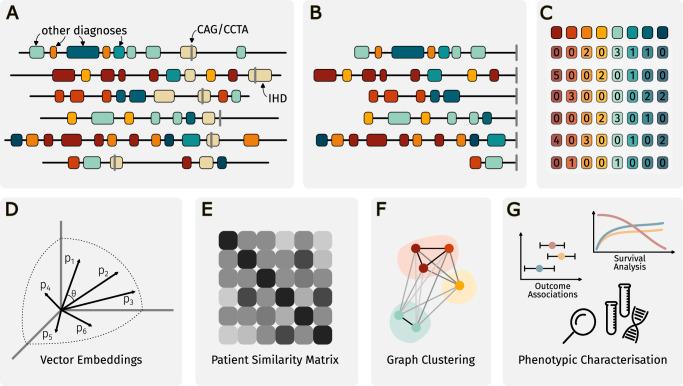
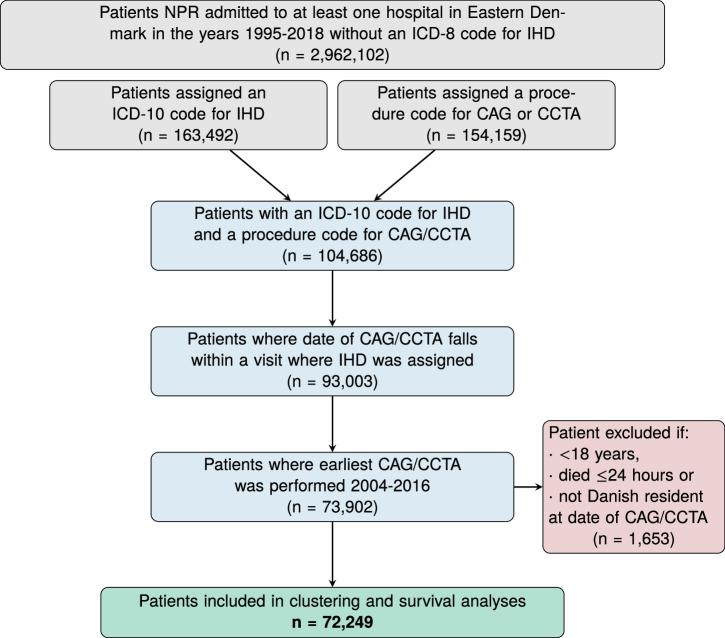
We included IHD patients who underwent coronary angiography (CAG) or coronary computed tomography angiography (CCTA) between 2004 and 2016 and used the earliest procedure as the index date. Patient health records were obtained from the Danish National Patient Registry, the Danish National Prescription Registry, and two in-hospital laboratory database systems. Genetic data were obtained from the Copenhagen Hospital Biobank. Using registered pre-index diagnosis codes (n = 3046), patients were clustered by application of the Markov Cluster algorithm. Multimorbidity clusters were then characterized using Cox regressions (new ischemic events, non-IHD mortality, and all-cause mortality) and enrichment analysis to explore both risks and phenotypical characteristics.
RESULTS
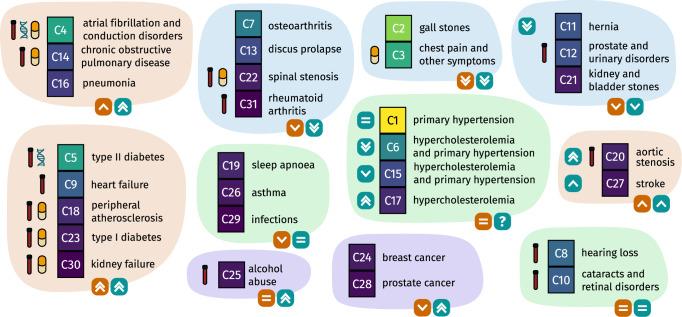
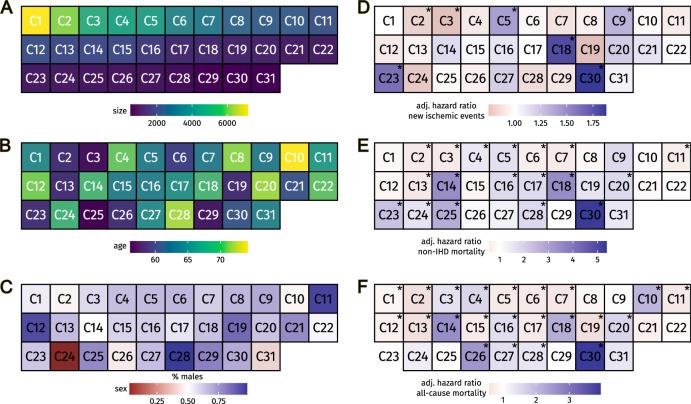
In a cohort of 72,249 patients with IHD (mean age 63.9 years, 63.1% males), 31 distinct clusters (C1-31, 67,136 patients) are identified. Comparing each cluster to the 30 others, seven clusters (9,590 patients) have significantly higher or lower risk of new ischemic events (five and two clusters, respectively). A total of 18 clusters (35,982 patients) have higher or lower risk of death from non-IHD causes (12 and six clusters, respectively), and 23 clusters have a statistically significant higher or lower risk for all-cause mortality. Cardiovascular or inflammatory diseases are commonly enriched in clusters (13). Distributions for 24 laboratory test results differ significantly across clusters. Polygenic risk scores are increased in a total of 15 clusters (48.4%).
CONCLUSIONS
Based on prior disease profiles, unsupervised clustering robustly stratify patients with IHD in subgroups with similar clinical features and outcomes.
背景
缺血性心脏病(IHD)在发病、症状负担和疾病进展方面具有异质性。我们假设无监督聚类分析有助于识别不同的且具有临床相关性的多病共存集群。
方法
我们纳入了2004年至2016年间接受冠状动脉造影(CAG)或冠状动脉计算机断层扫描血管造影(CCTA)的IHD患者,并将最早的检查作为索引日期。患者健康记录来自丹麦国家患者登记处、丹麦国家处方登记处以及两个院内实验室数据库系统。基因数据来自哥本哈根医院生物样本库。使用登记的索引前诊断代码(n = 3046),通过应用马尔可夫聚类算法对患者进行聚类。然后使用Cox回归(新发缺血事件、非IHD死亡率和全因死亡率)和富集分析对多病共存集群进行特征描述,以探索风险和表型特征。
结果
在一个包含72249例IHD患者(平均年龄63.9岁,63.1%为男性)的队列中,识别出31个不同的集群(C1 - 31,67136例患者)。将每个集群与其他30个集群进行比较,七个集群(9590例患者)发生新发缺血事件的风险显著更高或更低(分别为五个和两个集群)。共有18个集群(35982例患者)因非IHD原因死亡的风险更高或更低(分别为12个和六个集群),23个集群全因死亡率具有统计学显著更高或更低的风险。心血管或炎症性疾病在集群中通常富集(13个)。24项实验室检查结果的分布在各集群间存在显著差异。共有15个集群(48.4%)的多基因风险评分升高。
结论
基于既往疾病谱,无监督聚类可有力地将IHD患者分层为具有相似临床特征和结局的亚组。
 Zotero 插件