
饮食炎症潜能升高对肌少症肥胖的影响:两项观察性研究的证据。
The impact of elevated dietary inflammatory potential on sarcopenic obesity: evidence from two observational studies.
作者信息
Luo Xi, Jin Weiwei, Mao Shengcheng
机构信息
Department of Clinical Nutrition, Tongde Hospital of Zhejiang Province, Hangzhou, China.
Department of Endocrinology, Tongde Hospital of Zhejiang Province, Hangzhou, China.
出版信息
Front Nutr. 2025 Aug 11;12:1621199. doi: 10.3389/fnut.2025.1621199. eCollection 2025.
BACKGROUND AND OBJECTIVE
Chronic low-grade inflammation plays a critical role in the onset and progression of both sarcopenia and obesity. Diet, as a well-known modifiable factor of low-grade inflammation, significantly impacts adverse health conditions, including obesity and sarcopenia. This study aims to explore the association between dietary inflammatory potential and sarcopenic obesity (SO).
METHODS
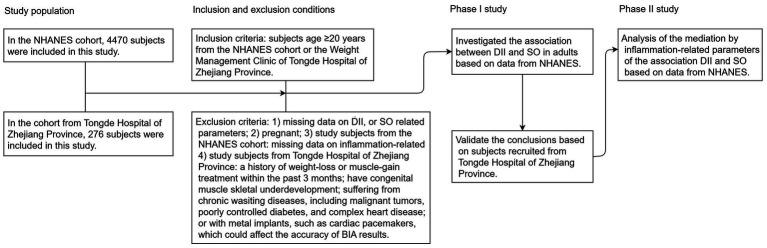
A total of 4,470 subjects from two National Health and Nutrition Examination Survey (NHANES) cycles (2015-2016 and 2017-2018) and 276 subjects enrolled at Tongde Hospital of Zhejiang Province between January 2024 and February 2025 were enrolled in the present study. Logistic regression was used to investigate the association between the dietary inflammatory index (DII) and SO. Moreover, the mediating effect of C-reactive protein-albumin-lymphocyte (CALLY) and neutrophil-percentage-to-albumin ratio (NPAR) was evaluated to investigate the association between DII and SO in the NHANES cohort.
RESULTS
In the NHANES cohort, logistic regression demonstrated a positive association between the DII score and SO (adjusted odds ratio (OR) = 1.19, 95% CI = 1.08, 1.32, = 0.012; adjusted OR = 1.93, 95% CI = 1.28, 2.92, for trend = 0.015). In the Chinese population cohort, a positive association also existed between DII and SO (adjusted OR = 1.59, 95% CI = 1.30, 1.94, < 0.001; adjusted OR = 6.10, 95% CI = 2.72, 13.68, for trend <0.001). Using the NHANES data, the mediation analysis indicated that CALLY mediated 39.49% of the association between DII and SO, while NPAR mediated 7.35%.
CONCLUSION
An elevated DII score is positively associated with the risk of SO in adults. The association appeared to be partially mediated through inflammatory/nutritional pathways, suggesting that the DII score may serve as a valuable indicator for the identification of individuals at risk of SO.
背景与目的
慢性低度炎症在肌肉减少症和肥胖症的发生及发展中起关键作用。饮食作为一种众所周知的可调节低度炎症的因素,会显著影响包括肥胖症和肌肉减少症在内的不良健康状况。本研究旨在探讨饮食炎症潜能与肌肉减少性肥胖(SO)之间的关联。
方法
本研究纳入了来自两个国家健康与营养检查调查(NHANES)周期(2015 - 2016年和2017 - 2018年)的4470名受试者,以及2024年1月至2025年2月在浙江省同德医院登记的276名受试者。采用逻辑回归分析来研究饮食炎症指数(DII)与SO之间的关联。此外,在NHANES队列中,评估了C反应蛋白 - 白蛋白 - 淋巴细胞(CALLY)和中性粒细胞百分比与白蛋白比值(NPAR)的中介作用,以研究DII与SO之间的关联。
结果
在NHANES队列中,逻辑回归显示DII评分与SO呈正相关(调整后的比值比(OR) = 1.19,95%置信区间(CI) = 1.08,1.32,P = = 0.012;调整后的OR = 1.93,95% CI = 1.28,2.92,趋势P = 0.015)。在中国人群队列中,DII与SO之间也存在正相关(调整后的OR = 1.59,95% CI = 1.30,1.94,P < 0.001;调整后的OR = 6.10,95% CI = 2.72,13.68,趋势P < 0.001)。使用NHANES数据进行的中介分析表明,CALLY介导了DII与SO之间关联的39.49%,而NPAR介导了7.35%。
结论
DII评分升高与成年人患SO的风险呈正相关。这种关联似乎部分通过炎症/营养途径介导,这表明DII评分可能是识别有SO风险个体的一个有价值的指标。



 Zotero 插件