
尼日利亚东南部阿比亚州父母对女性青少年人乳头瘤病毒疫苗的接受情况:一项实施前研究。
Parental acceptance of human papillomavirus vaccine for female adolescents in Abia State, southeastern Nigeria: a pre-implementation study.
作者信息
Amuzie Chidinma Ihuoma, Bassi Amos Paul, Fishman Eliza, Mekonnen Dessie, Rogers-Bloch Quail, Cappelier Kelli, LaMontagne Scott, Kalu Kalu Ulu, Izuka Michael, Sunday Sola Thomas
机构信息
John Snow Incorporated, Abuja, Nigeria.
Department of Community Medicine, Federal Medical Centre, Umuahia, Abia State, Nigeria.
出版信息
Pan Afr Med J. 2025 Jun 13;51:44. doi: 10.11604/pamj.2025.51.44.43317. eCollection 2025.
INTRODUCTION
cervical cancer is the second most common cancer amongst women in Nigeria, with an incidence rate of 26.2 per 100,000 and mortality rate of 14.3 per 1000 adult women. Vaccination is the primary prevention if initiated prior to Human Papillomavirus (HPV) infection. However, vaccine hesitancy remains a threat to the uptake of the HPV vaccine. This study identified the pattern and predictors of parental acceptance of HPV vaccines for their female adolescents in Abia State, Nigeria prior to state level introduction.
METHODS
we conducted a community-based cross-sectional study between August and September 2023 among parents of female adolescents residing in Abia State. A multistage sampling technique was used to select the study respondents. An interviewer-based, semi-structured questionnaire was administered to the respondents. Analysis was done using IBM SPSS version 26. Univariate analysis was used to present the socio-demographic characteristics of the respondents in frequencies and proportions. The association between parental acceptance and the independent variables was assessed using the chi-square test. Logistic regression was used to identify the independent predictors of parental acceptance of HPV vaccination. The level of significance was 5%.
RESULTS
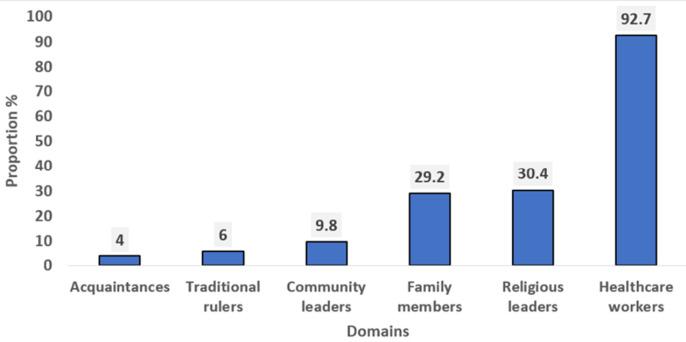
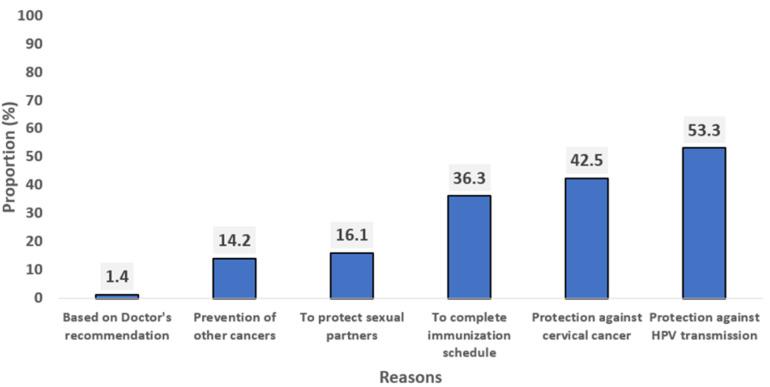
a total of 1,016 respondents participated in this survey, with a mean age of 42.2 ± 10.5 years. The prevalence of parental HPV vaccine acceptance was 63.0% (95% CI: 59.8 - 66.0). The major sources of information on the HPV vaccine were the healthcare workers (43.0%) and social media (37.8%). Among respondents who would accept the HPV vaccine for their female adolescents, the commonest reason was for the prevention of HPV transmission (58.3%). Most of the respondents who declined willingness reported lack of information (63.9%), followed by fear of adverse effects (32.9%) as the triggers for non-acceptance of the vaccine. The most preferable source of HPV vaccine recommendation mentioned by the respondents were healthcare workers (92.7%). Female (aOR=1.44, 95% CI: 1.02 - 2.03), good knowledge of HPV infection (aOR=2.87, 95% CI: 1.82 - 4.53) and good knowledge of HPV vaccine (aOR=18.52, 95% CI: 10.52 - 32.61) were the predictors of HPV vaccine acceptance.
CONCLUSION
prior to the introduction of HPV vaccine into the routine immunization of Abia State, Nigeria, most parents surveyed indicated that they would accept HPV vaccine for their female adolescents. Sex, knowledge of HPV infection and HPV vaccine were the independent predictors of parental acceptance of HPV vaccine. We recommend the raising of awareness campaign on HPV vaccine benefits and safety, prioritizing healthcare workers and the social media as the major channels of communication to support HPV vaccination.
引言
宫颈癌是尼日利亚女性中第二常见的癌症,发病率为每10万人26.2例,成年女性死亡率为每1000人14.3例。如果在人乳头瘤病毒(HPV)感染之前接种疫苗,疫苗接种是主要的预防措施。然而,疫苗犹豫仍然是HPV疫苗接种率的一个威胁。本研究确定了在尼日利亚阿比亚州引入HPV疫苗之前,父母对其青春期女性接种HPV疫苗的接受模式和预测因素。
方法
我们于2023年8月至9月在居住在阿比亚州的青春期女性的父母中进行了一项基于社区的横断面研究。采用多阶段抽样技术选择研究对象。向研究对象发放基于访谈的半结构化问卷。使用IBM SPSS 26版进行分析。单因素分析用于以频率和比例呈现研究对象的社会人口学特征。使用卡方检验评估父母接受程度与自变量之间的关联。使用逻辑回归确定父母接受HPV疫苗接种的独立预测因素。显著性水平为5%。
结果
共有1016名研究对象参与了本次调查,平均年龄为42.2±10.5岁。父母对HPV疫苗的接受率为63.0%(95%CI:59.8 - 66.0)。关于HPV疫苗的主要信息来源是医护人员(43.0%)和社交媒体(37.8%)。在愿意为其青春期女性接种HPV疫苗的研究对象中,最常见的原因是预防HPV传播(58.3%)。大多数拒绝接种意愿的研究对象报告称缺乏信息(63.9%),其次是担心不良反应(32.9%)是不接受疫苗的触发因素。研究对象提到的HPV疫苗推荐的最优选信息来源是医护人员(92.7%)。女性(调整后比值比[aOR]=1.44,95%CI:1.02 - 2.03)、对HPV感染的良好认知(aOR=2.87,95%CI:1.82 - 4.53)和对HPV疫苗的良好认知(aOR=18.52,95%CI:10.52 - 32.61)是HPV疫苗接受程度的预测因素。
结论
在尼日利亚阿比亚州将HPV疫苗引入常规免疫之前,大多数接受调查的父母表示他们愿意为其青春期女性接种HPV疫苗。性别、对HPV感染的认知和对HPV疫苗的认知是父母接受HPV疫苗的独立预测因素。我们建议开展提高对HPV疫苗益处和安全性认识的宣传活动,将医护人员和社交媒体作为支持HPV疫苗接种的主要沟通渠道加以优先考虑。


 Zotero 插件