
丁酸在哮喘中的免疫调节作用:机制与治疗潜力
Immunomodulatory roles of butyrate in asthma: mechanisms and therapeutic potentials.
作者信息
Liu Chao, Zeng Zhu, Chen Mei, Fan Yuwei, Huang Qingsong, Wu Jianying
机构信息
Department of Integrated Traditional Chinese and Western Clinical Medicine, School of Clinical Medicine, Chengdu University of Traditional Chinese Medicine, Chengdu, China.
Department of Respiratory Medicine, Hospital of Chengdu University of Traditional Chinese Medicine, Chengdu, China.
出版信息
Front Immunol. 2025 Aug 11;16:1639606. doi: 10.3389/fimmu.2025.1639606. eCollection 2025.
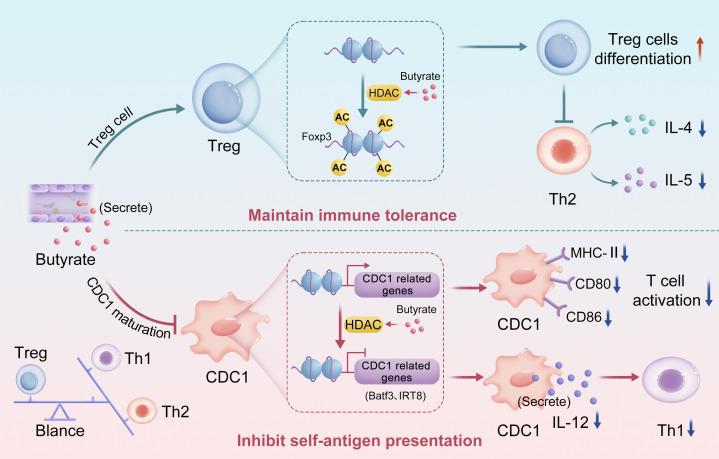
Asthma, a chronic airway inflammatory disease driven by complex immune dysregulation, still remains a global health challenge despite its advances in biologic therapies. Butyrate, a major short-chain fatty acids (SCFAs) produced by intestinal microorganisms in the fermentation of dietary fiber, has recently garnered considerable attention for its multifaceted roles in maintaining immune homeostasis and modulating airway inflammation. This review summarizes the molecular mechanisms and recent advances by which butyrate alleviates asthmatic inflammation, including suppression of excessive activation of type 2 innate lymphoid cells (ILC2s) and T helper 2 (Th2) cells, inhibition of mast cells (MCs) degranulation, epigenetic modulation, regulation of receptor-mediated signaling pathways, and interactions along the gut-lung axis. We integrate current knowledge of butyrate's multidimensional immunoregulatory network in asthma and propose a dual approach-via microbiota-based interventions and targeted modulation of the immune microenvironment-to potentially overcome the limitations of conventional corticosteroid therapies. Despite its promising prospects, its clinical translation still faces many challenges, especially in airway specific delivery, improved bioavailability, and long-term safety. Innovative strategies, including nano-carrier engineering and targeted probiotic preparations are expected to improve their bioavailability and tissue specificity. Future research should focus on clarifying the dose-response relationship, long-term safety, and establishing individualized treatment stratification based on patients' microbiota-metabolic characteristics.
哮喘是一种由复杂的免疫失调驱动的慢性气道炎症性疾病,尽管其在生物治疗方面取得了进展,但仍然是一项全球性的健康挑战。丁酸盐是肠道微生物在膳食纤维发酵过程中产生的一种主要短链脂肪酸(SCFAs),最近因其在维持免疫稳态和调节气道炎症方面的多方面作用而备受关注。这篇综述总结了丁酸盐减轻哮喘炎症的分子机制和最新进展,包括抑制2型固有淋巴细胞(ILC2s)和辅助性T细胞2(Th2)细胞的过度活化、抑制肥大细胞(MCs)脱颗粒、表观遗传调控、受体介导信号通路的调节以及肠道-肺轴上的相互作用。我们整合了目前关于丁酸盐在哮喘中的多维免疫调节网络的知识,并提出了一种双重方法——通过基于微生物群的干预和对免疫微环境的靶向调节——以潜在地克服传统皮质类固醇疗法的局限性。尽管其前景广阔,但其临床转化仍面临许多挑战,尤其是在气道特异性递送、提高生物利用度和长期安全性方面。包括纳米载体工程和靶向益生菌制剂在内的创新策略有望提高其生物利用度和组织特异性。未来的研究应集中在阐明剂量反应关系、长期安全性以及基于患者微生物群代谢特征建立个体化治疗分层。
 Zotero 插件