
铜锌比值作为2型糖尿病患者慢性肾脏病发病的预测指标:朝日糖尿病并发症研究
Copper/Zinc Ratio as a Predictor of Chronic Kidney Disease Incidence in Type 2 Diabetes: The Asahi Diabetes Complications Study.
作者信息
Takao Toshiko, Yanagisawa Hiroyuki, Suka Machi, Yoshida Yoko, Noda Mitsuhiko, Kasuga Masato
机构信息
JR East Health Promotion Center, East Japan Railway Company, Tokyo, JPN.
Division of Diabetes and Metabolism, The Institute of Medical Science, Asahi Life Foundation, Tokyo, JPN.
出版信息
Cureus. 2025 Jul 23;17(7):e88573. doi: 10.7759/cureus.88573. eCollection 2025 Jul.
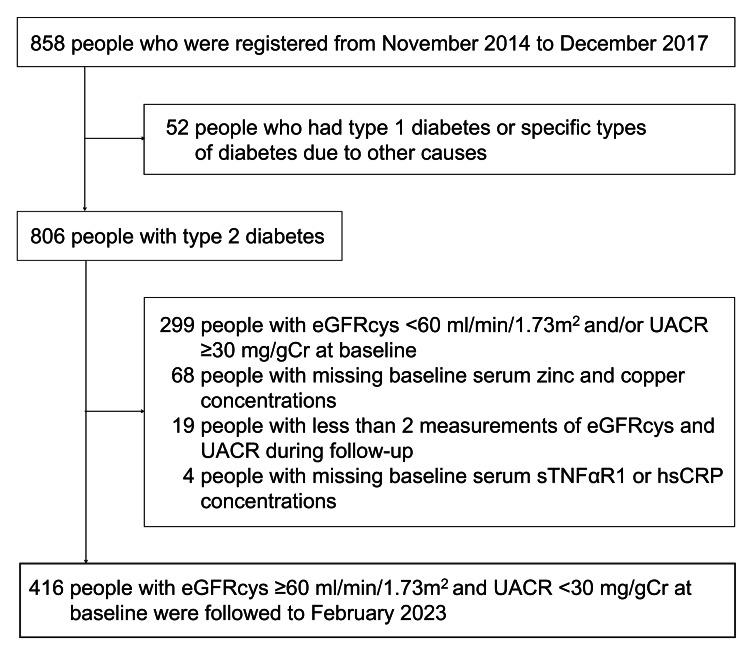
Aim This study aims to evaluate the associations between the copper/zinc (Cu/Zn) ratio and inflammatory biomarkers and the incidence of chronic kidney disease (CKD) in individuals with type 2 diabetes and to validate our previous cross-sectional study using the baseline data of this study. Methods We conducted a prospective, observational study of 416 individuals with type 2 diabetes without CKD. We used multivariable Cox proportional hazard models to determine the HRs for CKD incidence. The Cu/Zn ratio and soluble tumor necrosis factor-α receptor 1 (sTNFαR1) concentrations (pg/mL) were analyzed as continuous variables and as categories classified according to each cutoff value for detecting CKD. The high-sensitivity C-reactive protein (hsCRP) concentrations between these categories were compared. Results CKD was identified in 165 participants. The Cu/Zn ratio and sTNFαR1 concentrations were identified as significant predictors, independent of each other, after full adjustment (P = 0.048 and P = 0.006, respectively). Compared to the Cu/Zn <1.281 and sTNFαR1 <1081 group, the HRs for the CKD incidence were significantly higher in the Cu/Zn <1.281 and sTNFαR1 ≥1081 group (HR 2.06, 95% CI 1.34-3.26) and even higher in the Cu/Zn ≥1.281 and sTNFαR1 ≥1081 group (3.29, 1.97-5.50) after full adjustment. The hsCRP concentrations were significantly highest in the Cu/Zn ≥1.281 and sTNFαR1 ≥1081 group compared with the other three groups (all P < 0.05) and were significantly higher in the Cu/Zn ≥1.281 and sTNFαR1 <1081 group and in the Cu/Zn <1.281 and sTNFαR1 ≥1081 group compared with those in the Cu/Zn <1.281 and sTNFαR1 <1081 group (both P < 0.05). Conclusions The Cu/Zn ratio and sTNFαR1 concentrations are independent predictors of the incidence of CKD in individuals with type 2 diabetes. Furthermore, under elevated sTNFαR1 concentrations, an increase in the Cu/Zn ratio may further aggravate inflammation and accelerate the incidence of CKD in individuals with type 2 diabetes. These new findings are supported by the results from our previous cross-sectional study.
目的 本研究旨在评估2型糖尿病患者铜/锌(Cu/Zn)比值与炎症生物标志物及慢性肾脏病(CKD)发病率之间的关联,并利用本研究的基线数据验证我们之前的横断面研究。方法 我们对416例无CKD的2型糖尿病患者进行了一项前瞻性观察性研究。我们使用多变量Cox比例风险模型来确定CKD发病率的风险比(HRs)。将Cu/Zn比值和可溶性肿瘤坏死因子-α受体1(sTNFαR1)浓度(pg/mL)作为连续变量,并根据检测CKD的每个临界值分类进行分析。比较这些类别之间的高敏C反应蛋白(hsCRP)浓度。结果 在165名参与者中发现了CKD。在完全调整后,Cu/Zn比值和sTNFαR1浓度被确定为相互独立的显著预测因素(分别为P = 0.048和P = 0.006)。与Cu/Zn <1.281且sTNFαR1 <1081组相比,Cu/Zn <1.281且sTNFαR1≥1081组的CKD发病率HRs显著更高(HR 2.06,95%可信区间1.34 - 3.26),在完全调整后,Cu/Zn≥1.281且sTNFαR1≥1081组甚至更高(3.29,1.97 - 5.50)。与其他三组相比,Cu/Zn≥1.281且sTNFαR1≥1081组的hsCRP浓度显著最高(所有P < 0.05),与Cu/Zn <1.281且sTNFαR1 <1081组相比,Cu/Zn≥1.281且sTNFαR1 <1081组以及Cu/Zn <1.281且sTNFαR1≥1081组的hsCRP浓度也显著更高(均P < 0.05)。结论 Cu/Zn比值和sTNFαR1浓度是2型糖尿病患者CKD发病率的独立预测因素。此外,在sTNFαR1浓度升高的情况下,Cu/Zn比值的增加可能会进一步加重炎症并加速2型糖尿病患者CKD的发病。这些新发现得到了我们之前横断面研究结果的支持。


 Zotero 插件