
红细胞中的氧化还原稳态:从分子机制到抗氧化策略
Redox Homeostasis in Red Blood Cells: From Molecular Mechanisms to Antioxidant Strategies.
作者信息
Spinelli Sara, Marino Angela, Remigante Alessia, Morabito Rossana
机构信息
Department of Chemical, Biological, Pharmaceutical and Environmental Sciences, University of Messina, 98125 Messina, Italy.
Department of Biomedical, Dental and Morphological and Functional Imaging, University of Messina, 98125 Messina, Italy.
出版信息
Curr Issues Mol Biol. 2025 Aug 14;47(8):655. doi: 10.3390/cimb47080655.
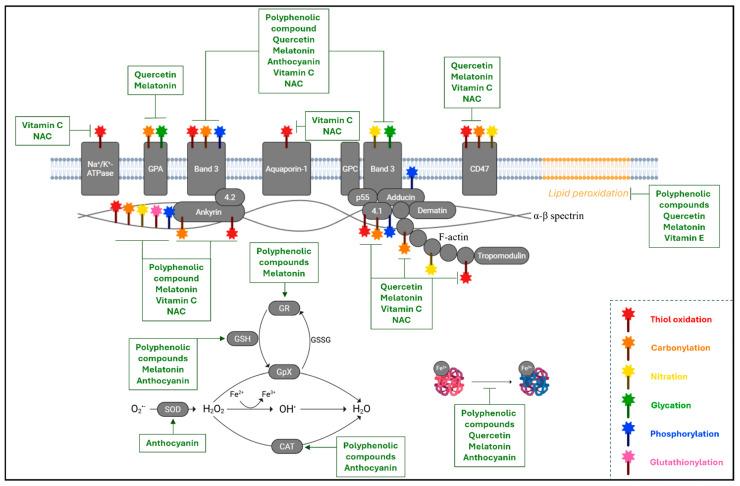
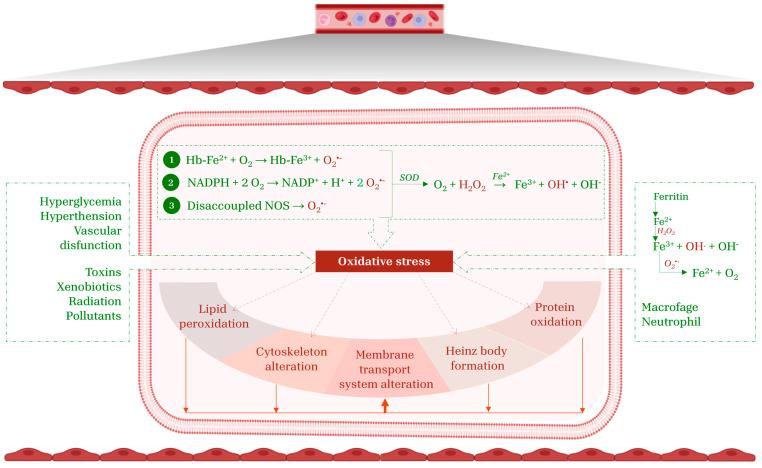
Red blood cells (RBCs) are uniquely vulnerable to oxidative stress due to their role in O transport and their high content of heme iron and polyunsaturated fatty acids (PUFAs). Despite lacking nuclei and organelles, RBC homeostasis relies on a finely tuned redox system to preserve membrane integrity, cytoskeletal organization, and metabolic function. Impairment of this delicate balance results in a series of oxidative events that ultimately leads to the premature clearance of RBCs from the bloodstream. This review outlines the main oxidative mechanisms that affect RBC at different levels, such as membrane, cytoskeleton, and intracellular environment, with a focus on the molecular targets of reactive species. The role of major antioxidant systems in preventing or reversing redox damage will also be examined, revealing their multiple mechanisms of action ranging from direct ROS scavenging to the enhancement of endogenous antioxidant defense pathways. Redox regulatory mechanisms in RBCs are required to maintain membrane integrity, cytoskeletal organization, and metabolic function. Disruption of these processes causes several oxidative processes that trigger premature RBC removal. Cumulative evidence places oxidative stress at the core of RBC dysfunction in both physiological aging and pathological conditions, including diabetes, inflammatory conditions, and hemolytic disorders. Antioxidant-based strategies, rather than providing generalized protection, should aim to selectively target the specific molecular pathways affected in distinct clinical settings.
红细胞(RBCs)因其在氧气运输中的作用以及高含量的血红素铁和多不饱和脂肪酸(PUFAs),而特别容易受到氧化应激的影响。尽管红细胞缺乏细胞核和细胞器,但其内环境稳定依赖于一个精细调节的氧化还原系统来维持膜的完整性、细胞骨架组织和代谢功能。这种微妙平衡的破坏会引发一系列氧化事件,最终导致红细胞从血液中过早清除。本综述概述了在不同水平上影响红细胞的主要氧化机制,如膜、细胞骨架和细胞内环境,并重点关注活性物质的分子靶点。还将研究主要抗氧化系统在预防或逆转氧化还原损伤中的作用,揭示其从直接清除活性氧到增强内源性抗氧化防御途径的多种作用机制。红细胞中的氧化还原调节机制对于维持膜的完整性、细胞骨架组织和代谢功能是必需的。这些过程的破坏会引发多种氧化过程,导致红细胞过早清除。越来越多的证据表明,在生理衰老以及包括糖尿病、炎症性疾病和溶血性疾病在内的病理状况下,氧化应激是红细胞功能障碍的核心。基于抗氧化剂的策略不应提供普遍的保护,而应旨在选择性地针对不同临床环境中受影响的特定分子途径。


 Zotero 插件