
代谢途径中的基因变异及其在心脏代谢风险中的作用:一项对4000多名个体的观察性研究。
Genetic Variants in Metabolic Pathways and Their Role in Cardiometabolic Risk: An Observational Study of >4000 Individuals.
作者信息
Kapellou Angeliki, Fotis Thanasis, Vrachnos Dimitrios Miltiadis, Salata Effie, Ntoumou Eleni, Papailia Sevastiani, Vittas Spiros
机构信息
iDNA Laboratories, 7 Kavalieratou Taki, 14564 Kifisia, Greece.
出版信息
Biomedicines. 2025 Jul 22;13(8):1791. doi: 10.3390/biomedicines13081791.
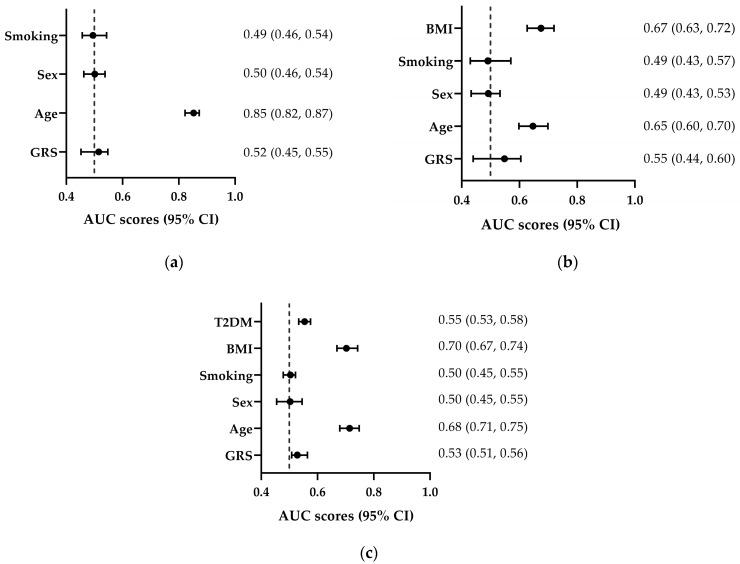
Obesity, a major risk factor for cardiometabolic traits, is influenced by both genetic and environmental factors. Genetic studies have identified multiple single-nucleotide polymorphisms (SNPs) associated with obesity and related traits. This study aimed to examine the association between genetic risk score (GRS) and obesity-associated traits, while incorporating SNPs with established gene-diet interactions to explore their potential role in precision nutrition (PN) strategies. : A total of 4279 participants were stratified into low- and intermediate-/high-GRS groups based on 18 SNPs linked to obesity and cardiometabolic traits. This study followed a case-control design, where cases included individuals with overweight/obesity, T2DM-positive (+), or CVD-positive (+) individuals and controls, which comprised individuals free of these traits. Logistic regression area under the curve (AUC) models were used to assess the predictive power of the GRS and traditional risk factors on BMI, T2DM and CVD. : Individuals in the intermediate-/high-GRS group had higher odds of being overweight or obese (OR = 1.23, CI: 1.03-1.48, = 0.02), presenting as T2DM+ (OR = 1.56, CI: 1.03-2.49, = 0.03) and exhibiting CVD-related traits (OR = 1.56, CI: 1.25-1.95, < 0.0001), compared to the low-GRS group. The GRS was the second most predictive factor after age for BMI (AUC = 0.515; 95% CI: 0.462-0.538). The GRS also demonstrated a predictive power of 0.528 (95% CI: 0.508-0.564) for CVD and 0.548 (95% CI: 0.440-0.605) for T2DM. : This study supports the potential utility of the GRS in assessing obesity and cardiometabolic risk, while emphasizing the potential of PN approaches in modulating genetic susceptibility. Incorporating gene-diet interactions provides actionable insights for personalized dietary strategies. Future research should integrate multiple gene-diet and gene-gene interactions to enhance risk prediction and targeted interventions.
肥胖是心脏代谢特征的主要风险因素,受到遗传和环境因素的双重影响。基因研究已经确定了多个与肥胖及相关特征相关的单核苷酸多态性(SNP)。本研究旨在检验遗传风险评分(GRS)与肥胖相关特征之间的关联,同时纳入已确定存在基因-饮食相互作用的SNP,以探索它们在精准营养(PN)策略中的潜在作用。:根据与肥胖和心脏代谢特征相关的18个SNP,将总共4279名参与者分为低GRS组和中/高GRS组。本研究采用病例对照设计,病例包括超重/肥胖个体、2型糖尿病阳性(+)个体或心血管疾病阳性(+)个体,对照组则为无这些特征的个体。使用逻辑回归曲线下面积(AUC)模型来评估GRS和传统风险因素对体重指数(BMI)、2型糖尿病和心血管疾病的预测能力。:与低GRS组相比,中/高GRS组个体超重或肥胖的几率更高(比值比[OR]=1.23,置信区间[CI]:1.03-1.48,P=0.02),表现为2型糖尿病阳性(OR=1.56,CI:1.03-2.49,P=0.03)以及表现出与心血管疾病相关的特征(OR=1.56,CI:1.25-1.95,P<0.0001)。对于BMI,GRS是仅次于年龄的第二大预测因素(AUC=0.515;95%CI:0.462-0.538)。GRS对心血管疾病的预测能力为0.528(95%CI:0.508-0.564),对2型糖尿病的预测能力为0.548(95%CI:0.440-0.605)。:本研究支持GRS在评估肥胖和心脏代谢风险方面的潜在效用,同时强调了PN方法在调节遗传易感性方面的潜力。纳入基因-饮食相互作用为个性化饮食策略提供了可操作的见解。未来的研究应整合多种基因-饮食和基因-基因相互作用,以加强风险预测和靶向干预。


 Zotero 插件