
用于研究神经疾病及其与睡眠关系的动物模型
Animal Models for the Study of Neurological Diseases and Their Link to Sleep.
作者信息
Rubio Carmen, González-Sánchez Emiliano, Lee Ángel, Ponce-Juárez Alexis, Serrano-García Norma, Rubio-Osornio Moisés
机构信息
Neurophysiology Department, National Institute of Neurology and Neurosurgery "Manuel Velasco Suárez", Mexico City 14269, Mexico.
Medicine School, Autonomous University of Chiapas, Tapachula Campus, Tapachula 30700, Mexico.
出版信息
Biomedicines. 2025 Aug 18;13(8):2005. doi: 10.3390/biomedicines13082005.
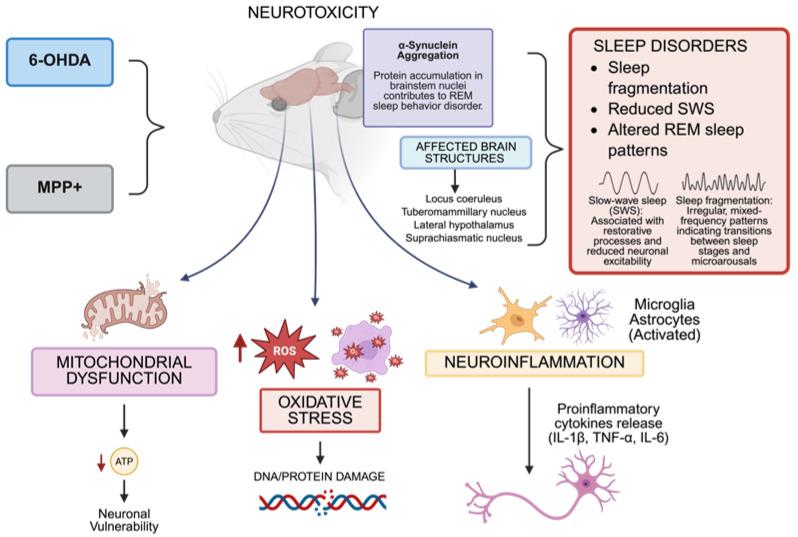
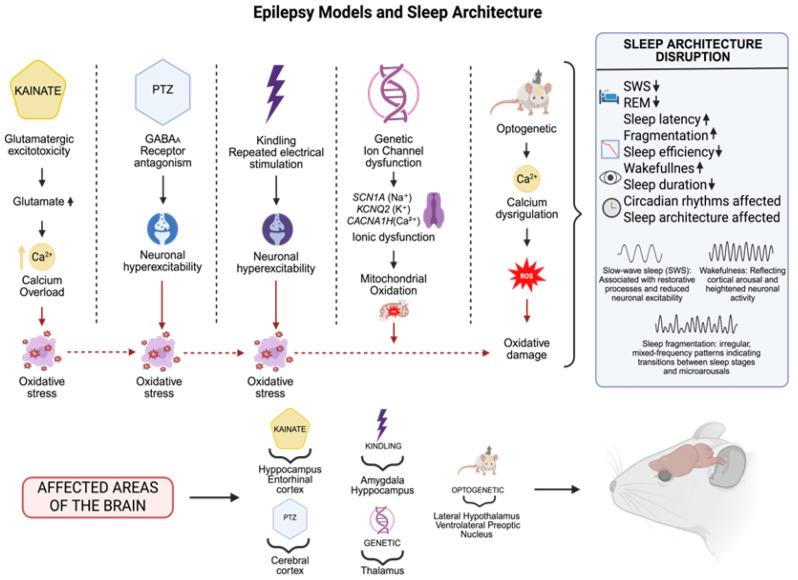
Sleep is a vital biological function governed by neuronal networks in the brainstem, hypothalamus, and thalamus. Disruptions in these circuits contribute to the sleep disturbances observed in neurodegenerative disorders, including Parkinson's disease, epilepsy, Huntington's disease, and Alzheimer's disease. Oxidative stress, mitochondrial dysfunction, neuroinflammation, and abnormal protein accumulation adversely affect sleep architecture in these conditions. The interaction among these pathological processes is believed to modify sleep-regulating circuits, consequently worsening clinical symptoms. This review examines the cellular and molecular mechanisms that impair sleep regulation in experimental models of these four disorders, emphasizing how oxidative stress, neuroinflammation and synaptic dysfunction contribute to sleep fragmentation and alterations in rapid eye movement (REM) sleep and slow-wave sleep (SWS) phases. In Parkinson's disease models (6-OHDA and MPTP), dopaminergic degeneration and damage to sleep-regulating nuclei result in daytime somnolence and disrupted sleep patterns. Epilepsy models (kainate, pentylenetetrazole, and kindling) provoke hyperexcitability and oxidative damage, compromising both REM and SWS. Huntington's disease models (R6/2 and 3-NP) demonstrate reduced sleep duration, circadian irregularities, and oxidative damage in the hypothalamus and suprachiasmatic nucleus. In Alzheimer's disease (AD) models (APP/PS1, 3xTg-AD, and Tg2576), early sleep problems include diminished SWS and REM sleep, increased awakenings, and circadian rhythm disruption. These changes correlate with β-amyloid and tau deposition, glial activation, chronic inflammation, and mitochondrial damage in the hypothalamus, hippocampus, and prefrontal cortex. Sleep disturbances across these neurodegenerative disease models share common underlying mechanisms like oxidative stress, neuroinflammation, and mitochondrial dysfunction. Understanding these pathways may reveal therapeutic targets to improve both motor symptoms and sleep quality in neurodegenerative disorders.
睡眠是一种至关重要的生物功能,受脑干、下丘脑和丘脑的神经网络调控。这些神经回路的紊乱会导致在神经退行性疾病中观察到的睡眠障碍,包括帕金森病、癫痫、亨廷顿舞蹈症和阿尔茨海默病。氧化应激、线粒体功能障碍、神经炎症和异常蛋白质积累在这些情况下会对睡眠结构产生不利影响。据信,这些病理过程之间的相互作用会改变睡眠调节回路,从而使临床症状恶化。本综述探讨了在这四种疾病的实验模型中损害睡眠调节的细胞和分子机制,重点强调氧化应激、神经炎症和突触功能障碍如何导致睡眠片段化以及快速眼动(REM)睡眠和慢波睡眠(SWS)阶段的改变。在帕金森病模型(6-OHDA和MPTP)中,多巴胺能神经元变性和对睡眠调节核团的损伤导致白天嗜睡和睡眠模式紊乱。癫痫模型(海人酸、戊四氮和点燃)引发过度兴奋和氧化损伤,损害REM睡眠和SWS睡眠。亨廷顿舞蹈症模型(R6/2和3-NP)表现出睡眠时间缩短、昼夜节律紊乱以及下丘脑和视交叉上核的氧化损伤。在阿尔茨海默病(AD)模型(APP/PS1、3xTg-AD和Tg2576)中,早期睡眠问题包括SWS睡眠和REM睡眠减少、觉醒增加以及昼夜节律紊乱。这些变化与下丘脑、海马体和前额叶皮质中的β-淀粉样蛋白和tau蛋白沉积、胶质细胞激活、慢性炎症以及线粒体损伤相关。这些神经退行性疾病模型中的睡眠障碍具有共同的潜在机制,如氧化应激、神经炎症和线粒体功能障碍。了解这些途径可能会揭示改善神经退行性疾病运动症状和睡眠质量的治疗靶点。


 Zotero 插件