
腺样体肥大患儿携带的分子与耐药特征
Molecular and Drug Resistance Characteristics of Carried by Pediatric Patients with Adenoid Hypertrophy.
作者信息
Xiao Nan, Qin Jia-Hao, Zhao Xiu-Ying, Liu Lin
机构信息
Department of Laboratory Medicine, Beijing Tsinghua Changgung Hospital, School of Clinical Medicine, Tsinghua University, Beijing 102218, China.
Dalian University Collage of Medicine, Dalian 116622, China.
出版信息
Microorganisms. 2025 Jul 29;13(8):1764. doi: 10.3390/microorganisms13081764.
PURPOSE
The adenoid microbiota plays a key role in adenoid hypertrophy (AH). This study explored the molecular epidemiology and antimicrobial resistance of () strains in pediatric AH patients.
METHODS
Retrospective analysis of pediatric AH patients undergoing endoscopic adenoidectomy. Adenoid tissue samples were cultured to screen for pathogens. strains were identified by 16S rRNA sequencing and serotyped via q-PCR. Multilocus sequence typing (MLST) and ftsI gene analysis were conducted using PubMLST. β-lactamase genes (, ) were detected by PCR, and antibiotic susceptibility testing (AST) was performed using the Etest method. For imipenem-resistant strains, the acrRAB efflux pump gene cluster and ompP2 porin gene were sequenced and compared with those of the wild-type strain Rd KW20.
RESULTS
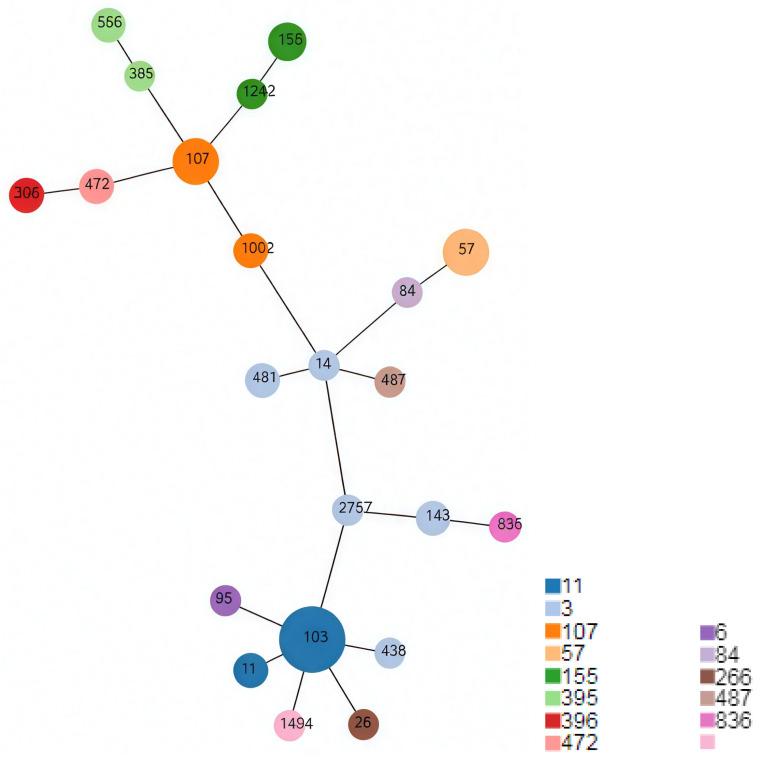
Over 8 months, 56 non-duplicate strains were isolated from 386 patients. The detection rate was highest in children under 5 years (30.5%) compared to those aged 5-10 years (13.4%) and 10-15 years (8.7%). Of 49 sub-cultured strains, all were non-typeable (NTHi). MLST identified 22 sequence types (STs) and 13 clonal complexes (CCs), with CC11 (26.5%), CC3 (14.3%), and CC107 (14.3%) being predominant. Common STs included ST103 (22.4%), ST57 (10.2%), and ST107 (10.2%). Most strains belonged to the ftsI group III-like+ (57.1%). β-lactamase positivity was 98.0% (48/49), with (95.9%) and (18.4%) detected. AST showed low susceptibility to ampicillin (10.2%), amoxicillin-clavulanate (34.7%), azithromycin (12.2%), and trimethoprim-sulfamethoxazole (14.3%). Among the β-lactamase-positive strains, 44/48 were β-lactamase-positive ampicillin-resistant (BLPAR); none were β-lactamase-negative ampicillin-resistant (BLNAR). Imipenem susceptibility was 91.8% (45/49). No carbapenemases were found in the imipenem-resistant strains, but mutations in acrRAB (88.12-94.94% identity) and ompP2 (77.10-82.94% identity) were observed.
CONCLUSIONS
BLPAR NTHi strains of CC11 are major epidemic strains in pediatric AH. Imipenem resistance in likely results from porin mutations rather than carbapenemase activity. Enhanced surveillance of 's role in AH and its resistance patterns is warranted.
目的
腺样体微生物群在腺样体肥大(AH)中起关键作用。本研究探讨了小儿AH患者中()菌株的分子流行病学和抗菌药物耐药性。
方法
对接受内镜下腺样体切除术的小儿AH患者进行回顾性分析。培养腺样体组织样本以筛选病原体。通过16S rRNA测序鉴定菌株,并通过q-PCR进行血清分型。使用PubMLST进行多位点序列分型(MLST)和ftsI基因分析。通过PCR检测β-内酰胺酶基因(,),并使用Etest方法进行药敏试验(AST)。对于耐亚胺培南菌株,对acrRAB外排泵基因簇和ompP2孔蛋白基因进行测序,并与野生型菌株Rd KW20进行比较。
结果
在8个月的时间里,从386例患者中分离出56株非重复菌株。5岁以下儿童的检出率最高(30.5%),而5-10岁儿童(13.4%)和10-15岁儿童(8.7%)的检出率较低。在49株传代培养菌株中,所有菌株均为不可分型(NTHi)。MLST鉴定出22种序列类型(STs)和13种克隆复合体(CCs),其中CC11(26.5%)、CC3(14.3%)和CC107(14.3%)占主导地位。常见的STs包括ST103(22.4%)、ST57(10.2%)和ST107(10.2%)。大多数菌株属于ftsI III型样+(57.1%)。β-内酰胺酶阳性率为98.0%(48/49),检测到(95.9%)和(18.4%)。AST显示对氨苄西林(10.2%)、阿莫西林-克拉维酸(34.7%)、阿奇霉素(12.2%)和甲氧苄啶-磺胺甲恶唑(14.3%)的敏感性较低。在β-内酰胺酶阳性菌株中,44/48为β-内酰胺酶阳性氨苄西林耐药(BLPAR);无一为β-内酰胺酶阴性氨苄西林耐药(BLNAR)。亚胺培南敏感性为91.8%(45/49)。在耐亚胺培南菌株中未发现碳青霉烯酶,但观察到acrRAB(同一性88.12-94.94%)和ompP2(同一性77.10-82.94%)的突变。
结论
CC11的BLPAR NTHi菌株是小儿AH的主要流行菌株。耐亚胺培南可能是由于孔蛋白突变而非碳青霉烯酶活性所致。有必要加强对在AH中的作用及其耐药模式的监测。

 Zotero 插件