
一种为半坐姿工作支撑设计的被动式下肢外骨骼对行走的生物力学影响
Biomechanical Effects of a Passive Lower-Limb Exoskeleton Designed for Half-Sitting Work Support on Walking.
作者信息
Li Qian, Haraguchi Naoto, Yoshimura Bian, Wang Sentong, Yoshida Makoto, Hase Kazunori
机构信息
Department of Mechanical Systems Engineering, Tokyo Metropolitan University, Tokyo 191-0065, Japan.
Department of Assistive Technology, Research Institute of National Rehabilitation Center for Persons with Disabilities, Tokorozawa 359-8555, Japan.
出版信息
Sensors (Basel). 2025 Aug 12;25(16):4999. doi: 10.3390/s25164999.
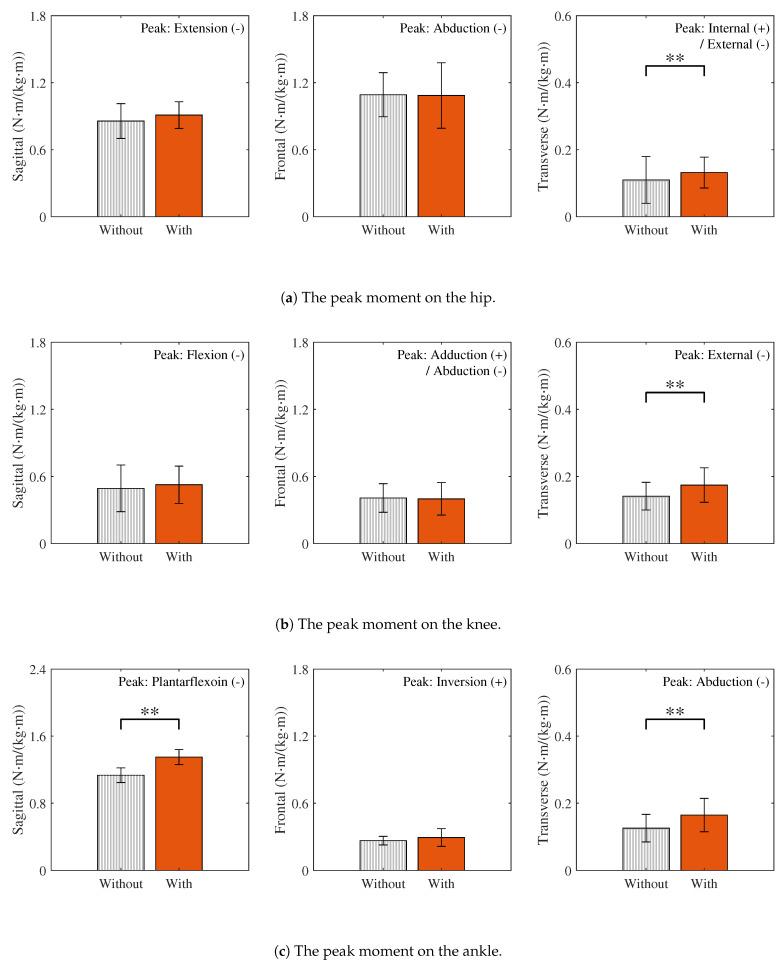
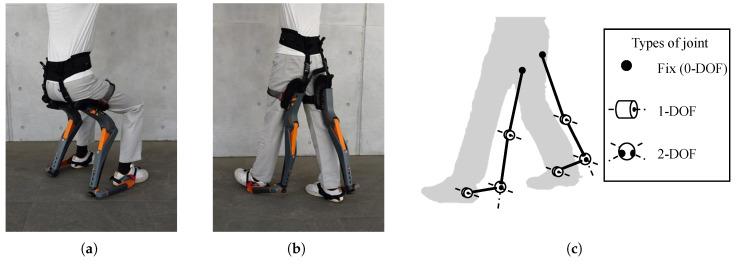
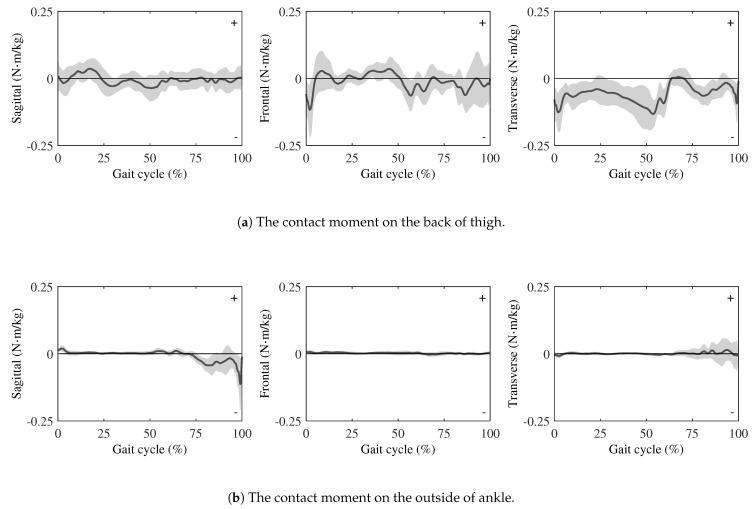
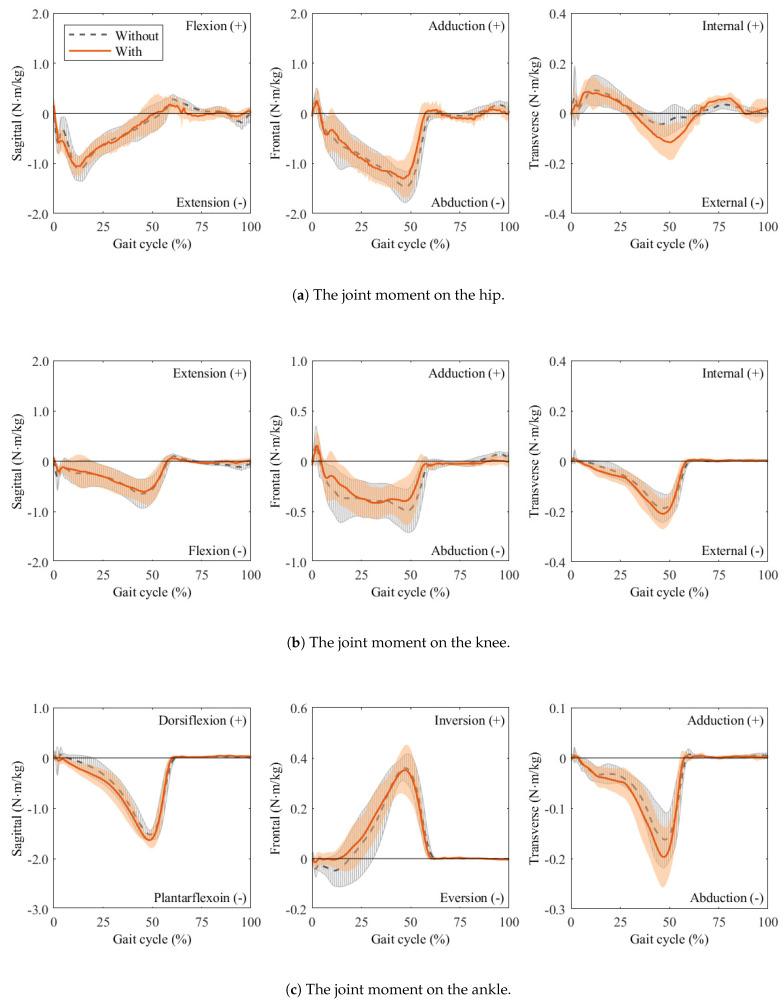
The half-sitting posture is essential for many functional tasks performed by industrial workers. Thus, passive lower-limb exoskeletons, known as wearable chairs, are increasingly used to relieve lower-limb loading in such scenarios. However, although these devices lighten muscle effort during half-sitting tasks, they can disrupt walking mechanics and balance. Moreover, rigorous biomechanical data on joint moments and contact forces during walking with such a device remain scarce. Therefore, this study conducted a biomechanical evaluation of level walking with a wearable chair to quantify its effects on gait and joint loading. Participants performed walking experiments with and without the wearable chair. An optical motion capture system and force plates collected kinematic and ground reaction data. Six-axis force sensors measured contact forces and moments. These measurements were fed into a Newton-Euler inverse dynamics model to estimate lower-limb joint moments and assess joint loading. The contact measurements showed that nearly all rotational load was absorbed at the thigh attachment, while the ankle attachment served mainly as a positional guide with minimal moment transfer. The inverse dynamics analysis revealed that the wearable chair introduced unintended rotational stresses at lower-limb joints, potentially elevating musculoskeletal risk. This detailed biomechanical evidence underpins targeted design refinements to redistribute loads and better protect lower-limb joints.
半坐姿势对于产业工人执行的许多功能性任务至关重要。因此,被称为可穿戴椅子的被动式下肢外骨骼越来越多地用于减轻此类场景下的下肢负荷。然而,尽管这些设备在半坐任务期间减轻了肌肉负担,但它们可能会干扰行走力学和平衡。此外,关于使用此类设备行走时关节力矩和接触力的严格生物力学数据仍然很少。因此,本研究对使用可穿戴椅子进行水平行走进行了生物力学评估,以量化其对步态和关节负荷的影响。参与者在有和没有可穿戴椅子的情况下进行了行走实验。一个光学运动捕捉系统和测力板收集了运动学和地面反作用力数据。六轴力传感器测量了接触力和力矩。这些测量数据被输入到一个牛顿 - 欧拉逆动力学模型中,以估计下肢关节力矩并评估关节负荷。接触测量表明,几乎所有的旋转负荷都在大腿连接处被吸收,而脚踝连接处主要作为一个位置引导,力矩传递最小。逆动力学分析表明,可穿戴椅子在下肢关节处引入了意外的旋转应力,可能会增加肌肉骨骼风险。这一详细的生物力学证据为有针对性的设计改进提供了依据,以重新分配负荷并更好地保护下肢关节。


 Zotero 插件