
塞尔维亚伏伊伏丁那自治省百日咳疫情再现:季节性变化、年龄模式及加强免疫需求
Resurgence of Pertussis in the Autonomous Province of Vojvodina, Serbia: Shifting Seasonality, Age Patterns, and the Need for Booster Immunization.
作者信息
Ristić Mioljub, Vuković Vladimir, Rajčević Smiljana, Medić Snežana, Koprivica Marko, Petrović Vladimir
机构信息
Institute of Public Health of Vojvodina, 21000 Novi Sad, Serbia.
Department of Epidemiology, Faculty of Medicine, University of Novi Sad, 21000 Novi Sad, Serbia.
出版信息
Vaccines (Basel). 2025 Jul 31;13(8):814. doi: 10.3390/vaccines13080814.
BACKGROUND
Despite decades of high childhood vaccination coverage, pertussis has re-emerged in the Autonomous Province of Vojvodina (AP Vojvodina), Serbia. We aimed to describe the temporal, seasonal, and age-specific patterns of pertussis in AP Vojvodina and to analyze trends by vaccination status in order to highlight changes in epidemiology and potential gaps in vaccine-induced protection.
METHODS
We retrospectively analyzed 2796 pertussis cases reported between January 1997 and December 2024, examining temporal, seasonal, and age-specific trends, stratifying by vaccination status across four consecutive periods (1997-2003, 2004-2010, 2011-2017, and 2018-2024).
RESULTS
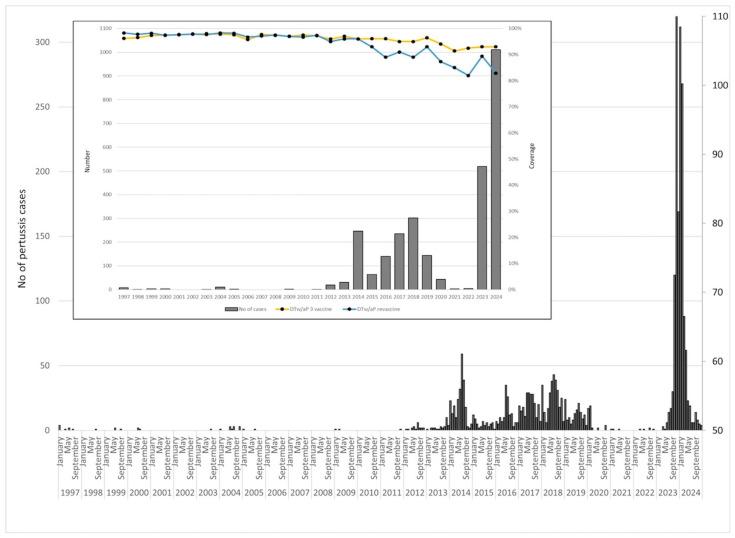
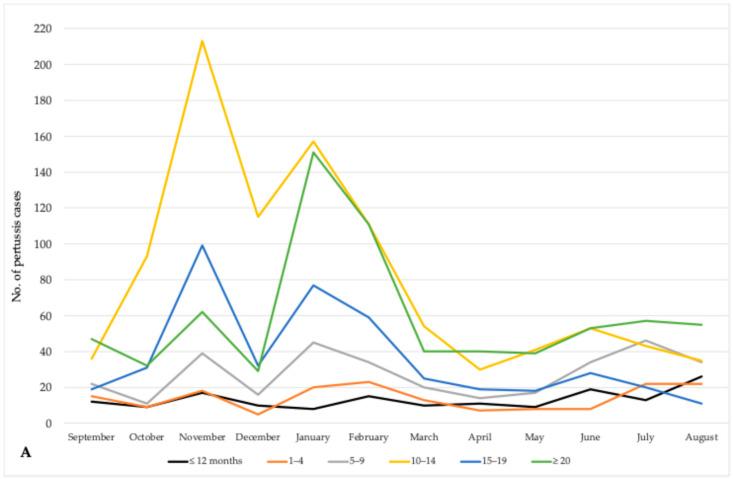
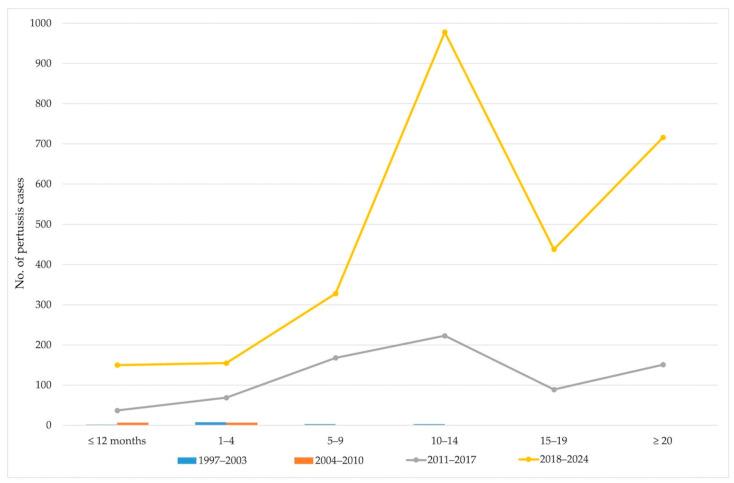
Throughout the 28-year period, after low and sporadic cases in the pre-2012 period, a dramatic rise was observed in 2014, 2017, and 2018, culminating in the highest annual number of reported cases in 2024 (1011 cases). Throughout this period, primary vaccination coverage with the DTwP/DTaP three-dose series ranged between 91% and 98%, while first booster coverage gradually declined from 98% in the early 2000s to 83% in 2024. Regarding seasonality, a sharp increase in cases began in 2012, peaking in November 2023 (>350 cases) and early 2024 (312 in January, 268 in February), with a seasonal shift from summer peaks in the 2011-2017 period to higher incidence rates during colder months more recently. Adolescents aged 10-14 years had the highest cumulative incidence (1149.4/100,000), followed by infants under 12 months (978.5/100,000), despite the latter representing fewer absolute cases. The proportion of pertussis in fully vaccinated individuals rose from 6.3% (1997-2003) to 49.7% (2018-2024).
CONCLUSIONS
These findings suggest that booster immunization in adolescence and routine maternal vaccination during pregnancy could reduce transmission, particularly to infants. Enhanced surveillance and updated immunization policies are critical to mitigating future pertussis outbreaks.
背景
尽管几十年来儿童疫苗接种覆盖率很高,但百日咳在塞尔维亚伏伊伏丁那自治省(AP伏伊伏丁那)再次出现。我们旨在描述AP伏伊伏丁那百日咳的时间、季节和年龄特异性模式,并按疫苗接种状况分析趋势,以突出流行病学变化和疫苗诱导保护方面的潜在差距。
方法
我们回顾性分析了1997年1月至2024年12月期间报告的2796例百日咳病例,研究时间、季节和年龄特异性趋势,并在四个连续时期(1997 - 2003年、2004 - 2010年、2011 - 2017年和2018 - 2024年)按疫苗接种状况进行分层。
结果
在整个28年期间,2012年之前病例数较少且呈散发性,2014年、2017年和2018年出现急剧上升,在2024年达到报告病例数的最高年度值(1011例)。在此期间,百白破/无细胞百白破三剂系列的初次疫苗接种覆盖率在91%至98%之间,而首次加强免疫覆盖率从21世纪初的98%逐渐下降至2024年的83%。关于季节性,病例数在2012年开始急剧增加,在2023年11月(>350例)和2024年初(1月312例,2月268例)达到峰值,季节性从2011 - 2017年的夏季峰值转变为最近较冷月份的更高发病率。10 - 14岁青少年的累积发病率最高(1149.4/10万),其次是12个月以下婴儿(978.5/10万),尽管后者的绝对病例数较少。完全接种疫苗个体中的百日咳比例从6.3%(1997 - 2003年)上升至49.7%(2018 - 2024年)。
结论
这些发现表明,青少年加强免疫和孕期常规母体疫苗接种可减少传播,尤其是对婴儿的传播。加强监测和更新免疫政策对于减轻未来百日咳疫情至关重要。



 Zotero 插件