
高拷贝数探针选择与交叉结合减少的计算框架
Computational Framework for High Copy-Number Probe Selection and Cross-Binding Reduction.
作者信息
Kim Younghwan, Mohanty Swomitra Kumar
机构信息
Department of Materials Science and Engineering The University of Utah Salt Lake City Utah USA.
Department of Chemical Engineering The University of Utah Salt Lake City Utah USA.
出版信息
Anal Sci Adv. 2025 Aug 26;6(2):e70034. doi: 10.1002/ansa.70034. eCollection 2025 Dec.
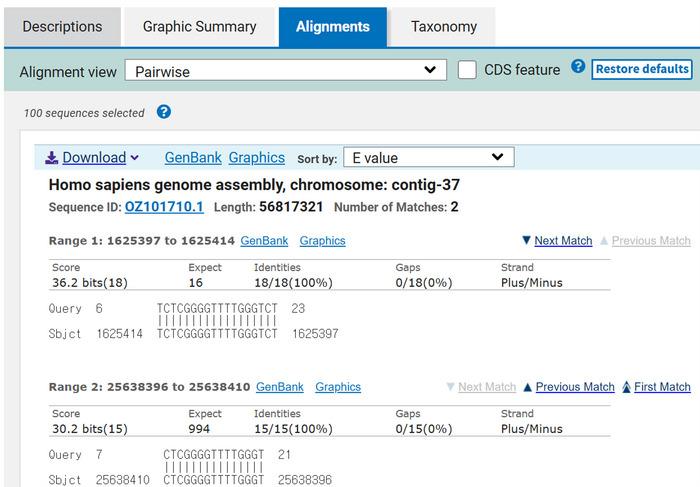
DNA probe design plays a critical role in biosensor-based disease diagnostics, gene expression analysis and environmental monitoring. Traditional probe designs primarily target lower-copy genetic sequences, often leading to low detection sensitivity due to limited hybridization events. This study introduces a novel probe design strategy that leverages highly repetitive DNA sequences as target sites to amplify biosensor signals without requiring PCR-based amplification. The computational selection process is conducted using a custom-developed bioinformatics tool to identify repetitive sequences across the entire genome, independent of gene boundaries. The identified sequences are then cross-referenced against the genome using BLAST to minimize host cross-reactivity. The analysis revealed that a 23 bp sequence repeated 39 times in exhibits only 78% sequence identity with human DNA and is present in just two copies within the human genome. This suggests that the selected probe may yield substantially stronger hybridization signals for relative to human cfDNA, thereby enhancing biosensor sensitivity. The computational methodology introduced in this study provides a robust framework for designing high-sensitivity biosensors, enabling more effective infectious disease diagnostics, environmental monitoring and clinical point-of-care testing.
DNA探针设计在基于生物传感器的疾病诊断、基因表达分析和环境监测中起着关键作用。传统的探针设计主要针对低拷贝数的基因序列,由于杂交事件有限,往往导致检测灵敏度较低。本研究引入了一种新颖的探针设计策略,该策略利用高度重复的DNA序列作为靶位点来放大生物传感器信号,而无需基于PCR的扩增。使用定制开发的生物信息学工具进行计算选择过程,以识别整个基因组中的重复序列,而不考虑基因边界。然后使用BLAST将鉴定出的序列与基因组进行交叉比对,以尽量减少宿主交叉反应。分析表明,在[具体物种]中重复39次的一个23bp序列与人类DNA的序列同一性仅为78%,并且在人类基因组中仅以两个拷贝存在。这表明相对于人类cfDNA,所选探针可能会为[具体物种]产生更强的杂交信号,从而提高生物传感器的灵敏度。本研究中引入的计算方法为设计高灵敏度生物传感器提供了一个强大的框架,能够实现更有效的传染病诊断、环境监测和临床即时检测。

 Zotero 插件