
睾丸生殖细胞肿瘤幸存者的心血管毒性
Cardiovascular toxicity in testicular germ cell tumor survivors.
作者信息
Orszaghova Zuzana, Mladosievicova Beata, Mego Michal, Chovanec Michal
机构信息
2ndDepartment of Oncology, Faculty of Medicine, Comenius University and National Cancer Institute, Bratislava, Slovakia.
Department of Clinical Pathophysiology, Faculty of Medicine, Comenius University, Bratislava, Slovakia.
出版信息
Front Oncol. 2025 Aug 13;15:1654063. doi: 10.3389/fonc.2025.1654063. eCollection 2025.
INTRODUCTION
Testicular germ cell tumors (TGCT) are highly curable malignancies, with excellent survival rates largely attributable to advances in cancer treatment. Consequently, there is a growing population of long-term TGCT survivors whose life expectancy approaches that of the general population. However, these survivors may experience acute and late adverse effects of cancer treatment, with cardiovascular toxicity being among the most serious and potentially life-threatening.
METHODS
This narrative review synthesizes current evidence on cardiovascular toxicity in testicular cancer survivors, including clinical manifestations, pathophysiology of cisplatin-induced cardiovascular damage, additional adverse effects of radiotherapy, and prevalence of traditional cardiovascular risk factors. Key clinical guidelines, observational studies, and experimental findings were analyzed to identify trends, knowledge gaps, and opportunities for improving survivorship care.
RESULTS
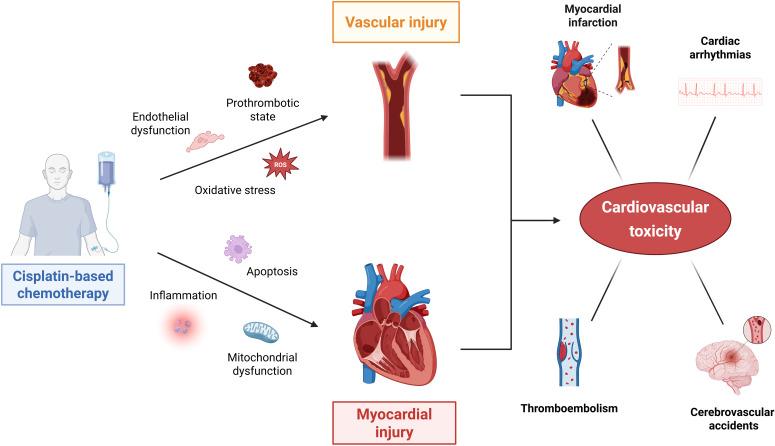
Multiple studies consistently demonstrate an increased risk of cardiovascular disease (CVD) among TGCT survivors, particularly following cisplatin-based chemotherapy. Common clinical manifestations include myocardial infarction, angina pectoris, cerebrovascular events, thromboembolism, and heart failure. The highest risk occurs within the first year post-treatment but may persist or recur even after a decade. Cisplatin-induced cardiovascular toxicity involves vascular injury - characterized by endothelial dysfunction, oxidative stress, and prothrombotic state - and myocardial damage driven by oxidative stress, inflammation, and apoptosis. Furthermore, TGCT survivors exhibit a higher prevalence of traditional cardiovascular risk factors, such as smoking, hypertension, dyslipidemia, diabetes, and obesity, contributing to the overall elevated CVD risk.
DISCUSSION
There is an urgent need for a structured, long-term survivorship care model for TGCT survivors. Cardiovascular risk assessment and prevention should be central components, especially in survivors treated with cisplatin-based chemotherapy. Early detection of treatment-related toxicities, combined with lifestyle interventions and regular monitoring, is essential. Future research should focus on elucidating molecular mechanisms of cardiovascular toxicity, validating TGCT survivor-specific screening tools, identifying early biomarkers of cardiac injury, and exploring pharmacologic and behavioral interventions.
CONCLUSION
Protecting cardiovascular health in TGCT survivors requires a proactive, personalized, and multidisciplinary approach. Integrating cardiometabolic monitoring, risk factor modification, and tailored follow-up strategies into survivorship care is vital. Focused research and clinical attention are needed to ensure that the long-term success of cancer treatment is not compromised by preventable cardiovascular disease.
引言
睾丸生殖细胞肿瘤(TGCT)是高度可治愈的恶性肿瘤,其出色的生存率很大程度上归因于癌症治疗的进展。因此,长期TGCT幸存者的数量不断增加,他们的预期寿命接近普通人群。然而,这些幸存者可能会经历癌症治疗的急性和晚期不良反应,其中心血管毒性是最严重且可能危及生命的不良反应之一。
方法
本叙述性综述综合了目前关于睾丸癌幸存者心血管毒性的证据,包括临床表现、顺铂诱导的心血管损伤的病理生理学、放疗的其他不良反应以及传统心血管危险因素的患病率。分析了关键临床指南、观察性研究和实验结果,以确定趋势、知识差距以及改善生存护理的机会。
结果
多项研究一致表明,TGCT幸存者患心血管疾病(CVD)的风险增加,尤其是在接受以顺铂为基础的化疗后。常见临床表现包括心肌梗死、心绞痛、脑血管事件、血栓栓塞和心力衰竭。最高风险出现在治疗后的第一年内,但即使在十年后也可能持续或复发。顺铂诱导的心血管毒性涉及血管损伤——其特征为内皮功能障碍、氧化应激和血栓前状态——以及由氧化应激、炎症和细胞凋亡驱动的心肌损伤。此外,TGCT幸存者表现出较高的传统心血管危险因素患病率,如吸烟、高血压、血脂异常、糖尿病和肥胖,这导致了整体CVD风险的升高。
讨论
迫切需要为TGCT幸存者建立一个结构化的长期生存护理模式。心血管风险评估和预防应是核心组成部分,特别是在接受以顺铂为基础的化疗的幸存者中。早期发现与治疗相关的毒性,结合生活方式干预和定期监测,至关重要。未来的研究应专注于阐明心血管毒性的分子机制、验证针对TGCT幸存者的筛查工具、识别心脏损伤的早期生物标志物以及探索药物和行为干预措施。
结论
保护TGCT幸存者的心血管健康需要积极主动、个性化和多学科的方法。将心脏代谢监测、危险因素修正和量身定制的随访策略纳入生存护理至关重要。需要有针对性的研究和临床关注,以确保癌症治疗的长期成功不会因可预防的心血管疾病而受到影响。

 Zotero 插件