
针刺疗法治疗创伤后三叉神经痛:24个月随访病例报告
Acupuncture on Management of Post-Traumatic Trigeminal Neuropathic Pain: A 24-Month Follow-Up Case Report.
作者信息
Marubayashi Lucas Masaru, Herreira Ferreira Mtheus, Torres Carolina Paes, Galo Rodrigo, Borsatto Maria Cristina
机构信息
Department of Pediatric Dentistry, Faculty of Dentistry of Ribeirao Preto, University of São Paulo, Ribeirão Preto, Brazil.
Department of Biological Sciences, Bauru School of Dentistry, University of São Paulo, Bauru, Brazil.
出版信息
Spec Care Dentist. 2025 Sep-Oct;45(5):e70094. doi: 10.1111/scd.70094.
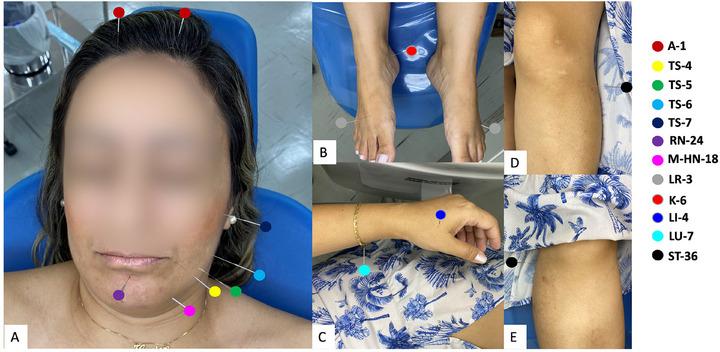
Neuropathic pain and its high impact on patient's quality of life, must be thoroughly assessed to be adequately managed. Unfortunately, there remains a lack of evidence for different treatment options that could improve the quality of life of those patients. Beyond first-choice therapies, complementary integrative therapies can emerge as a highly valuable option for controlling chronic pain. Thus, the aim of this study was to report a case of acupuncture utilized to manage chronic neuropathic pain associated with sensory loss following trauma after dental implant surgery. A 41-year-old female patient presented with a complaint of left-sided intraoral pain (visual analogic scale [VAS] = 9) in the posterior mandibula region over the last year following a dental implant surgery. On physical examination, the patient exhibited hypoesthesia in the region identified by qualitative somatosensory tests. The implant showed no clinical or tomographic alterations. The initial diagnosis was probable post-traumatic neuropathic pain (PTNP). As the patient opted against initiating central-acting medications, five sessions of acupuncture were performed. Following the proposed treatment, there was a significant reduction in the patient's pain report (VAS = 1) and a significant decrease in the sensory loss area. We can therefore conclude, that in this case, the use of acupuncture was effective in controlling pain and significantly reducing the sensory loss area caused by PTNP.
神经性疼痛及其对患者生活质量的严重影响,必须进行全面评估以便进行充分管理。不幸的是,对于不同治疗方案能否改善这些患者的生活质量,仍然缺乏证据。除了首选疗法之外,补充性综合疗法可成为控制慢性疼痛的极有价值的选择。因此,本研究的目的是报告一例针刺疗法用于管理种植牙手术后创伤后伴有感觉丧失的慢性神经性疼痛的病例。一名41岁女性患者主诉,在种植牙手术后的过去一年里,下颌骨后部区域左侧口腔内疼痛(视觉模拟量表[VAS]=9)。体格检查时,通过定性体感测试确定的区域内患者表现出感觉减退。种植体未显示临床或断层扫描改变。初步诊断为可能的创伤后神经性疼痛(PTNP)。由于患者选择不开始使用中枢作用药物,进行了五次针刺治疗。按照建议的治疗方法,患者的疼痛报告显著减轻(VAS=1),感觉丧失区域明显减小。因此我们可以得出结论,在该病例中,针刺疗法有效地控制了疼痛,并显著减小了由PTNP导致的感觉丧失区域。


 Zotero 插件