
特发性肺纤维化急性加重预测模型的开发:韩国特发性肺纤维化队列登记研究
Development of a Prediction Model for Acute Exacerbation in Idiopathic Pulmonary Fibrosis: A Study of the Korea IPF Cohort Registry.
作者信息
Lee Jae Ha, Jang Ji Hoon, Kim Song Yee, Park Moo Suk, Chung Man Pyo, Yoo Hongseok, Jeong Sung Hwan, Lee Hong Lyeol, Choi Sun Mi, Kim Young Whan, Kim Yong Hyun, Park Sung Woo, Park Jong Sun, Jegal Yangjin, Jo Yong Suk, Yoon Hee-Young, Kim Tae-Hyung, Kim Yee Hyung, Shin Beomsu, Lee Hyun-Kyung, Yang Sei-Hoon, Lee Hyun, Kim Sang-Heon, Lee Eun Joo, Choi Hye Sook, Kang Hyung Koo, Heo Eun Young, Lee Won-Yeon, Song Jin Woo
机构信息
Division of Pulmonology and Critical Care Medicine, Department of Internal Medicine, Inje University Haeundae Paik Hospital, Inje University College of Medicine, Busan, Korea.
Division of Pulmonology and Critical Care Medicine, Department of Internal Medicine, Severance Hospital, Yonsei University College of Medicine, Seoul, Korea.
出版信息
J Korean Med Sci. 2025 Sep 1;40(34):e212. doi: 10.3346/jkms.2025.40.e212.
BACKGROUND
Acute exacerbation (AE) of idiopathic pulmonary fibrosis (IPF) has the most disastrous impact on prognosis as a major cause of morbidity and mortality. However, there is no proven treatment, and the occurrence of AE is unpredictable. This study aimed to develop a prediction model for AE in patients with IPF using the nationwide Korea IPF Cohort (KICO) registry.
METHODS
This is a retrospective study of Korean patients with IPF who were enrolled from June 2016 to February 2022 in the KICO registry. We developed a prediction model for AE based on risk factors found in the multivariable logistic regression model.
RESULTS
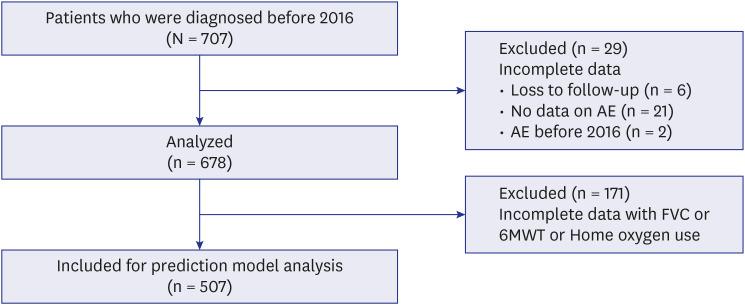
Of 678 patients with IPF, the mean age was 69.4 years, and 82.0% were male. AE occurred in 165 patients (24.3%) during follow-up (median: 40.7 months). The median time from IPF diagnosis to AE was 11.6 (interquartile range: 3.6-23.5) months. Lower forced vital capacity (FVC), shorter six-minute walking distance (6MWD), and the use of home oxygen were independently associated with AE in the multivariable logistic analysis. In a risk-predicting model using variables of FVC, 6MWD, and the use of home oxygen, there was a significant predictive power for AE in both score (area under the curve [AUC], 0.746; 95% confidence interval [CI], 0.705-0.783; < 0.001) and stage (AUC, 0.696; 95% CI, 0.654-0.736; < 0.001).
CONCLUSION
Our results suggest that a model using FVC, 6MWD, and home oxygen use may be useful in predicting AE in patients with IPF.
背景
特发性肺纤维化(IPF)的急性加重(AE)作为发病和死亡的主要原因,对预后具有最灾难性的影响。然而,目前尚无经证实的治疗方法,且AE的发生不可预测。本研究旨在利用韩国全国IPF队列(KICO)登记处的数据,开发一种IPF患者AE的预测模型。
方法
这是一项对2016年6月至2022年2月纳入KICO登记处的韩国IPF患者的回顾性研究。我们基于多变量逻辑回归模型中发现的危险因素,开发了一种AE的预测模型。
结果
678例IPF患者的平均年龄为69.4岁,82.0%为男性。随访期间,165例患者(24.3%)发生了AE(中位时间:40.7个月)。从IPF诊断到AE的中位时间为11.6(四分位间距:3.6 - 23.5)个月。在多变量逻辑分析中,较低的用力肺活量(FVC)、较短的6分钟步行距离(6MWD)以及家庭氧疗的使用与AE独立相关。在使用FVC、6MWD和家庭氧疗使用变量的风险预测模型中,评分(曲线下面积[AUC],0.746;95%置信区间[CI],0.705 - 0.783;P < 0.001)和分期(AUC,0.696;95% CI,0.654 - 0.736;P < 0.001)对AE均具有显著的预测能力。
结论
我们的结果表明,使用FVC、6MWD和家庭氧疗使用情况的模型可能有助于预测IPF患者的AE。

 Zotero 插件