
同伴辅导以支持初级保健中的体重管理:一项整群随机临床试验。
Peer Coaching to Support Weight Management in Primary Care: A Cluster Randomized Clinical Trial.
作者信息
Wittleder Sandra, Wong Laura, Ruan Andrea M, Illenberger Nicholas, Nicholson Andrew, Portelli Dilara, Cansler Rachel, Tenner Craig T, Sherman Scott E, Aguilar Adrian D, Sweat Victoria, Orstad Stephanie L, Vandyousefi Sarvenaz, Fronshtein Marina, Smith Shea, Dixon Alia, Goldstein Michael G, Raffa Susan D, Wylie-Rosett Judith, Jay Melanie
机构信息
Department of Medicine, Veterans Affairs New York Harbor Healthcare System, New York.
Department of Medicine, New York University (NYU) Grossman School of Medicine, New York.
出版信息
JAMA Netw Open. 2025 Sep 2;8(9):e2529136. doi: 10.1001/jamanetworkopen.2025.29136.
IMPORTANCE
Employing peer coaches to provide weight management counseling in primary care could address patient- and clinician-level barriers to obesity care, improve outcomes, and boost engagement in weight management programs.
OBJECTIVE
To evaluate the efficacy of peer coaching to deliver a low- to moderate-intensity intervention for weight management compared with enhanced usual care (EUC).
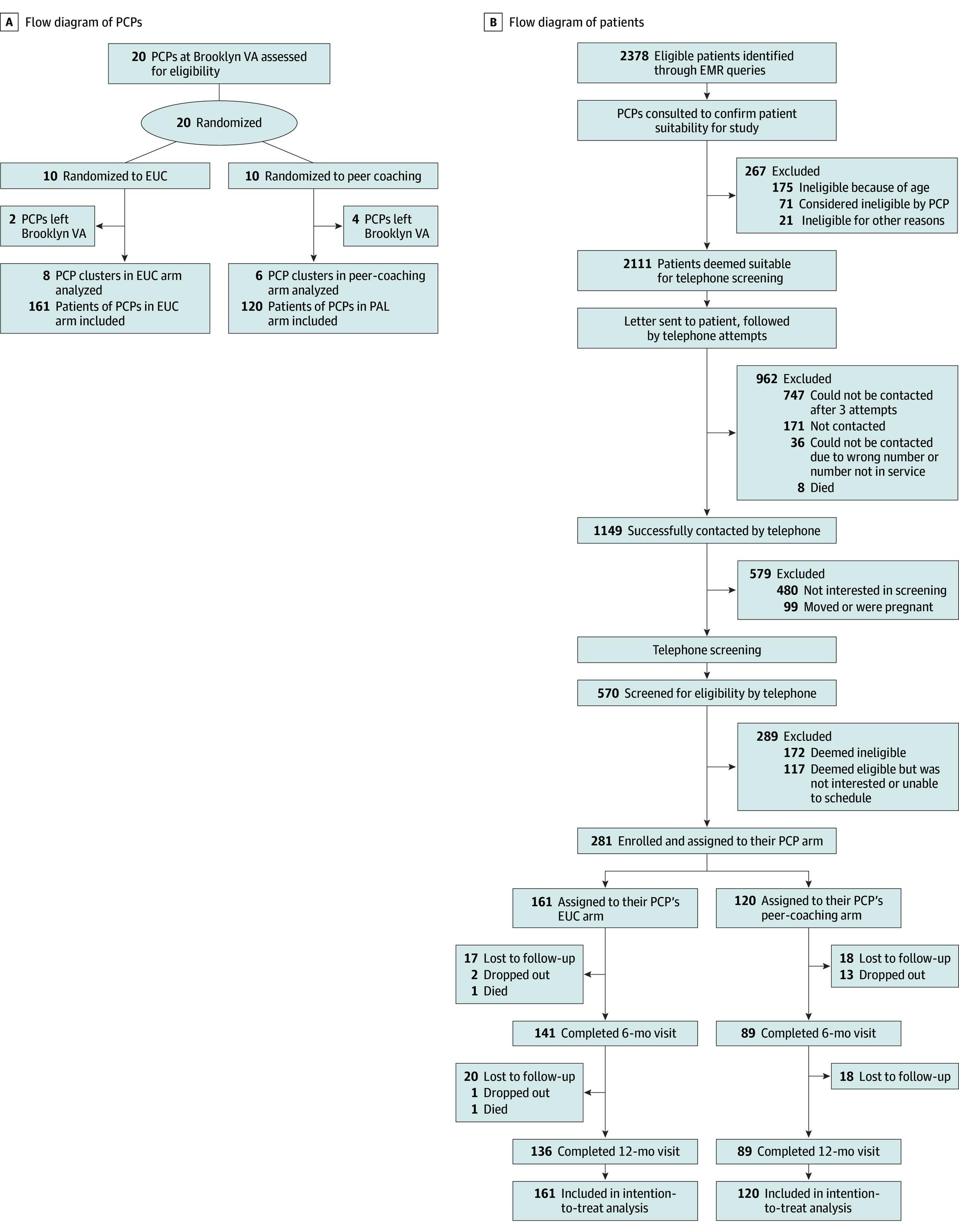
DESIGN, SETTING, AND PARTICIPANTS: This 2-arm, cluster randomized clinical trial was conducted from November 2017 to August 2021 at a single US Department of Veteran Affairs (VA) site. Primary care physicians (PCPs) and their patients with a body mass index (calculated as weight in kilograms divided by height in meters squared) of at least 25 (overweight) or 30 or more (obesity) were invited to participate. Enrollment was stopped early due to the COVID-19 pandemic, when weight management services at the VA site transitioned to primarily virtual care. PCPs were randomized to either the peer coaching (ie, Peer-Assisted Lifestyle) intervention or EUC arm, and their patients received the corresponding treatment for those arms. Data were analyzed according to the intention-to-treat principle from February 2023 and July 2024.
INTERVENTIONS
Patients in the peer coaching arm completed a tablet-based, goal-setting tool and received 1 in-person and up to 12 individual peer-coaching telephone sessions over 1 year. Peer coaches were veterans with a bachelor's degree and training for a minimum of 20 hours. Patients in the EUC control arm received health education materials.
MAIN OUTCOMES AND MEASURES
The primary outcome was mean (SE) change in weight (in kilograms) at 12 months. Secondary outcomes included mean (SE) weight change in percentage, proportion of patients achieving 5% or higher weight loss, and change in waist circumference in inches.
RESULTS
A total of 20 PCPs (11 women [55.0%]) and 281 patients were enrolled. Patients had a mean (SD) age of 50.6 (11.5) years and included 221 men (78.6%). The mean (SD) body mass index at baseline was 33.4 (5.1). At 12 months, the adjusted mean (SE) weight change was -2.51 (0.73) kg in the peer coaching arm and -0.79 (0.48) kg in the EUC arm, but the difference was not statistically signficant (difference, -1.72 [0.88] kg; P = .05). At 6 months, the adjusted mean (SE) proportion of patients who lost at least 5% of body weight was 16.68% (0.47%) in the peer coaching arm vs 5.50% (0.32%) in the EUC arm (difference, 11.18 [5.22] percentage points; P = .03). At 6 months, the adjusted mean (SE) proportion of patients who attended a weight management program was 28.68% (5.37%) in the peer coaching arm and 13.32% (3.38%) in the EUC arm (difference, 15.37 [6.45] percentage points; P = .02).
CONCLUSIONS AND RELEVANCE
In this randomized clinical trial, a low- to moderate-intensity peer-coaching intervention did not result in greater weight loss at 12 months, but it improved attendance at weight management programs.
TRIAL REGISTRATION
ClinicalTrials.gov Identifier: NCT03163264.
重要性
在初级保健中聘请同伴教练提供体重管理咨询可以消除患者和临床医生层面在肥胖护理方面的障碍,改善治疗效果,并提高对体重管理计划的参与度。
目的
评估与强化常规护理(EUC)相比,同伴教练提供低至中等强度体重管理干预措施的效果。
设计、地点和参与者:这项双臂、整群随机临床试验于2017年11月至2021年8月在美国退伍军人事务部(VA)的一个地点进行。邀请了初级保健医生(PCP)及其体重指数(以千克为单位的体重除以身高米数的平方)至少为25(超重)或30及以上(肥胖)的患者参与。由于COVID-19大流行,当VA站点的体重管理服务主要转变为虚拟护理时,招募提前停止。PCP被随机分配到同伴教练(即同伴辅助生活方式)干预组或EUC组,他们的患者接受相应组别的治疗。根据意向性分析原则,于2023年2月至2024年7月对数据进行了分析。
干预措施
同伴教练组的患者完成了一个基于平板电脑的目标设定工具,并在1年内接受了1次面对面和最多12次个人同伴教练电话辅导。同伴教练是拥有学士学位且接受了至少20小时培训的退伍军人。EUC对照组的患者收到了健康教育材料。
主要结局和测量指标
主要结局是12个月时体重(千克)的平均(SE)变化。次要结局包括体重变化百分比的平均(SE)值、体重减轻5%或更多的患者比例以及腰围(英寸)的变化。
结果
共招募了20名PCP(11名女性[55.0%])和281名患者。患者的平均(SD)年龄为50.6(11.5)岁,其中包括221名男性(78.6%)。基线时的平均(SD)体重指数为33.4(5.1)。在12个月时,同伴教练组调整后的平均(SE)体重变化为-2.51(0.73)千克,EUC组为-0.79(0.48)千克,但差异无统计学意义(差异为-1.72[0.88]千克;P = 0.05)。在6个月时,同伴教练组体重减轻至少5%的患者调整后的平均(SE)比例为16.68%(0.47%),EUC组为5.50%(0.32%)(差异为11.18[5.22]个百分点;P = 0.03)。在6个月时,参加体重管理计划的患者调整后的平均(SE)比例在同伴教练组为28.68%(5.37%),在EUC组为13.32%(3.38%)(差异为15.37[6.4]个百分点;P = 0.02)。
结论和相关性
在这项随机临床试验中,低至中等强度的同伴教练干预在12个月时并未导致更大程度的体重减轻,但提高了体重管理计划的参与率。
试验注册
ClinicalTrials.gov标识符:NCT03163264。
 Zotero 插件