
1990年至2021年美国儿童、青少年和成年人中超重和肥胖的国家级和州级患病率,以及到2050年的预测。
National-level and state-level prevalence of overweight and obesity among children, adolescents, and adults in the USA, 1990-2021, and forecasts up to 2050.
出版信息
Lancet. 2024 Dec 7;404(10469):2278-2298. doi: 10.1016/S0140-6736(24)01548-4. Epub 2024 Nov 14.
BACKGROUND
Over the past several decades, the overweight and obesity epidemic in the USA has resulted in a significant health and economic burden. Understanding current trends and future trajectories at both national and state levels is crucial for assessing the success of existing interventions and informing future health policy changes. We estimated the prevalence of overweight and obesity from 1990 to 2021 with forecasts to 2050 for children and adolescents (aged 5-24 years) and adults (aged ≥25 years) at the national level. Additionally, we derived state-specific estimates and projections for older adolescents (aged 15-24 years) and adults for all 50 states and Washington, DC.
METHODS
In this analysis, self-reported and measured anthropometric data were extracted from 134 unique sources, which included all major national surveillance survey data. Adjustments were made to correct for self-reporting bias. For individuals older than 18 years, overweight was defined as having a BMI of 25 kg/m to less than 30 kg/m and obesity was defined as a BMI of 30 kg/m or higher, and for individuals younger than 18 years definitions were based on International Obesity Task Force criteria. Historical trends of overweight and obesity prevalence from 1990 to 2021 were estimated using spatiotemporal Gaussian process regression models. A generalised ensemble modelling approach was then used to derive projected estimates up to 2050, assuming continuation of past trends and patterns. All estimates were calculated by age and sex at the national level, with estimates for older adolescents (aged 15-24 years) and adults aged (≥25 years) also calculated for 50 states and Washington, DC. 95% uncertainty intervals (UIs) were derived from the 2·5th and 97·5th percentiles of the posterior distributions of the respective estimates.
FINDINGS
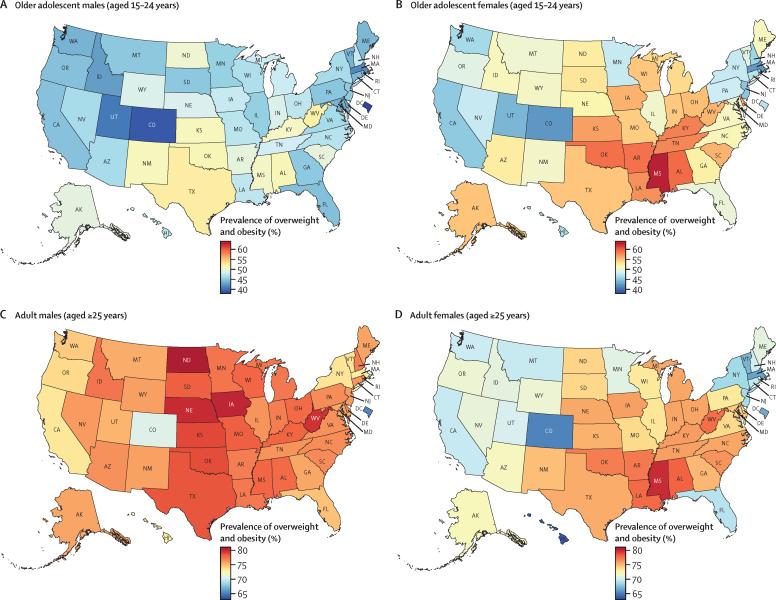
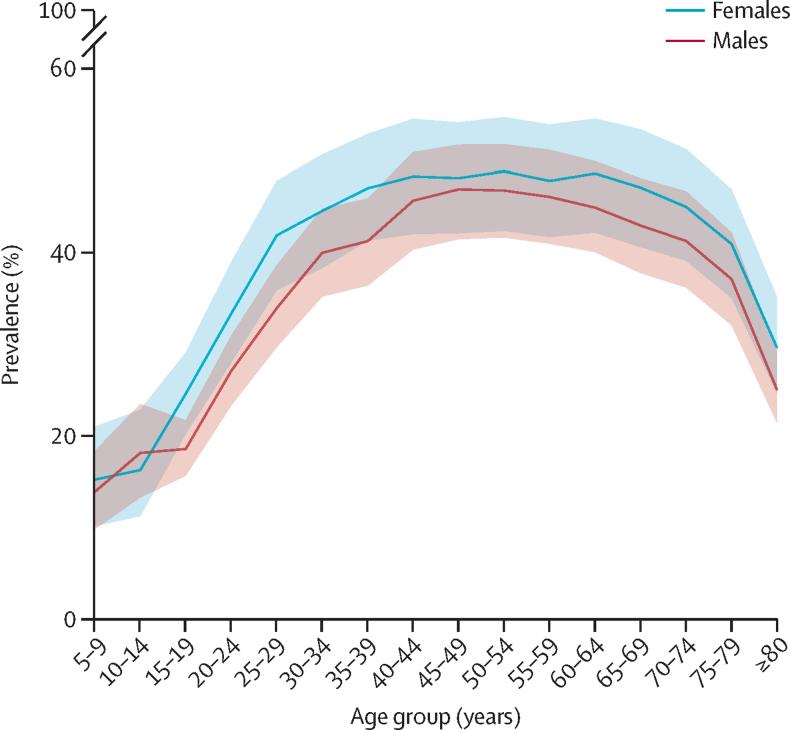
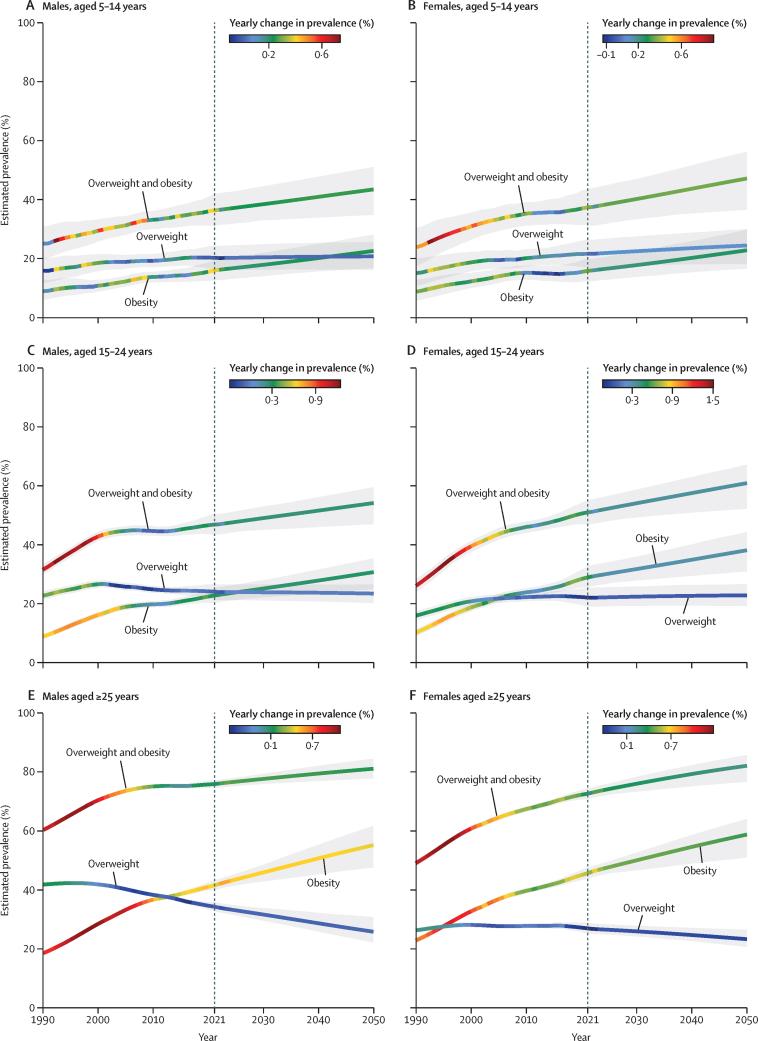
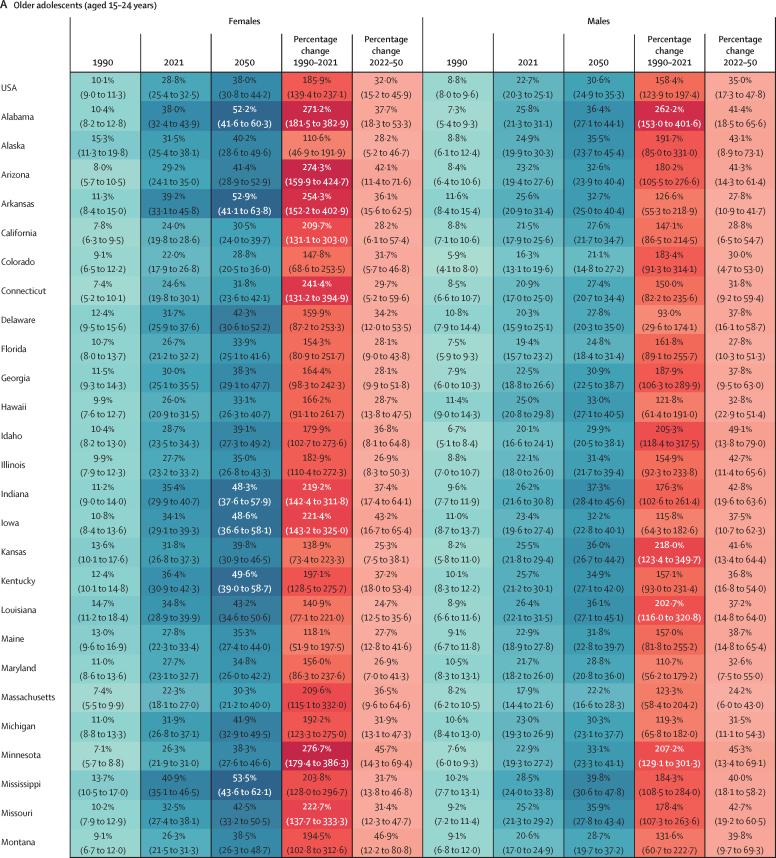
In 2021, an estimated 15·1 million (95% UI 13·5-16·8) children and young adolescents (aged 5-14 years), 21·4 million (20·2-22·6) older adolescents (aged 15-24 years), and 172 million (169-174) adults (aged ≥25 years) had overweight or obesity in the USA. Texas had the highest age-standardised prevalence of overweight or obesity for male adolescents (aged 15-24 years), at 52·4% (47·4-57·6), whereas Mississippi had the highest for female adolescents (aged 15-24 years), at 63·0% (57·0-68·5). Among adults, the prevalence of overweight or obesity was highest in North Dakota for males, estimated at 80·6% (78·5-82·6), and in Mississippi for females at 79·9% (77·8-81·8). The prevalence of obesity has outpaced the increase in overweight over time, especially among adolescents. Between 1990 and 2021, the percentage change in the age-standardised prevalence of obesity increased by 158·4% (123·9-197·4) among male adolescents and 185·9% (139·4-237·1) among female adolescents (15-24 years). For adults, the percentage change in prevalence of obesity was 123·6% (112·4-136·4) in males and 99·9% (88·8-111·1) in females. Forecast results suggest that if past trends and patterns continue, an additional 3·33 million children and young adolescents (aged 5-14 years), 3·41 million older adolescents (aged 15-24 years), and 41·4 million adults (aged ≥25 years) will have overweight or obesity by 2050. By 2050, the total number of children and adolescents with overweight and obesity will reach 43·1 million (37·2-47·4) and the total number of adults with overweight and obesity will reach 213 million (202-221). In 2050, in most states, a projected one in three adolescents (aged 15-24 years) and two in three adults (≥25 years) will have obesity. Although southern states, such as Oklahoma, Mississippi, Alabama, Arkansas, West Virginia, and Kentucky, are forecast to continue to have a high prevalence of obesity, the highest percentage changes from 2021 are projected in states such as Utah for adolescents and Colorado for adults.
INTERPRETATION
Existing policies have failed to address overweight and obesity. Without major reform, the forecasted trends will be devastating at the individual and population level, and the associated disease burden and economic costs will continue to escalate. Stronger governance is needed to support and implement a multifaceted whole-system approach to disrupt the structural drivers of overweight and obesity at both national and local levels. Although clinical innovations should be leveraged to treat and manage existing obesity equitably, population-level prevention remains central to any intervention strategies, particularly for children and adolescents.
FUNDING
Bill & Melinda Gates Foundation.
背景
在过去几十年中,美国的超重和肥胖流行给健康和经济带来了巨大负担。了解国家和州层面的当前趋势及未来轨迹对于评估现有干预措施的成效以及为未来的卫生政策变革提供依据至关重要。我们估计了1990年至2021年美国儿童和青少年(5 - 24岁)及成年人(≥25岁)超重和肥胖的患病率,并预测了到2050年的情况。此外,我们还得出了50个州和华盛顿特区15 - 24岁青少年及成年人的州级特定估计值和预测值。
方法
在本分析中,从134个独特来源提取了自我报告和测量的人体测量数据,其中包括所有主要的国家监测调查数据。进行了调整以校正自我报告偏差。对于18岁以上的个体,超重定义为体重指数(BMI)为25 kg/m²至小于30 kg/m²,肥胖定义为BMI为30 kg/m²或更高;对于18岁以下的个体,定义基于国际肥胖特别工作组的标准。使用时空高斯过程回归模型估计了1990年至2021年超重和肥胖患病率的历史趋势。然后采用广义集合建模方法得出到2050年的预测估计值,假设过去的趋势和模式持续。所有估计值均按国家层面的年龄和性别计算,同时也计算了50个州和华盛顿特区15 - 24岁青少年及≥25岁成年人的估计值。95%的不确定性区间(UI)来自各自估计值后验分布的第2.5和第97.5百分位数。
结果
2021年,美国估计有1510万(95% UI 1350 - 1680万)儿童和青少年(5 - 14岁)、2140万(2020 - 2260万)青少年(15 - 24岁)以及1.72亿(1.69 - 1.74亿)成年人(≥25岁)超重或肥胖。德克萨斯州15 - 24岁男性青少年超重或肥胖的年龄标准化患病率最高,为52.4%(47.4 - 57.6%),而密西西比州15 - 24岁女性青少年的患病率最高,为63.0%(57.0 - 68.5%)。在成年人中,北达科他州男性超重或肥胖的患病率最高,估计为80.6%(78.5 - 82.6%),密西西比州女性的患病率为79.9%(77.8 - 81.8%)。随着时间推移,肥胖患病率的增长超过了超重患病率的增长,尤其是在青少年中。1990年至2021年期间,15 - 24岁男性青少年肥胖年龄标准化患病率的百分比变化增加了158.4%(123.9 - 197.4%),女性青少年增加了185.9%(139.4 - 237.1%)。对于成年人,肥胖患病率的百分比变化男性为123.6%(112.4 - 136.4%),女性为99.9%(88.8 - 111.1%)。预测结果表明,如果过去的趋势和模式持续,到2050年将有额外的333万儿童和青少年(5 - 14岁)、341万青少年(15 - 24岁)以及4140万成年人(≥25岁)超重或肥胖。到2050年,超重和肥胖的儿童及青少年总数将达到4310万(3720 - 4740万),超重和肥胖的成年人总数将达到2.13亿(2.02 - 2.21亿)。2050年,在大多数州,预计三分之一的青少年(15 - 24岁)和三分之二的成年人(≥25岁)将患有肥胖症。尽管预计俄克拉荷马州、密西西比州、阿拉巴马州、阿肯色州、西弗吉尼亚州和肯塔基州等南部州的肥胖患病率仍将居高不下,但预计从2021年起变化百分比最高的州在青少年中是犹他州,在成年人中是科罗拉多州。
解读
现有政策未能解决超重和肥胖问题。若不进行重大改革,预测的趋势将在个体和人群层面造成灾难性后果,相关的疾病负担和经济成本将持续上升。需要更强有力的治理来支持和实施多方面的全系统方法,以在国家和地方层面打破超重和肥胖的结构性驱动因素。虽然应利用临床创新来公平地治疗和管理现有的肥胖症,但人群层面的预防仍是任何干预策略的核心,尤其是对于儿童和青少年。
资金来源
比尔及梅琳达·盖茨基金会

 Zotero 插件