
《美国的十个地区:对美国预期寿命差异的系统分析》
Ten Americas: a systematic analysis of life expectancy disparities in the USA.
作者信息
Dwyer-Lindgren Laura, Baumann Mathew M, Li Zhuochen, Kelly Yekaterina O, Schmidt Chris, Searchinger Chloe, La Motte-Kerr Wichada, Bollyky Thomas J, Mokdad Ali H, Murray Christopher Jl
机构信息
Institute for Health Metrics and Evaluation, University of Washington, Seattle, WA, USA; Department of Health Metrics Sciences, University of Washington, Seattle, WA, USA.
Institute for Health Metrics and Evaluation, University of Washington, Seattle, WA, USA.
出版信息
Lancet. 2024 Dec 7;404(10469):2299-2313. doi: 10.1016/S0140-6736(24)01495-8. Epub 2024 Nov 21.
BACKGROUND
Nearly two decades ago, the Eight Americas study offered a novel lens for examining health inequities in the USA by partitioning the US population into eight groups based on geography, race, urbanicity, income per capita, and homicide rate. That study found gaps of 12·8 years for females and 15·4 years for males in life expectancy in 2001 across these eight groups. In this study, we aimed to update and expand the original Eight Americas study, examining trends in life expectancy from 2000 to 2021 for ten Americas (analogues to the original eight, plus two additional groups comprising the US Latino population), by year, sex, and age group.
METHODS
In this systematic analysis, we defined ten mutually exclusive and collectively exhaustive Americas comprising the entire US population, starting with all combinations of county and race and ethnicity, and assigning each to one of the ten Americas based on race and ethnicity and a variable combination of geographical location, metropolitan status, income, and Black-White residential segregation. We adjusted deaths from the National Vital Statistics System to account for misreporting of race and ethnicity on death certificates. We then tabulated deaths from the National Vital Statistics System and population estimates from the US Census Bureau and the National Center for Health Statistics from Jan 1, 2000, to Dec 31, 2021, by America, year, sex, and age, and calculated age-specific mortality rates in each of these strata. Finally, we constructed abridged life tables for each America, year, and sex, and extracted life expectancy at birth, partial life expectancy within five age groups (0-4, 5-24, 25-44, 45-64, and 65-84 years), and remaining life expectancy at age 85 years.
FINDINGS
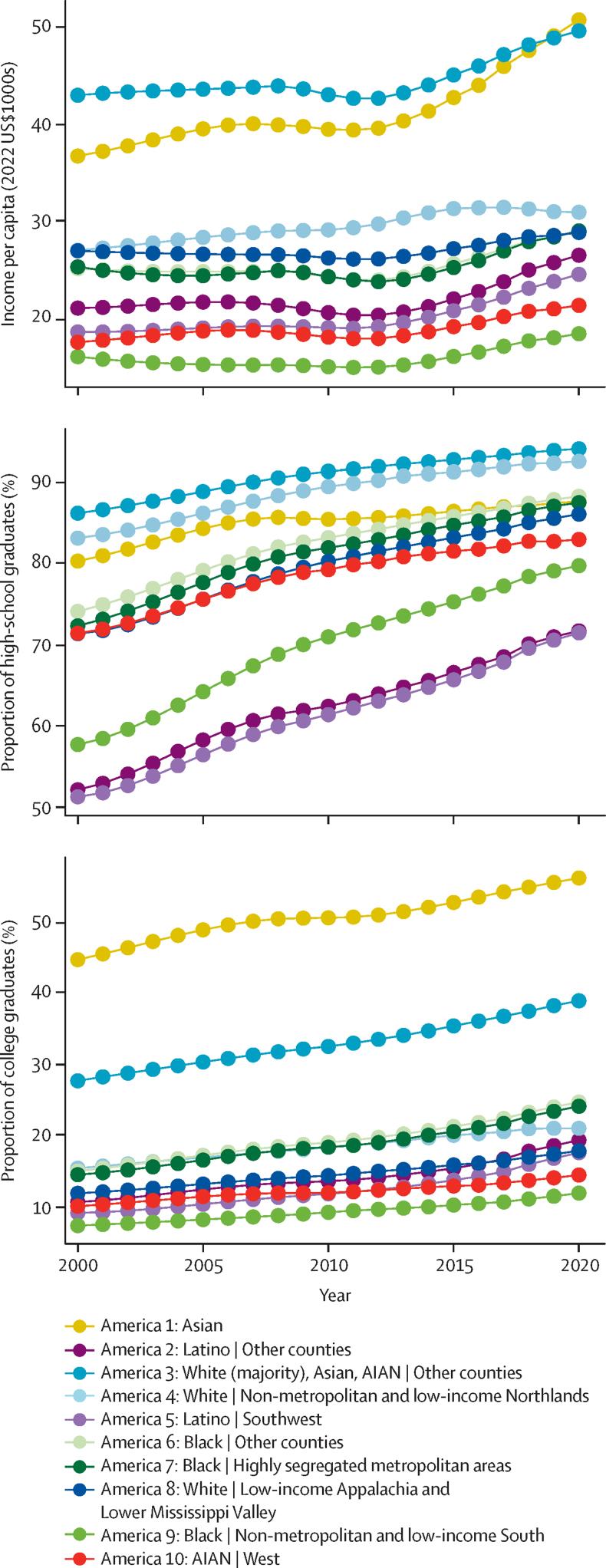
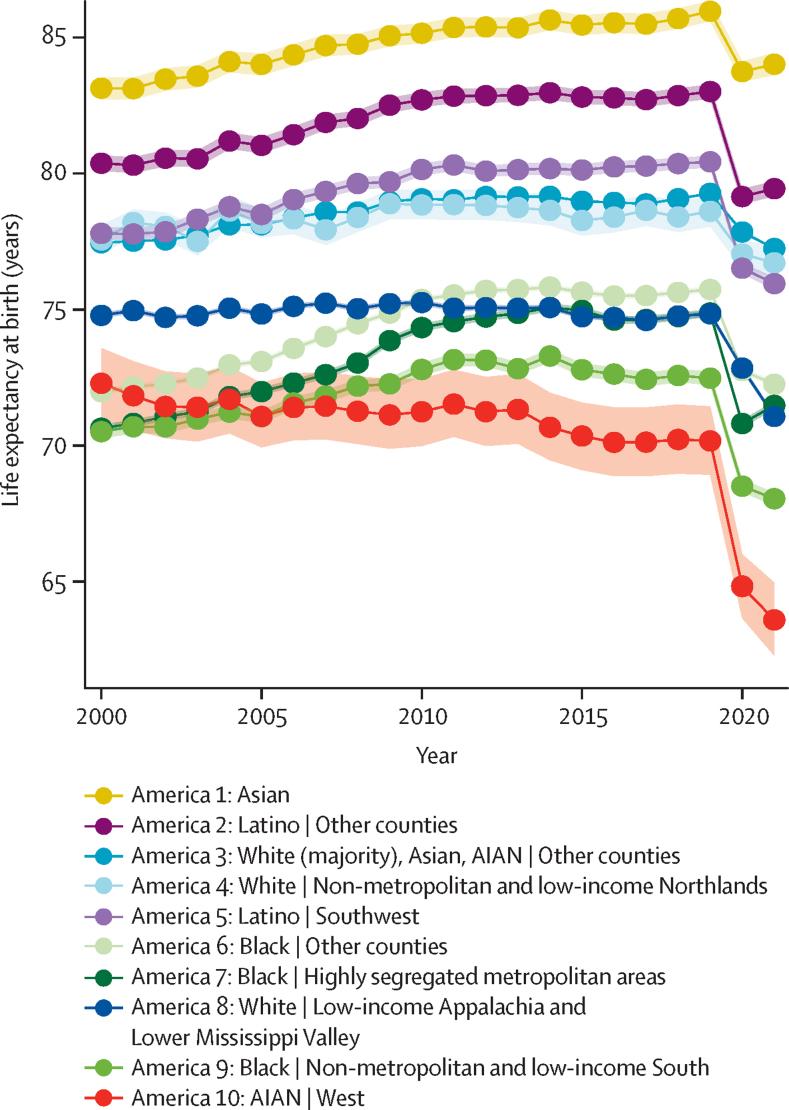
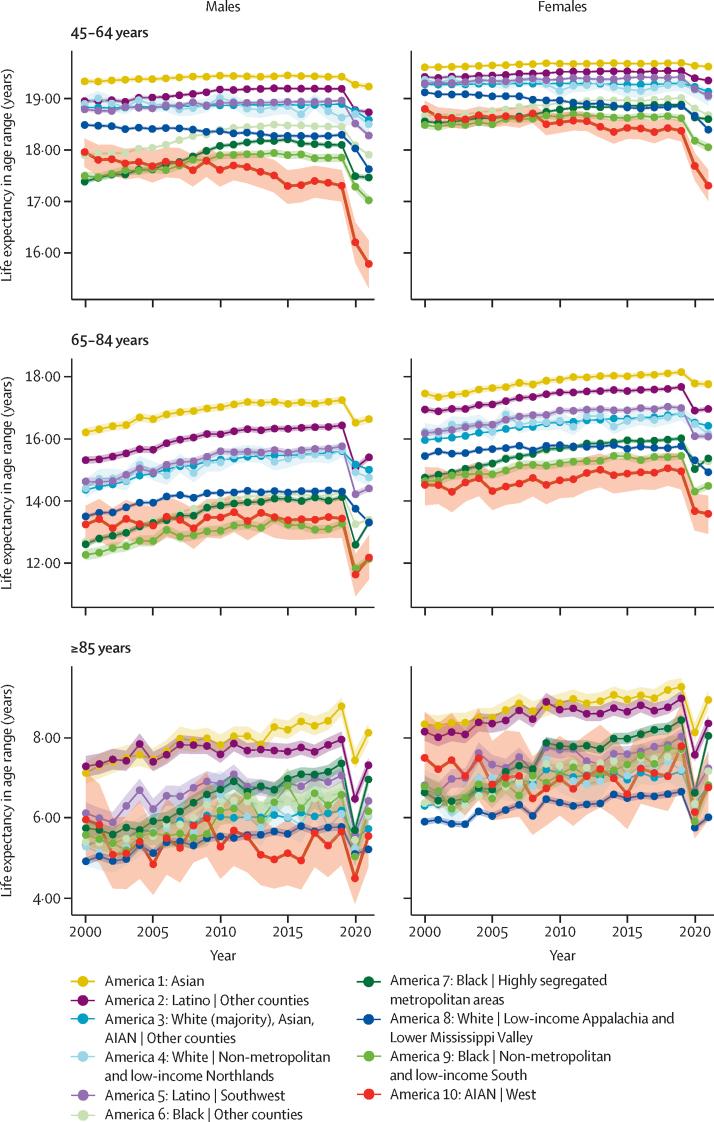
We defined the ten Americas as: America 1-Asian individuals; America 2-Latino individuals in other counties; America 3-White (majority), Asian, and American Indian or Alaska Native (AIAN) individuals in other counties; America 4-White individuals in non-metropolitan and low-income Northlands; America 5-Latino individuals in the Southwest; America 6-Black individuals in other counties; America 7-Black individuals in highly segregated metropolitan areas; America 8-White individuals in low-income Appalachia and Lower Mississippi Valley; America 9-Black individuals in the non-metropolitan and low-income South; and America 10-AIAN individuals in the West. Large disparities in life expectancy between the Americas were apparent throughout the study period but grew more substantial over time, particularly during the first 2 years of the COVID-19 pandemic. In 2000, life expectancy ranged 12·6 years (95% uncertainty interval 12·2-13·1), from 70·5 years (70·3-70·7) for America 9 to 83·1 years (82·7-83·5) for America 1. The gap between Americas with the lowest and highest life expectancies increased to 13·9 years (12·6-15·2) in 2010, 15·8 years (14·4-17·1) in 2019, 18·9 years (17·7-20·2) in 2020, and 20·4 years (19·0-21·8) in 2021. The trends over time in life expectancy varied by America, leading to changes in the ordering of the Americas over this time period. America 10 was the only America to experience substantial declines in life expectancy from 2000 to 2019, and experienced the largest declines from 2019 to 2021. The three Black Americas (Americas 6, 7, and 9) all experienced relatively large increases in life expectancy before 2020, and thus all three had higher life expectancy than America 10 by 2006, despite starting at a lower level in 2000. By 2010, the increase in America 6 was sufficient to also overtake America 8, which had a relatively flat trend from 2000 to 2019. America 5 had relatively similar life expectancy to Americas 3 and 4 in 2000, but a faster rate of increase in life expectancy from 2000 to 2019, and thus higher life expectancy in 2019; however, America 5 experienced a much larger decline in 2020, reversing this advantage. In some cases, these trends varied substantially by sex and age group. There were also large differences in income and educational attainment among the ten Americas, but the patterns in these variables differed from each other and from the patterns in life expectancy in some notable ways. For example, America 3 had the highest income in most years, and the highest proportion of high-school graduates in all years, but was ranked fourth or fifth in life expectancy before 2020.
INTERPRETATION
Our analysis confirms the continued existence of different Americas within the USA. One's life expectancy varies dramatically depending on where one lives, the economic conditions in that location, and one's racial and ethnic identity. This gulf was large at the beginning of the century, only grew larger over the first two decades, and was dramatically exacerbated by the COVID-19 pandemic. These results underscore the vital need to reduce the massive inequity in longevity in the USA, as well as the benefits of detailed analyses of the interacting drivers of health disparities to fully understand the nature of the problem. Such analyses make targeted action possible-local planning and national prioritisation and resource allocation-to address the root causes of poor health for those most disadvantaged so that all Americans can live long, healthy lives, regardless of where they live and their race, ethnicity, or income.
FUNDING
State of Washington, Bloomberg Philanthropies, Bill & Melinda Gates Foundation.
背景
近二十年前,“美国八阶层”研究提供了一个全新视角,通过根据地理位置、种族、城市化程度、人均收入和凶杀率将美国人口划分为八个群体,来审视美国的健康不平等问题。该研究发现,2001年这八个群体中,女性预期寿命差距为12.8岁,男性为15.4岁。在本研究中,我们旨在更新并扩展最初的“美国八阶层”研究,按年份、性别和年龄组,考察2000年至2021年十个“美国群体”(类似于最初的八个群体,加上另外两个包括美国拉丁裔人口的群体)的预期寿命趋势。
方法
在这项系统分析中,我们定义了十个相互排斥且涵盖整个美国人口的“美国群体”,从县与种族和族裔的所有组合开始,并根据种族和族裔以及地理位置、大都市地位、收入和黑白居住隔离的可变组合,将每个组合分配到十个“美国群体”之一。我们对国家生命统计系统的死亡数据进行了调整,以校正死亡证明上种族和族裔的误报。然后,我们将2000年1月1日至2021年12月31日期间国家生命统计系统的死亡数据以及美国人口普查局和国家卫生统计中心的人口估计数据,按“美国群体”、年份、性别和年龄进行列表,并计算每个阶层的特定年龄死亡率。最后,我们为每个“美国群体”、年份和性别构建了简略寿命表,并提取了出生时的预期寿命、五个年龄组(0 - 4岁、5 - 24岁、25 - 44岁、45 - 64岁和65 - 84岁)内的部分预期寿命以及85岁时的剩余预期寿命。
结果
我们将十个“美国群体”定义为:群体1 - 亚裔个体;群体2 - 其他县的拉丁裔个体;群体3 - 其他县的白人(多数)、亚裔以及美洲印第安人或阿拉斯加原住民(AIAN)个体;群体4 - 非大都市和低收入北方地区的白人个体;群体5 - 西南部的拉丁裔个体;群体6 - 其他县的黑人个体;群体7 - 高度隔离的大都市地区的黑人个体;群体8 - 低收入阿巴拉契亚和密西西比河下游流域的白人个体;群体9 - 非大都市和低收入南部的黑人个体;群体10 - 西部的AIAN个体。在整个研究期间,各“美国群体”之间的预期寿命存在巨大差异,且随着时间推移差异变得更加显著,尤其是在新冠疫情的头两年。2000年,预期寿命范围为12.6岁(95%不确定区间12.2 - 13.1),从群体9的70.5岁(70.3 - 70.7)到群体1的83.1岁(82.7 - 83.5)。预期寿命最低和最高的“美国群体”之间的差距在2010年增至13.9岁(12.6 - 15.2),2019年为15.8岁(14.4 - 17.1),2020年为18.9岁(17.7 - 20.2),2021年为20.4岁(19.0 - 21.8)。预期寿命随时间的趋势因“美国群体 ”而异,导致在此期间各“美国群体”的排名发生变化。群体10是2000年至2019年期间唯一预期寿命大幅下降的“美国群体”,且在2019年至2021年期间下降幅度最大。三个黑人“美国群体”(群体6、7和9)在2020年前预期寿命都有相对较大的增长,因此尽管2000年起点较低,但到2006年这三个群体的预期寿命都高于群体10。到2010年,群体6的增长足以超过群体8,群体8在2000年至2019年期间趋势相对平稳。2000年群体5的预期寿命与群体3和4相对相似,但在2000年至2019年期间预期寿命增长速度更快,因此在2019年预期寿命更高;然而,群体5在2020年经历了更大幅度的下降,扭转了这一优势。在某些情况下,这些趋势在性别和年龄组之间差异很大。十个“美国群体”在收入和教育程度方面也存在很大差异,但这些变量的模式彼此不同,并且在一些显著方面与预期寿命的模式不同。例如群体3在大多数年份收入最高且各年份高中毕业生比例最高,但在2020年前预期寿命排名第四或第五。
解读
我们的分析证实了美国国内不同“美国群体”的持续存在。一个人的预期寿命因居住地点、该地的经济状况以及其种族和族裔身份而有巨大差异。本世纪初这种差距就很大,在头二十年里进一步扩大,并且新冠疫情使其急剧加剧。这些结果凸显了在美国减少巨大的长寿不平等的迫切需求,以及详细分析健康差距相互作用驱动因素以全面理解问题本质的益处。这样的分析使得有针对性的行动成为可能——地方规划以及国家层面的优先事项设定和资源分配——以解决最弱势群体健康状况不佳的根本原因,从而让所有美国人无论居住在哪里、属于什么种族、族裔或收入水平,都能过上长寿、健康的生活。
资金来源
华盛顿州、彭博慈善基金会、比尔及梅琳达·盖茨基金会。

 Zotero 插件