
1990年至2021年中国缺血性心脏病负担:来自2021年全球疾病负担数据库的数据。
Burden of ischemic heart disease in China from 1990 to 2021: Data from the global disease burden database 2021.
作者信息
Lin Zibo, Ren Ting, Wang Zhe, Zhou Mi, Li Haiqing, Zhu Yunpeng, Xu Hong, Sun Yanjun, Qiu Jiapei, Zhao Qiang
机构信息
Department of Cardiovascular Surgery, Ruijin Hospital, Shanghai Jiao Tong University School of Medicine, Shanghai, China.
出版信息
Int J Cardiol Cardiovasc Risk Prev. 2025 Aug 9;27:200489. doi: 10.1016/j.ijcrp.2025.200489. eCollection 2025 Dec.
OBJECTIVES
This study aims to analyze the disease burden of ischemic heart disease (IHD) in China from 1990 to 2021 utilizing data from Global Burden of Disease (GBD) 2021 database.
METHODS
Data from the GBD 2021 database were used to evaluate the prevalence, incidence, mortality, disability-adjusted life years (DALYs), years lived with disability (YLDs), and years of life lost (YLLs) attributable to IHD in China from 1990 to 2021. Age-standardized rates and Joinpoint analysis were employed to assess temporal trends, with comparisons across gender and age groups.
RESULTS
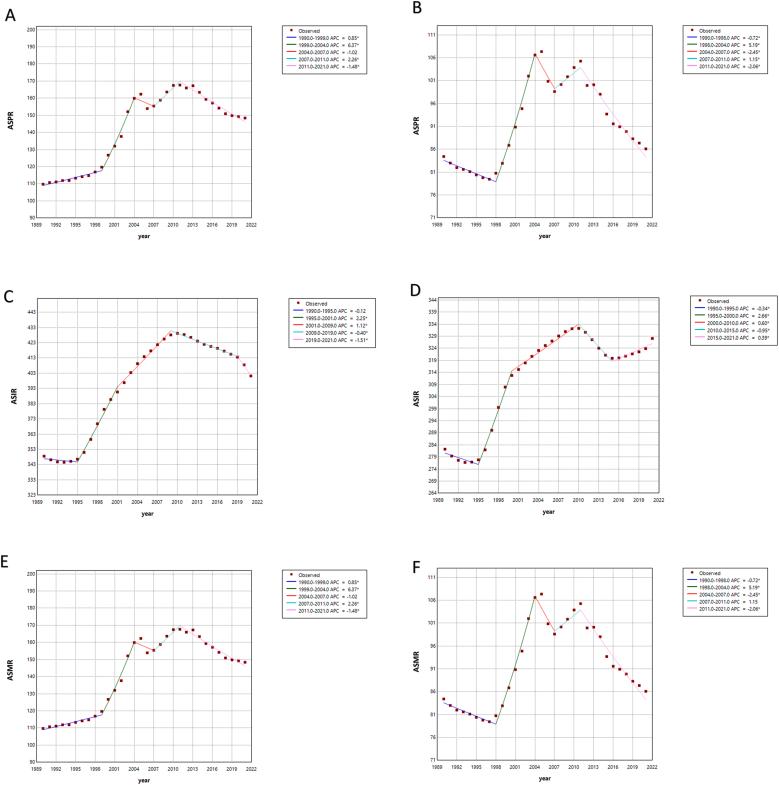
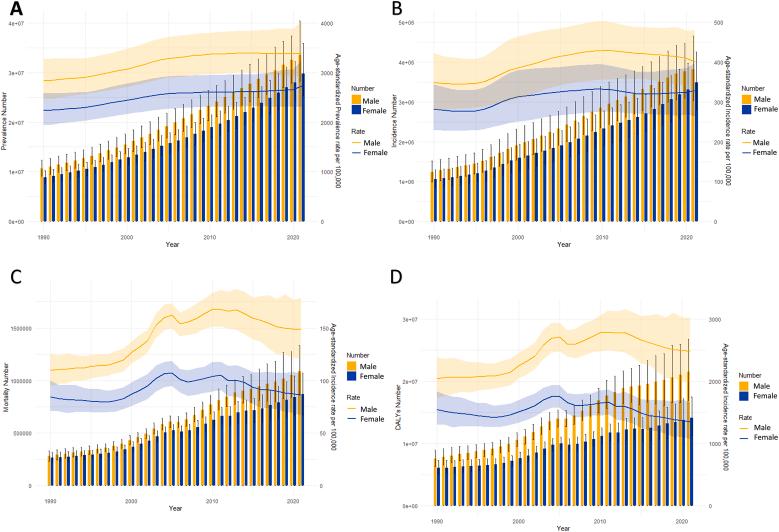
In 2021, the incidence rate was 365.67 per 100,000 population (95 % CI: 293.32-440.07), and the mortality rate was 110.91 per 100,000 population (95 % CI: 92.42-128.56). Males exhibited a significantly higher disease burden compared to females. Among the population, incidence rates increased markedly after age 60, peaking at ages 70-74, while mortality rates rose sharply after age 75. From 1990 to 2021, the incidence, prevalence, mortality, and DALY rates showed an upward trend. However, after age standardization, the trends for incidence and prevalence flattened, while mortality and DALY rates showed a downward trend. Joinpoint analysis indicated a downward trend in age-standardized incidence, prevalence, mortality, and DALY rates.
CONCLUSION
The overall burden of IHD in China remains high, but age-standardized data reflects the effectiveness of disease prevention and control. In the future, greater emphasis should be placed on high-risk populations, particularly aging population and postmenopausal women, to further alleviate the social burden of IHD.
目的
本研究旨在利用全球疾病负担(GBD)2021数据库的数据,分析1990年至2021年中国缺血性心脏病(IHD)的疾病负担。
方法
使用GBD 2021数据库的数据评估1990年至2021年中国IHD的患病率、发病率、死亡率、伤残调整生命年(DALYs)、带病生存年数(YLDs)和寿命损失年数(YLLs)。采用年龄标准化率和Joinpoint分析评估时间趋势,并在性别和年龄组之间进行比较。
结果
2021年,发病率为每10万人365.67例(95%CI:293.32 - 440.07),死亡率为每10万人110.91例(95%CI:92.42 - 128.56)。男性的疾病负担明显高于女性。在人群中,发病率在60岁后显著上升,在70 - 74岁达到峰值,而死亡率在75岁后急剧上升。1990年至2021年,发病率、患病率、死亡率和DALY率呈上升趋势。然而,年龄标准化后,发病率和患病率趋势趋于平稳,而死亡率和DALY率呈下降趋势。Joinpoint分析表明年龄标准化发病率、患病率、死亡率和DALY率呈下降趋势。
结论
中国IHD的总体负担仍然很高,但年龄标准化数据反映了疾病预防和控制的成效。未来,应更加关注高危人群,特别是老年人群和绝经后女性,以进一步减轻IHD的社会负担。


 Zotero 插件