
简易认知测试可预测根治性膀胱切除术后脱机期间康复干预的需求。
Mini-Cog test predicts need for rehabilitation intervention during weaning after radical cystectomy.
作者信息
Yajima Shugo, Nakanishi Yasukazu, Yasujima Rikuto, Hirose Kohei, Umino Yosuke, Okubo Naoya, Kataoka Madoka, Masuda Hitoshi
机构信息
Department of Urology, National Cancer Center Hospital East, Chiba, Japan.
出版信息
Curr Urol. 2025 Sep;19(5):347-352. doi: 10.1097/CU9.0000000000000294. Epub 2025 Jul 11.
BACKGROUND
This study aimed to determine whether preoperative cognitive screening using the Mini-Cognitive Assessment Instrument (Mini-Cog) was useful for predicting the need for postoperative rehabilitation intervention in patients with bladder cancer who underwent radical cystectomy.
MATERIALS AND METHODS
We collected the medical records of consecutive patients who underwent radical cystectomy and preoperative cognitive screening based on the Mini-Cog test in our department between 2020 and 2021 (n = 114). Univariate and multivariate logistic regression analyses were used to identify the clinical risk factors for requiring rehabilitation intervention because of failure to wean postoperatively.
RESULTS
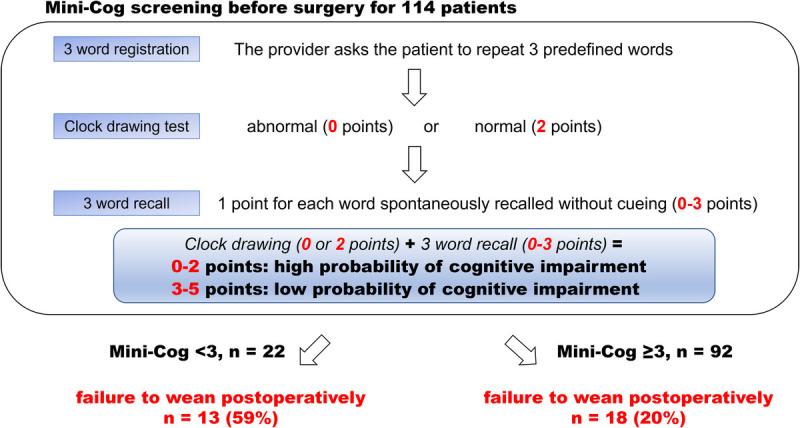
The median age of the participants was 76 years, and 96 (84%) were male. Of the 114 patients, 31 (27%) required rehabilitation intervention for weaning. Based on the Mini-Cog test, the patients were classified into 2 groups: 22 (19%) had probable cognitive impairment (Mini-Cog score <3). Of the 22 patients with a Mini-Cog score of <3, 13 (59%) required rehabilitation intervention because of failure to wean postoperatively. In the multivariate analysis, being 75 years or older (odds ratio [OR], 9.7; 95% confidence interval [CI], 2.6-36.3; < 0.001), a Mini-Cog score of <3 (OR, 3.7; 95% CI, 1.2-11.2; = 0.02), and an operative time ≥310 minutes (OR, 3.6; 95% CI, 1.1-11.9; = 0.04) were independent risk factors for requiring postoperative rehabilitation intervention.
CONCLUSIONS
Effective screening with the Mini-Cog test, a simple cognitive screening tool with only 2 components (delayed 3-word recall task and clock drawing), reflects not only cognitive function but also physical frailty and may lead to the establishment of appropriate rehabilitation programs during the perioperative period for early patient mobility after surgery.
背景
本研究旨在确定使用简易认知评估工具(Mini-Cog)进行术前认知筛查是否有助于预测接受根治性膀胱切除术的膀胱癌患者术后康复干预的需求。
材料与方法
我们收集了2020年至2021年期间在我科接受根治性膀胱切除术并基于Mini-Cog测试进行术前认知筛查的连续患者的病历(n = 114)。采用单因素和多因素逻辑回归分析来确定术后因脱机失败而需要康复干预的临床危险因素。
结果
参与者的中位年龄为76岁,96例(84%)为男性。114例患者中,31例(27%)需要康复干预以实现脱机。根据Mini-Cog测试,患者被分为两组:22例(19%)可能存在认知障碍(Mini-Cog评分<3)。在22例Mini-Cog评分为<3的患者中,13例(59%)因术后脱机失败而需要康复干预。在多因素分析中,年龄75岁及以上(比值比[OR],9.7;95%置信区间[CI],2.6 - 36.3;P < 0.001)、Mini-Cog评分为<3(OR,3.7;95% CI,1.2 - 11.2;P = 0.02)以及手术时间≥310分钟(OR,3.6;95% CI,1.1 - 11.9;P = 0.04)是术后需要康复干预的独立危险因素。
结论
使用Mini-Cog测试进行有效筛查,这是一种仅包含两个部分(延迟的三字回忆任务和画钟)的简单认知筛查工具,不仅反映认知功能,还反映身体虚弱状况,可能有助于在围手术期制定适当的康复计划,以促进患者术后早期活动。
 Zotero 插件