
来自铜绿假单胞菌的AprA和绿脓菌素对银耐受性的作用。 (注:原文中“from on ”表述有误,推测可能是“from Pseudomonas aeruginosa on”,这里按推测后的内容翻译,若原文无误请告知以便准确翻译)
Role of AprA and pyocyanin from on tolerance to silver.
作者信息
Gorodetsky Jakob, Monych Nadia, Turner Raymond J, Haji-Ghassemi Omid, Booth Sean C
机构信息
Department of Biological Sciences, University of Calgary, Calgary, Alberta, Canada.
Department of Microbiology, University of Manitoba, Winnipeg, Manitoba, Canada.
出版信息
Microbiology (Reading). 2025 Sep;171(9). doi: 10.1099/mic.0.001596.
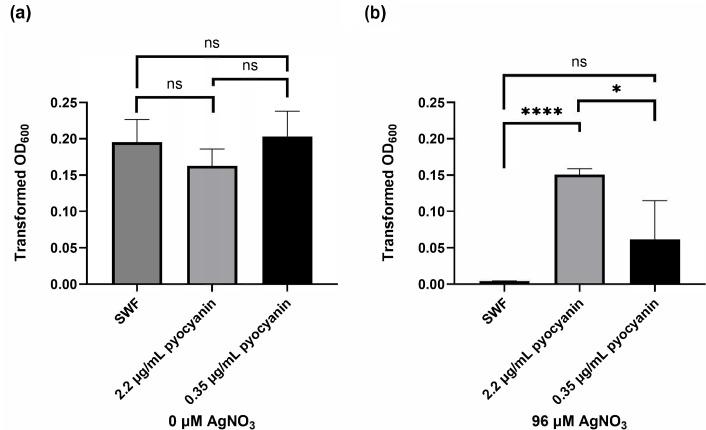
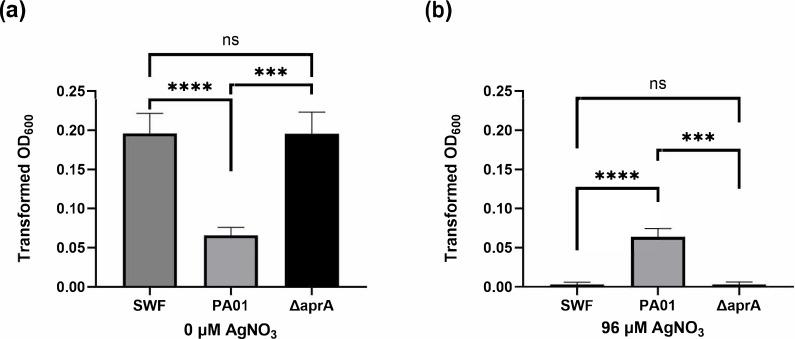
The opportunistic pathogens and are often found together causing persistent infections where they exhibit complex interactions that affect their virulence and resistance to treatment. We sought to clarify how interactions between these organisms affect their resistance to the antimicrobial metal silver (AgNO). As previous work showed that cell-free supernatant from enhances the resistance of we aimed to identify the exact factor(s) responsible for this increase. Using molecular weight cutoff filters and proteomics, we identified the protein AprA and pyocyanin as the responsible factors. Transposon-mediated disruption of led to the production of supernatant which could not enhance the silver tolerance of . These findings suggest that the protease AprA from plays an important role in increasing the tolerance of to AgNO via in part by mediating the levels of pyocyanin which in turn reduces Ag to detoxify it.
机会性病原体[具体名称1]和[具体名称2]经常共同出现,引发持续性感染,在这种情况下它们会表现出复杂的相互作用,影响其毒力和对治疗的抗性。我们试图阐明这些生物体之间的相互作用如何影响它们对抗菌金属银(AgNO₃)的抗性。由于先前的研究表明[具体名称1]的无细胞上清液可增强[具体名称2]的抗性,我们旨在确定导致这种增加的确切因素。使用分子量截留过滤器和蛋白质组学,我们确定蛋白质AprA和绿脓菌素是相关因素。转座子介导的[具体名称1]破坏导致产生的上清液无法增强[具体名称2]对银的耐受性。这些发现表明,来自[具体名称1]的蛋白酶AprA在提高[具体名称2]对AgNO₃的耐受性方面发挥着重要作用,部分原因是通过介导绿脓菌素的水平,进而将Ag还原以使其解毒。


 Zotero 插件