
糖尿病患者铁状态与肾功能及糖尿病肾病的因果关联:一项两样本孟德尔随机化研究
Causal Associations of Iron Status With the Renal Function and Diabetic Nephropathy in Patients With Diabetes Mellitus: A Two-Sample Mendelian Randomization Study.
作者信息
Zhang Ying, Peng Wujian, Huang Jianrong, Zhang Wenchang, Jiang Peishan, He Yuqin, Wang Meiyun
机构信息
Department of Endocrinology, Shenzhen Third People's Hospital, The Second Affiliated Hospital, School of Medicine, Southern University of Science and Technology, Shenzhen, Guangdong Province, China.
Department of Nephrology, Shenzhen Third People's Hospital, The Second Affiliated Hospital, School of Medicine, Southern University of Science and Technology, Shenzhen, Guangdong Province, China.
出版信息
J Diabetes Res. 2025 Jul 30;2025:6658794. doi: 10.1155/jdr/6658794. eCollection 2025.
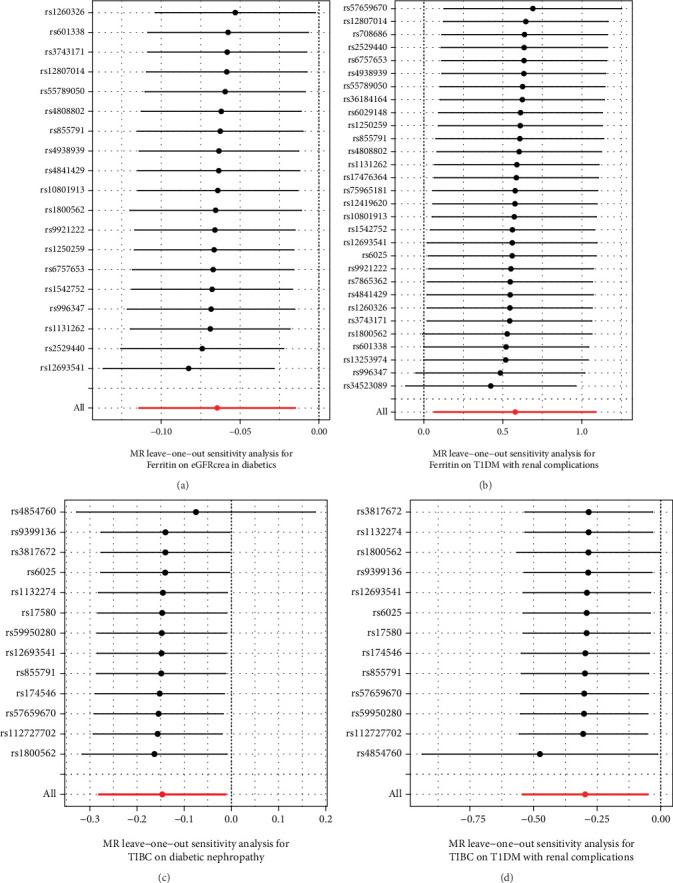
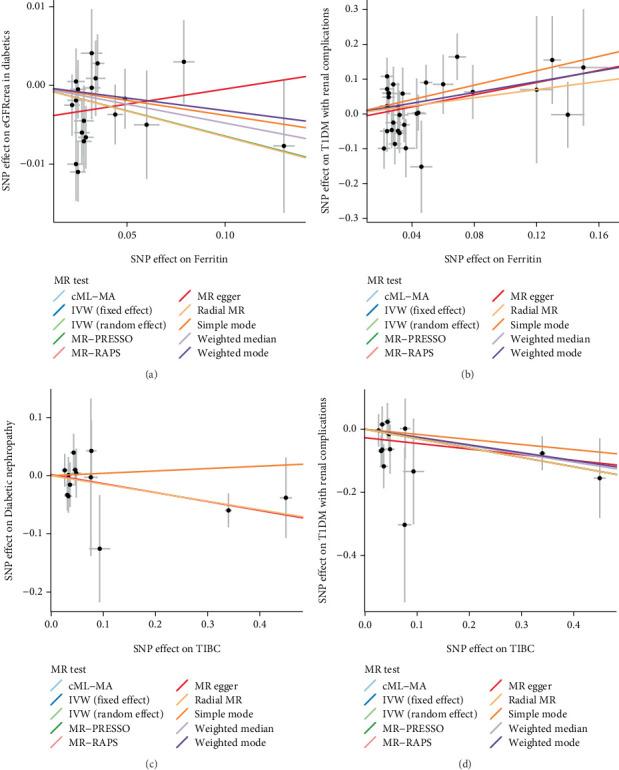
This study was to explore the causal effect of iron status on renal function and the risk of diabetic nephropathy in diabetic patients. The data on exposures including ferritin, serum iron, transferrin saturation (TSAT), and total iron-binding capacity (TIBC) were obtained from a genome-wide association study (GWAS). The outcomes were diabetic nephropathy, Type 1 diabetes mellitus (T1DM) with renal complications, Type 2 diabetes mellitus (T2DM) with renal complications, estimated glomerular filtration rate (creatinine) (eGFRcrea) in diabetes mellitus, and urinary albumin-to-creatinine ratio (UACR) in diabetes mellitus. The causal associations of exposures and outcomes were analyzed using MR analysis with the inverse variance-weighted (IVW) method as the primary analytical method. Leave-one-out analysis was utilized to find any individual SNP associated with exposures influencing outcomes. Odds ratio (OR) and 95% confidence interval (95% CI) were estimated. The values of all the SNPs were > 10, indicating a sufficient strength of the instrumental variables. The results from pleiotropy analysis indicated that most SNPs showed no horizontal pleiotropy ( > 0.05). The ferritin level had a causal effect on decreased eGFRcrea level in diabetes mellitus patients (OR = 0.937, 95% CI: 0.887-0.990) and increased risk of T1DM with renal complications (OR = 1.783, 95% CI: 1.005-3.162). TIBC level was causally associated with decreased risk of diabetic nephropathy (OR = 0.864, 95% CI: 0.771-0.968) and T1DM with renal complications (OR = 0.743, 95% CI: 0.603-0.916). Ferritin level had a causal effect on eGFRcrea level in diabetes mellitus patients and T1DM with renal complications. In conclusion, TIBC levels are causally linked to a lower risk of both diabetic nephropathy and T1DM with renal complications. The findings might provide a reference for using TIBC levels as a biomarker for prevention and treatment of diabetic nephropathy in the future. As the study was an MR analysis based on gene, the value of TIBC levels still should be validated in large prospective trials.
本研究旨在探讨铁状态对糖尿病患者肾功能及糖尿病肾病风险的因果效应。关于铁蛋白、血清铁、转铁蛋白饱和度(TSAT)和总铁结合力(TIBC)等暴露因素的数据来自一项全基因组关联研究(GWAS)。结局指标为糖尿病肾病、伴有肾脏并发症的1型糖尿病(T1DM)、伴有肾脏并发症的2型糖尿病(T2DM)、糖尿病患者的估计肾小球滤过率(肌酐)(eGFRcrea)以及糖尿病患者的尿白蛋白与肌酐比值(UACR)。采用逆方差加权(IVW)法作为主要分析方法,通过孟德尔随机化(MR)分析来分析暴露因素与结局指标之间的因果关联。采用留一法分析来寻找任何与影响结局的暴露因素相关的单个单核苷酸多态性(SNP)。估计比值比(OR)和95%置信区间(95%CI)。所有SNP的值均>10,表明工具变量的强度足够。多效性分析结果表明,大多数SNP无水平多效性(>0.05)。铁蛋白水平对糖尿病患者eGFRcrea水平降低(OR = 0.937,95%CI:0.887 - 0.990)以及伴有肾脏并发症的T1DM风险增加(OR = 1.783,95%CI:1.005 - 3.162)具有因果效应。TIBC水平与糖尿病肾病风险降低(OR = 0.864,95%CI:0.771 - 0.968)以及伴有肾脏并发症的T1DM(OR = 0.743,95%CI:0.603 - 0.916)存在因果关联。铁蛋白水平对糖尿病患者和伴有肾脏并发症的T1DM的eGFRcrea水平具有因果效应。总之,TIBC水平与糖尿病肾病和伴有肾脏并发症的T1DM的较低风险存在因果联系。这些发现可能为未来将TIBC水平用作糖尿病肾病预防和治疗的生物标志物提供参考。由于该研究是基于基因的MR分析,TIBC水平的价值仍需在大型前瞻性试验中进行验证。

 Zotero 插件