
多民族东南亚初级保健人群中影响早期慢性肾脏病疾病进展的因素
Factors affecting disease progression in early-stage chronic kidney disease in a multi-ethnic, southeast Asian primary care population.
作者信息
Koh Hui Qi, Sim Xueling, Koh Sky Wei Chee
机构信息
National University Polyclinics, National University Health System, Singapore, Singapore.
Saw Swee Hock School of Public Health, National University of Singapore and National University Health System, Singapore, Singapore.
出版信息
Front Med (Lausanne). 2025 Aug 19;12:1526596. doi: 10.3389/fmed.2025.1526596. eCollection 2025.
BACKGROUND
While effective risk factor control and medication optimization in early-stage CKD can significantly slow disease progression, a paucity of studies hinders comprehensive understanding. This study aims to identify factors associated with progression of early-stage CKD in primary care.
METHODS
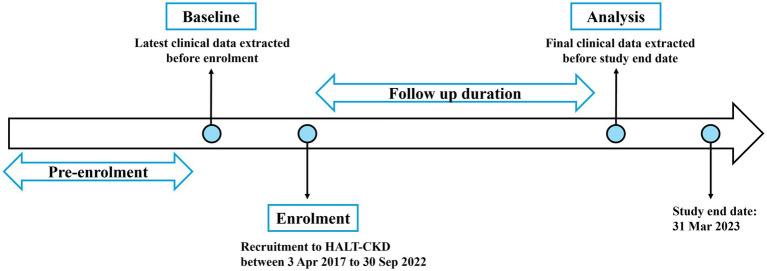
We retrospectively analyzed data of CKD G1-G2 patients with type 2 diabetes or hypertension, recruited from an ongoing cohort between 2017 and 2023 from six polyclinics in Singapore. The outcome of interest was CKD progression, defined as a 25% decline in eGFR from baseline and worsening of CKD stage. Multivariable logistic regression was used to analyze the factors associated with CKD progression among early-stage CKD patients.
RESULTS
Among 19,274 patients analyzed, CKD progression occurred in 1,992 patients (10.3%). Patients had a mean age of 62.27 years (SD 9.54), 54.4% were male, 70.4% Chinese, 18.1% Malay, 8.2% Indian, and 3.4% Others. On multivariable analysis, factors associated with CKD progression include Malay ethnicity (OR: 1.52, 95% CI: 1.35, 1.72), A2 (OR: 1.41, 95% CI: 1.18, 1.70) and A3 albuminuria (OR: 4.19, 95% CI: 3.45, 5.10), diabetes (OR: 2.59, 95% CI: 2.18, 3.09), hypertension (OR: 1.69, 95% CI: 1.18, 2.41), increasing systolic BP (OR: 1.005, 95% CI 1.001, 1.008), active smoking (OR: 1.26, 95% CI: 1.09, 1.47), being on maximum doses of ACE inhibitors/ARBs at baseline (OR: 1.28, 95% CI 1.07, 1.53) and having undergone CKD counseling (OR: 1.84, 95% CI 1.59, 2.12). Increasing age (OR: 0.991, 95% CI 0.984, 0.998), higher baseline eGFR (OR: 0.968, 95% CI 0.965, 0.972), higher diastolic BP (OR: 0.989, 95% CI 0.983, 0.995), and BMI (OR: 0.981, 95% CI 0.971, 0.991) significantly reduced odds of CKD progression.
CONCLUSION
This study identified key factors associated with early-stage CKD progression in a multi-ethnic Asian population. Further research is also needed to address benefits of patient counseling and SGLT2i use. Refining risk stratification methods will enable targeted interventions and improve outcomes for high-risk CKD patients.
背景
虽然在早期慢性肾脏病(CKD)中有效控制危险因素和优化药物治疗可显著减缓疾病进展,但相关研究的匮乏阻碍了全面理解。本研究旨在确定基层医疗中与早期CKD进展相关的因素。
方法
我们回顾性分析了2017年至2023年间从新加坡六家综合诊所的一个正在进行的队列中招募的2型糖尿病或高血压CKD G1 - G2期患者的数据。感兴趣的结局是CKD进展,定义为估算肾小球滤过率(eGFR)较基线下降25%且CKD分期恶化。采用多变量逻辑回归分析早期CKD患者中与CKD进展相关的因素。
结果
在分析的19274例患者中,1992例(10.3%)发生了CKD进展。患者的平均年龄为62.27岁(标准差9.54),54.4%为男性,70.4%为华人,18.1%为马来人,8.2%为印度人,3.4%为其他种族。多变量分析显示,与CKD进展相关的因素包括马来族裔(比值比[OR]:1.52,95%置信区间[CI]:1.35,1.72)、A2(OR:1.41,95% CI:1.18,1.70)和A3级蛋白尿(OR:4.19,95% CI:3.45,5.10)、糖尿病(OR:2.59,95% CI:2.18,3.09)、高血压(OR:1.69,95% CI:1.18,2.41)、收缩压升高(OR:1.005,95% CI 1.001,1.008)、当前吸烟(OR:1.26,95% CI:1.09,1.47)、基线时使用最大剂量的血管紧张素转换酶抑制剂/血管紧张素Ⅱ受体阻滞剂(OR:1.28,95% CI 1.07,1.53)以及接受过CKD咨询(OR:1.84,95% CI 1.59,2.12)。年龄增加(OR:0.991,95% CI 0.984,0.998)、基线eGFR较高(OR:0.968,95% CI 0.965,0.972)、舒张压较高(OR:0.989,95% CI 0.983,0.995)以及体重指数(OR:0.981,95% CI 0.971,0.991)显著降低了CKD进展的几率。
结论
本研究确定了多民族亚洲人群中与早期CKD进展相关的关键因素。还需要进一步研究以探讨患者咨询和使用钠 - 葡萄糖协同转运蛋白2抑制剂(SGLT2i)的益处。完善风险分层方法将有助于进行针对性干预并改善高危CKD患者的结局。

 Zotero 插件